PROCESS, WITHOUT END, AMEN: TOWARDS AUSTIN HEARNE

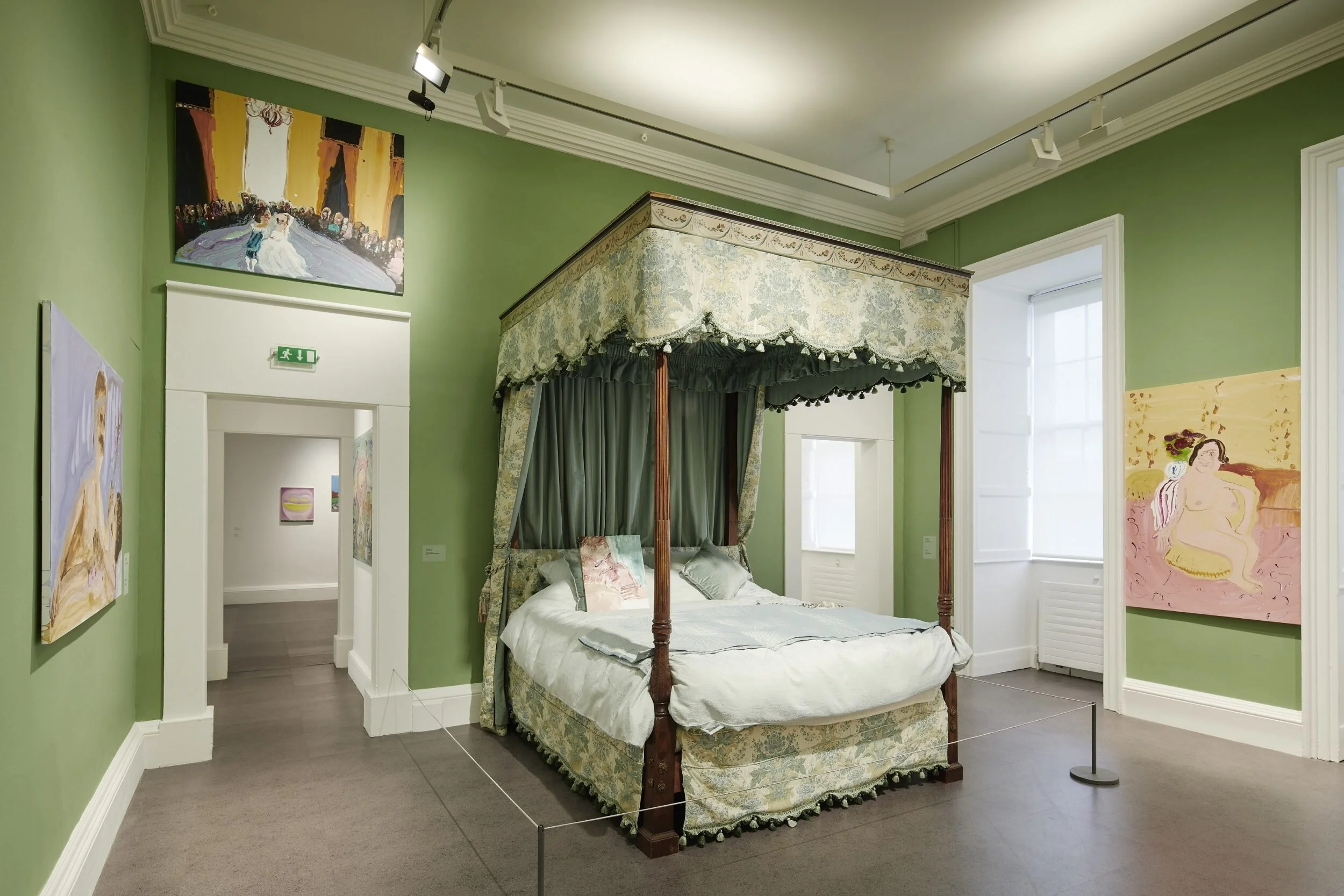
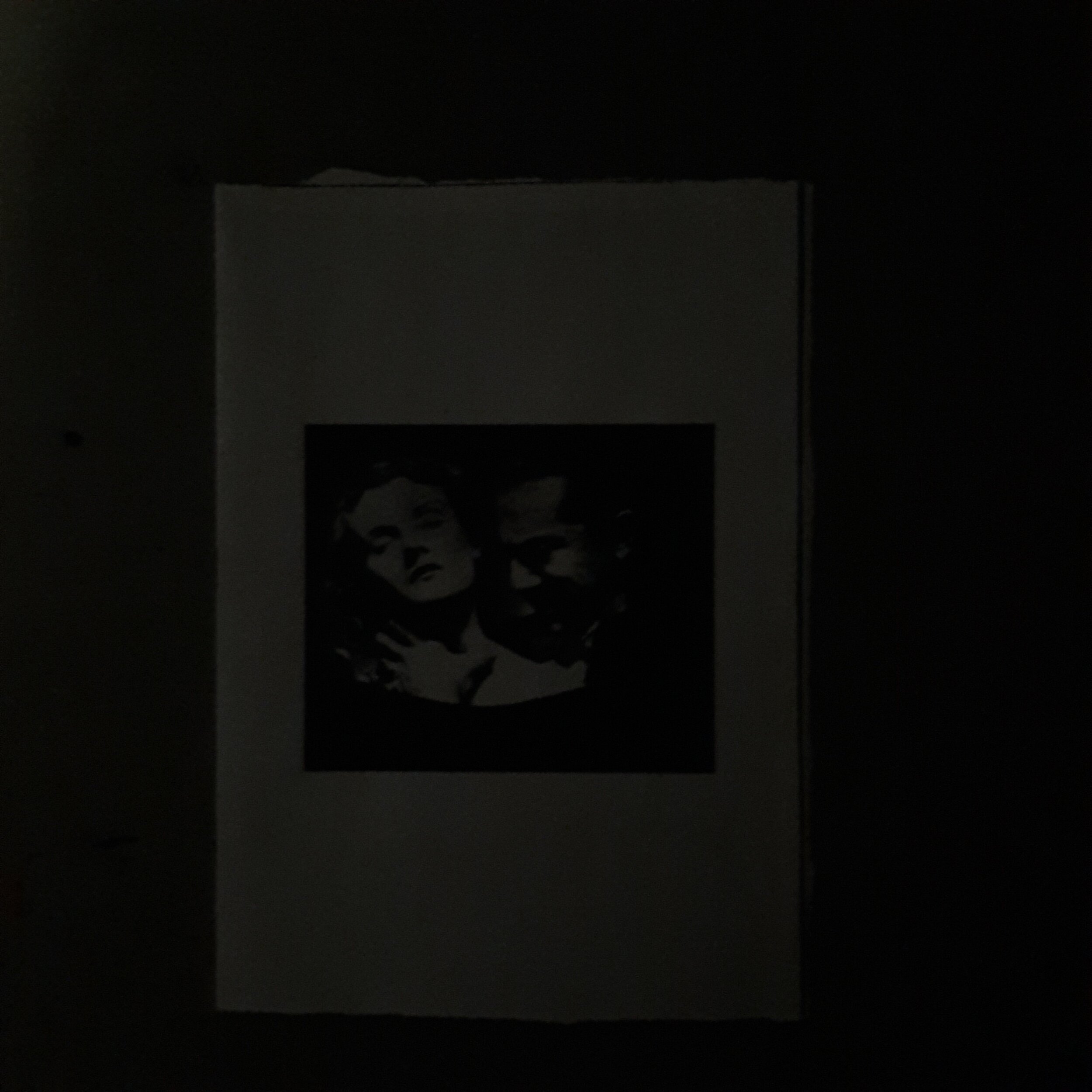
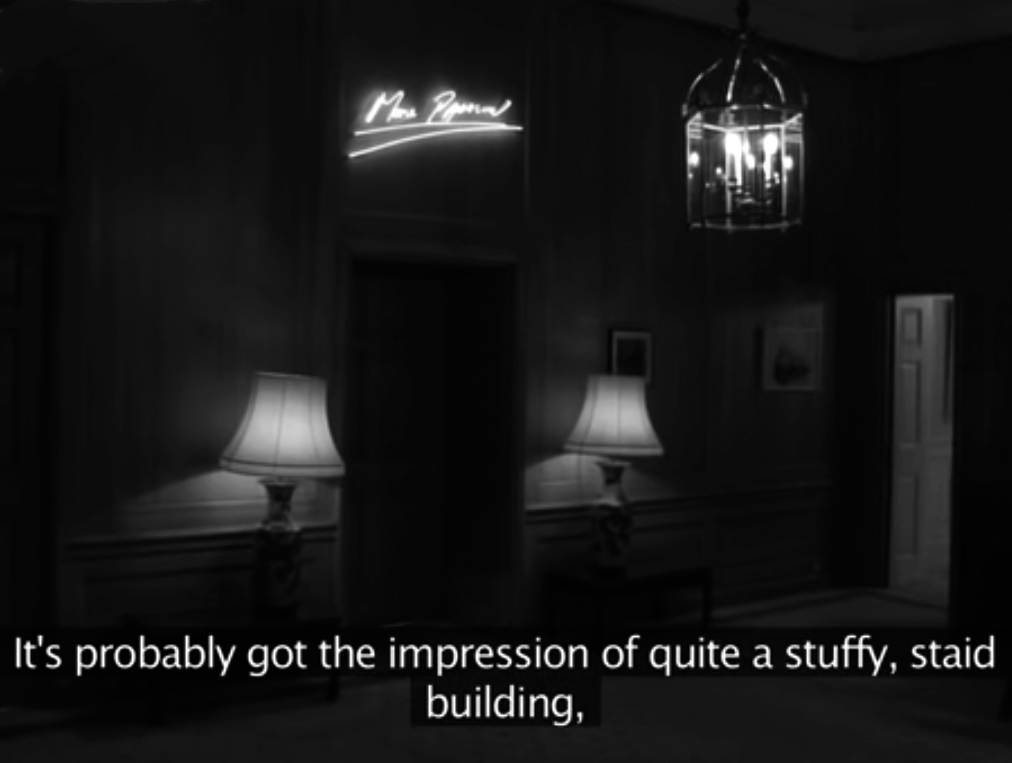
AUSTIN HEARNE, LOVE LETTERS TO CARDINAL RAYMO, 2021, Periphery Space, Gorey School of Art, 📸LOUIS HAUGH

TWELVE YEARS AGO I was part of a group show in Gallery 2 and 3 of the RHA Dublin. When installing, Nevan Lahart was also installing his solo A lively start to the year in Gallery 1. I was a big fan of Nevan Lahart’s work at the time; he brought energy and irreverence to his art and the role of being an artist.

An opportunity for a sneak peek of the artist’s work in progress was granted and I took it with both feet and eyes. The large wooden expanse of floor in Gallery 1 was covered from end to end in a bricolage of paintings and other roughly constructed things. There was no centre, like L.A. It was exciting. Was this it? If it was, it was enough. It was more than enough. It was better than anything I could imagine it becoming. This would turn out to be true.

On the opening night I was met by a wave of consensus re how good Nevan’s installation was before I made it to the 1st floor summit of the RHA. I wondered what he could have done beyond what I had experienced during the mid-installation days earlier. I was more excited about seeing the result of his work than secretly invigilating the response to my work across the way.

NEVAN LAHART, A LIVELY START TO THE NEW YEAR, 2010, RHA DUBLIN

The RHA was packed. I climbed the stairs, took a left and entered Gallery 1. Everything had been corralled into one quadrant of the space with stray sculptures activating pockets of space in the ever-expanding universe that is Gallery 1. Even with the crowd it felt lonely (or maybe that was just me — packed art openings can make artists feel lonely). It wasn’t what I had experienced a few days earlier. It had become something, something that would remain the way it was, then and there, until the end. Its potential stripped, its energy, its synergy with the space, its dissent in respect to its disruptive and disobedient grammar, punctuated, proper. I was disappointed that I had managed to gain access on that fateful day to experience the process of the exhibition in the midst of becoming. I wanted to experience what everyone else was experiencing that opening night, to be on the same hymn sheet, to not feel so alone. Twelve years ago I confronted what I know today, but didn’t know then, in its transformation from object of desire to process of desire, as the fetish.

I have been interested in art process and its transposition into the gallery space since art school. There is always the suspicion, in the beginning, which turns to belief later on, that the gallery space robs art of its lively process. Artists try to offset this robbery by inviting processes into the gallery during their art’s wake through performance, incremental rejigging or transformations, workshops, press releases, or simply the artist talk. The existence of such resuscitative processes explicitly exhibits the lack (or death) the artists and art administrators feel the exhibition possesses and hence poses under the apathy of the public. Things should seem alive when they are deemed dead, even if it is a resuscitated kind of alive, an undead kind of living.

Nevan Lahart’s work was a local model of permissibility to deploy the raw into the cooked gallery in the early days of my artworld education. My work across the way from his in the RHA in 2010 employed a similar raw repertoire, constructed from materials bought in B&Q not the art supplies store. A hardware aesthetic was in the air at the time. Experiences such as Thomas Hirshhorn’s cardboard abjection installed in a mid-tier commercial gallery off Oxford Street London was massively influential, and so were the theories expounded by Nicolas Bourriaud’s “Radicant” or Gilles Deluzes and Felix Guattari’s “Rhizome”. Art was something unrepressed in their anti-arboreal theories, which freed me as an artist from an anthropological or commodity fetishism, to one that was relational and processional (a necessary neologism).

AUSTIN HEARNE, LOVE LETTERS TO CARDINAL RAYMO, 2021, Periphery Space, Gorey School of Art, 📸 LOUIS HAUGH

The fetish, in all its material and psychic processes, has become, ironically so, a fetish in my ongoing analysis of cultural production and the artist behind it all. Due to its complexity as both object of desire and process of desire, it can help explain what Jacques Lacan theoretically diagnosed as our inability to confront reality without a filter, fantasy, object or process. And even with those filters, objects and processes, we still cannot afford to touch reality. The same way our fingertips, when pressed together, don’t touch in reality due to the sliver of gravitational space that separates them.

This in between, or triangulation of relationships between object and process, is the gap I perceive as the fetish, a phenomenon that is dressed in different metaphysical and clinical clothes, from Donald Winnicott’s “transitional object”, a healthy object that helps the infant to transition from the mother’s embrace to the world’s embrace, to Jacques Lacan’s objet petit a, the object cause of desire that impels desire proper to take form in reality. Simply put: we seem dependent on another object or process outside the relationship between things in the world, to cope with experience or make experiences and relationships happen, or not happen as it were.

For instance: Instagram. Our experience of art on Instagram is one that perpetuates a fantasy, but not the reality of cultural production. The Instagram phenomenon of the #wip (work in progress) places value on process over product, even though the capturing of process as an image is just another form of objectification. It’s what I mentioned earlier in relation to how process makes the object more desired in fantasy but less in reality. Process becomes a fetish, and imbues the fantastic art object with more, like the artist’s biography does, without having the artist at hand or the object in hand. It is what Slavoj Žižek defines as “surplus enjoyment”, whereby processes, outside the holding of the object or real experience, are inflated beyond anything they can achieve in reality. The social media trope “Looking forward to this” is a symptom of this. Overly colourful anticipation forecasts a grey day for reality.

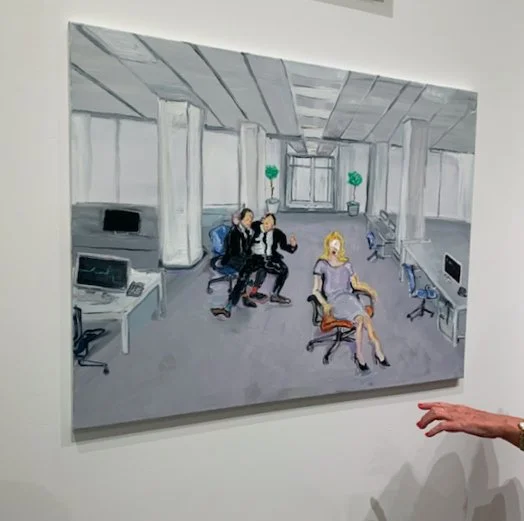
THOMAS DEMAND, BÜRO, 1995

MAKING OF 'BÜRO' (BY THOMAS DEMAND, 1995), 2020, Digital C-type print, mounted, wooden frame with museum glass, 72 x 107 cm, edition of 6 plus 1 artist's proof (#2/6).

Recently I learnt of the existence of a series of standalone prints that reveal the photographic process of Thomas Demand’s cardboard and paper simulacrums of reality. His process was already fetishistic, but doubly so by way of the dismantling of his illusory photographs into uncropped portraits of process. The degrees of separation between object or experience are necessary. We cannot confront reality, and when we do, freely or forcibly, we experience trauma, which is when fingertips do break science to touch, for emotion and subjectivity to take rule.

Trauma is something that Austin’s Hearne’s work exhibits in spades. And yet it is a trauma that is not so close that it rules, it is trauma fetishistic in its disavowal of the very thing it confronts: the Catholic Church. For Periphery Space in 2021, Austin Hearne presented his first manifestation of, or manifesto to, a figure who embodies the Church in all its rituals in the name of sacrifice and faith (believing in an object that can only exist in its absence) — Love Letters to Cardinal Raymo. Of course the artist’s letter never did arrive on the lap of the Cardinal, but the mere proffering of a letter is enough of a foil, or fetish, to set events in motion, as was the stolen letter in Edgar Allan Poe’s The Purloined Letter.
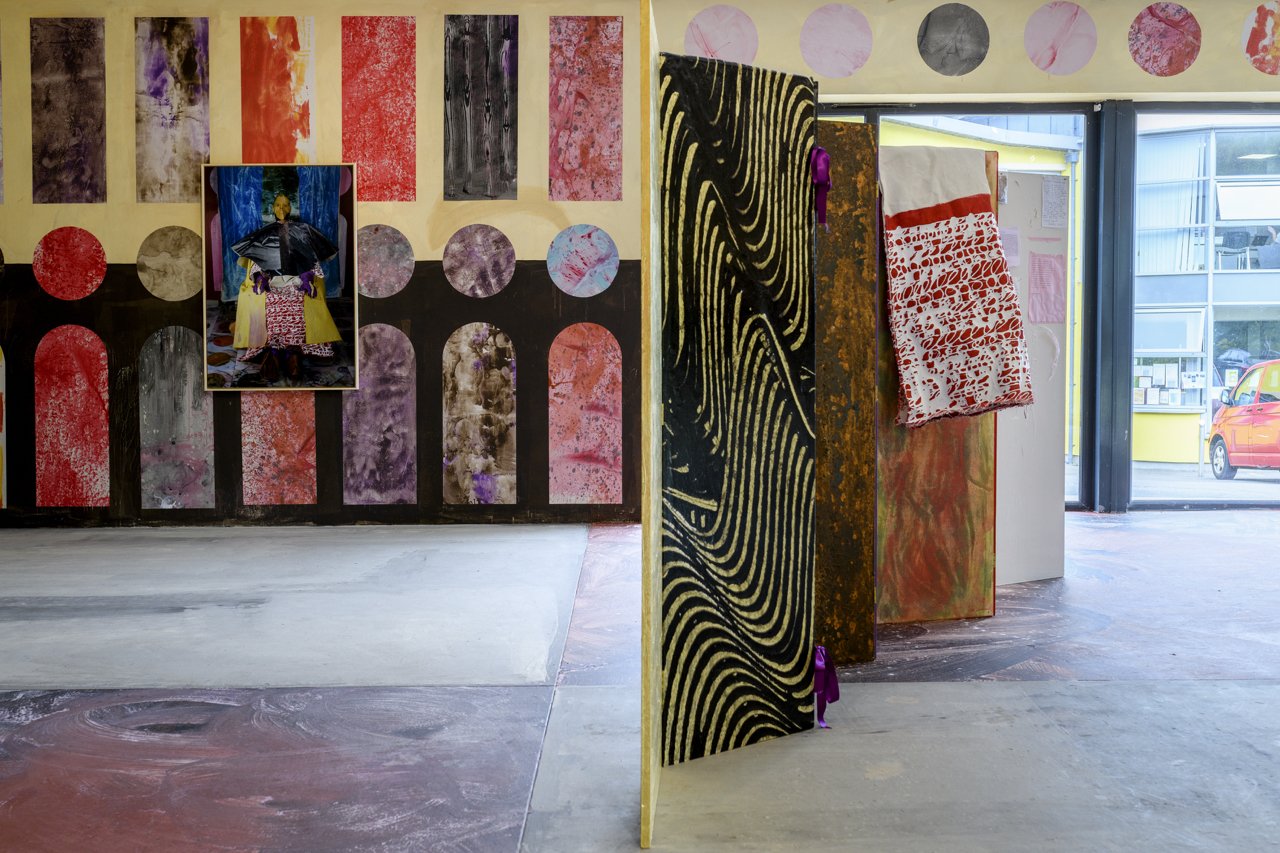
AUSTIN HEARNE, LOVE LETTERS TO CARDINAL RAYMO, 2021, Periphery Space, Gorey School of Art, 📸 LOUIS HAUGH

On entering Periphery Space, after a three-week installation, we were overwhelmed by the sheer ambition of the transformation of the main gallery space, and the two smaller adjoining spaces that make up Periphery Space. Walls, floors and smell, everything was awash with a sensory simulacrum of the church. It was too much. The eyes, eager to rest on expected white walls, were met by an environment eviscerated, so that the contents seemed to spill out from the walls, not hang upon them. This was not a representation of the church. It wasn’t a stand in, or a placeholder, but the thing in itself.

AUSTIN HEARNE, LOVE LETTERS TO CARDINAL RAYMO, 2021, Periphery Space, Gorey School of Art, 📸 LOUIS HAUGH

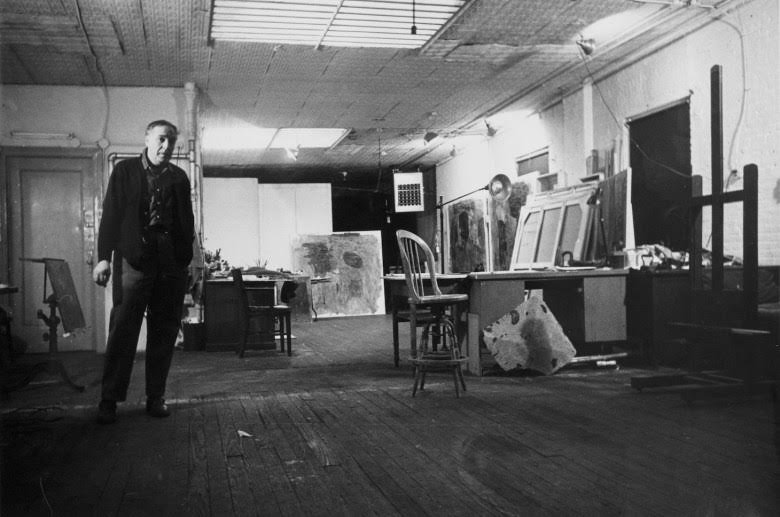
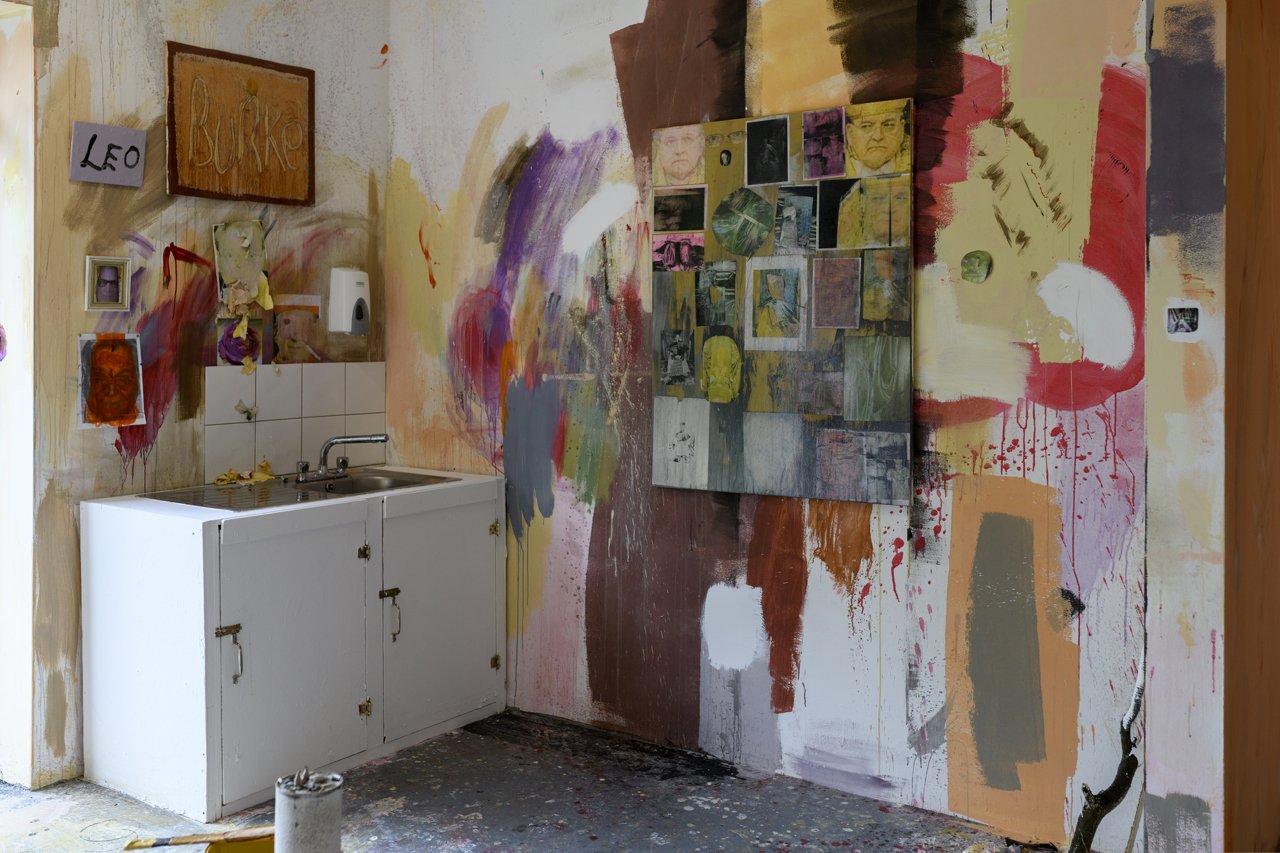
However, in fetishistic fashion, it is not the whole that haunts my memory of Austin Hearne’s Love Letters to Cardinal Raymo, it is one part, one act, in one corner of one of the adjoining spaces. Before the installation began, we asked the artist if the grubby paint-splattered sink and cabinet situated in a corner of one of the spaces, would be a problem for him. He replied “no”, and the space became the place in which he would mix and make, paste and paint the materials that would create the skin for the space. It became his process room, and would remain the process room during the exhibition run, filled with the tools and empty paint buckets of his process. Against this backdrop of process, the artist decided to scrub the sink and gloss the cabinet to what we thought was an impossible clean. It was the strangest inversion. Everything except the sink and cabinets was an abject mess. Even the ceiling was splattered with process. Sink as God.
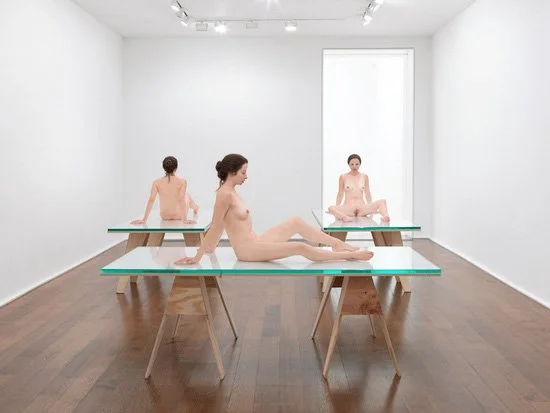
PAUL MCCARTHY, LIFE CAST, 2013, Hauser & Wirth New York

Eight years previous, and across the Atlantic, I experienced uncanny cleanliness adjoining processional abjection in the installation Life Cast by Paul McCarthy at Hauser & Wirth New York. The juxtapositioning of hyper-real casts of naked female triplets, sat spread-eagled on glass tables in one brightly lit room, and in the next room, the video documentation of the process of casting the single female model surrounded by a gangbang of male technicians, with a wooden table scored with pencil marks describing the fragmented body of the model who once lay there, was unnerving. It was the precision of McCarthy’s aim to unnerve the senses through a deliberate juxtapositioning of uncanny objects of desire that misled, and the process and conditions in which those objects had been constructed under the desiring gazes of the male technicians and the hidden gaze of the artist. From time to time Austin Hearne’s aim is as deliberate and precise as Paul McCarthy’s. Which, with appropriate fetishistic delay and suspension, leads me to Austin Hearne’s current solo at the RHA Dublin entitled Requiem for Raymo

In an imaginary world, where I, Austin Hearne, a queer/gay man, has had a bad lapse of judgement and lost all reasoning, became besotted by the arch homophobe, transphobe and misogynistic hater Cardinal Burke. An act of self-loathing and extreme confusion caused this grown adult to fantasise about turning this despotic being from ogre to saviour. Finding love and lust within him, to live a life together in sexy, healthy and pure love. Our love story was never to be as he went and fucking died.
— AUSTIN HEARNE, INSTAGRAM @austinhearne

Cardinal Raymond Leo Burke is not dead, as far I know, but, like Austin Hearne’s Love Letters to Cardinal Raymo, his imaginary death acts as a foil or fetish to energetically motivate the artist to upend Gallery 2 and 3 of the RHA in a reverie of process and ritual. The setting of the RHA for such ritual and reverie, as a 200-years old institution that still periodically exhibits the trappings of ceremonial pink member gowns (excuse the pun) and stone mason open-selection processes, is fun to observe. Austin Hearne, who Lily Cahill hilariously describes as a “Superfan” of the Cardinal in the accompanying exhibition text, introjects Cardinal Raymo like every single white female before him. As a Superfan, the artist as Cardinal, is found mourning the death of the Cardinal, and the death of the love that never was.

AUSTIN HEARNE, REQUIEM FOR RAYMO, 2022-23, RHA Gallery Dublin 📸 ROS KAVANAGH

Initially felt as an understatement in Gallery 2 is the monolithic Janus-faced screens found smack dead centre in the blacked-out space. Cardinal Hearne mourns and weeps and cries, evacuating or ejaculating like no other mourner or libertine. Full frontal, red and white trappings with purple velvet gloves, the whole regalia — dress and emotion — is so over the top that it is more about willing, wishing, than mourning death. The artist embodies the live Cardinal like a Voodoo Doll effigy, that, ‘sticks pins’ in himself like some wish fulfilment. It’s all about degrees, degrees of separation, so emotion is sharpened for use. It’s what makes Austin Hearne able to embody his predicament while tearing it down. The artist is not drenched in anger or cynicism, but mockery.

If Gallery 2 is a space of negation, condensing mourning into a coffin-sized hollow, Gallery 3 is where the artist lets process rip with centrifugal force. Pulling back the black curtain, the full light blinds for an instant like a mid-summer sun, I gradually make out the shit storm. Everywhere. The grandness eviscerated. Super tall white walls and invisible ceilings give way to a tonal splatter fest that is somehow lush and elegant. It’s like standing in a deep forest the moment lightning strikes. Deep paint coils like undergrowth, a libidinal pattern that hides the alternating colours of red, yellow and pink underneath. Austin Hearne is a painter. One who is seduced by surface in both its gestural and abject qualities.

AUSTIN HEARNE, REQUIEM FOR RAYMO, 2022-23. RHA Gallery Dublin 📸 ROS KAVANAGH

Found on the floor, centrestage, the spoils of the artist’s thank-badness-it’s-Friday performative process are left torn and repasted to the walls, and as an offering before a pulpit. No pews or congregation or privacy, a segmented screen of exaggerated proportions articulates like a long insect. This is not a church, it’s the sacristy behind the church proper, where ritual is condensed and secret. The ritual before the ritual; the will before the wish fulfilled. Metamorphosis is all around, and no one thing is the thing itself: the artist as cardinal; the gallery as church; the libertine as mourner; lie as truth hidden in plain sight. I find myself happy in the belly of some monster. And as was the case during COVID, when exhibitions lay in wait behind closed doors, I wonder what this place of lively death will feel like during the Christmas holidays, when people celebrate the birth of this thing we call faith in its glorious absence… —James Merrigan
DAMIEN FLOOD: TODAY

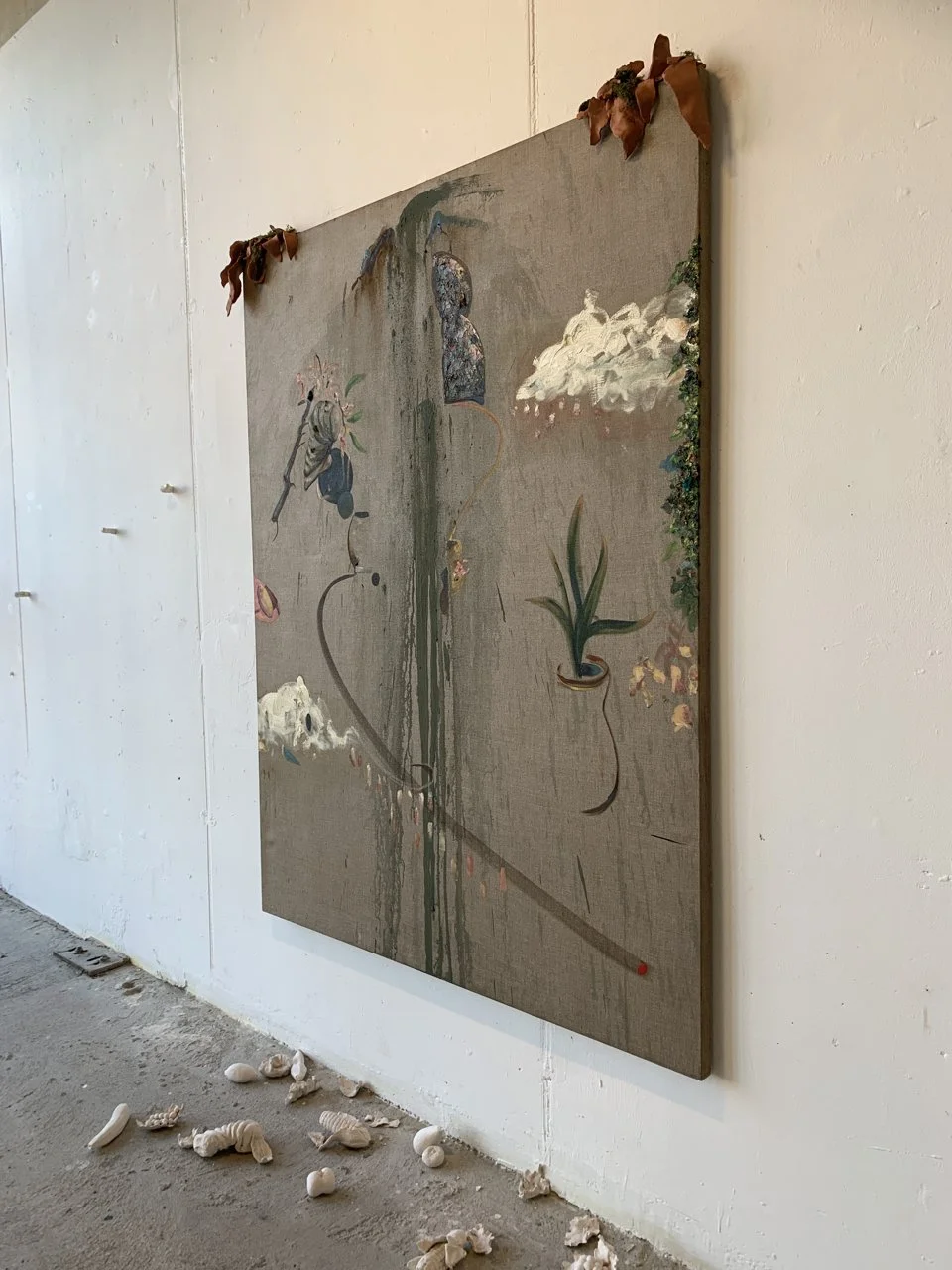
WHEN I think of archaeology and anthropology, I think of three things: digging, death and Damien Flood’s paintings. Over a decade ago I critically called out Flood in my first text on his paintings, The Corrupt Geologist and the Awkward Coroner.

Extract: “Damien Flood's paintings look like they were made by a corrupt geologist. He is knee-deep in browns, drips, rainbows, islands and mountains, that either shadow or seem to be in the act of swallowing everything whole around them. His daily painting routine is a process of excavation, when several layers of painted horizons are either covered over or dug back up, using the awkward relationship between chance and intent to uncover a corrupted space or form.” 

That was 2011. Later, in 2020, in the monograph essay The Mythology of D & Me, I wrote: “Words, words, words, and paint; the dumb reality of words and paint.” I have written and spoken many dumb words about Flood’s paintings. Experiencing his work today (Wednesday 16th November, 1pm) at Green on Red Gallery Dublin, I wanted to experience them as they are, without words, without sublimation — solid to gas. But here I am. That says something that I won’t understand until after today.

Today I thought about civilisation. That thing we proclaim when emerging from the wilderness after being lost for days in said wilderness. The shout of CIVILISATION! as we exit the woods, dirty and almost dead, is elevated to saviour in this context. But what are we really shouting at the moment of least hope followed by gracious relief.

Detail.

Civilisation, outside the context of despair and relief, is a society that has reached a mature and highly developed state of development in terms of human behaviour, technology, and what Michel Foucault might call “the administration”, or with sunshades and bondage gear on, “the police”. Culture is generally included in the definition of civilisation. And yet I like to think of culture as the thing that questions and criticises the foundations of civilisation, while also keeping in mind that the final resting place of culture will be, for good or ill, the tomb of civilisation, not the wilderness of culture. To my mind culture exists in efflorescence not civilisation. Civilisation is culture all grown up, secure in its own legacy. Sean Scully thinks he and his paintings are civilisation. He may be correct.

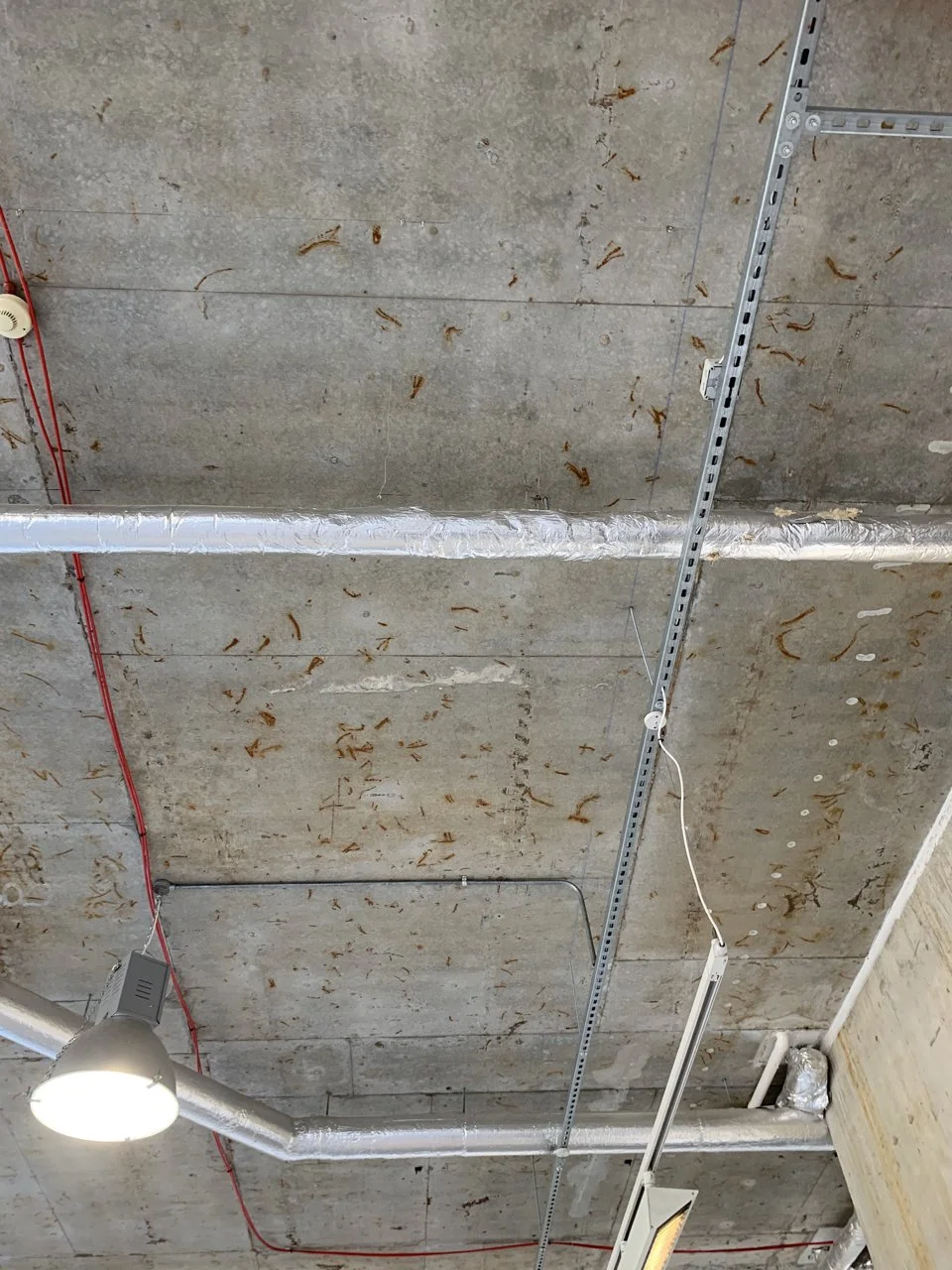
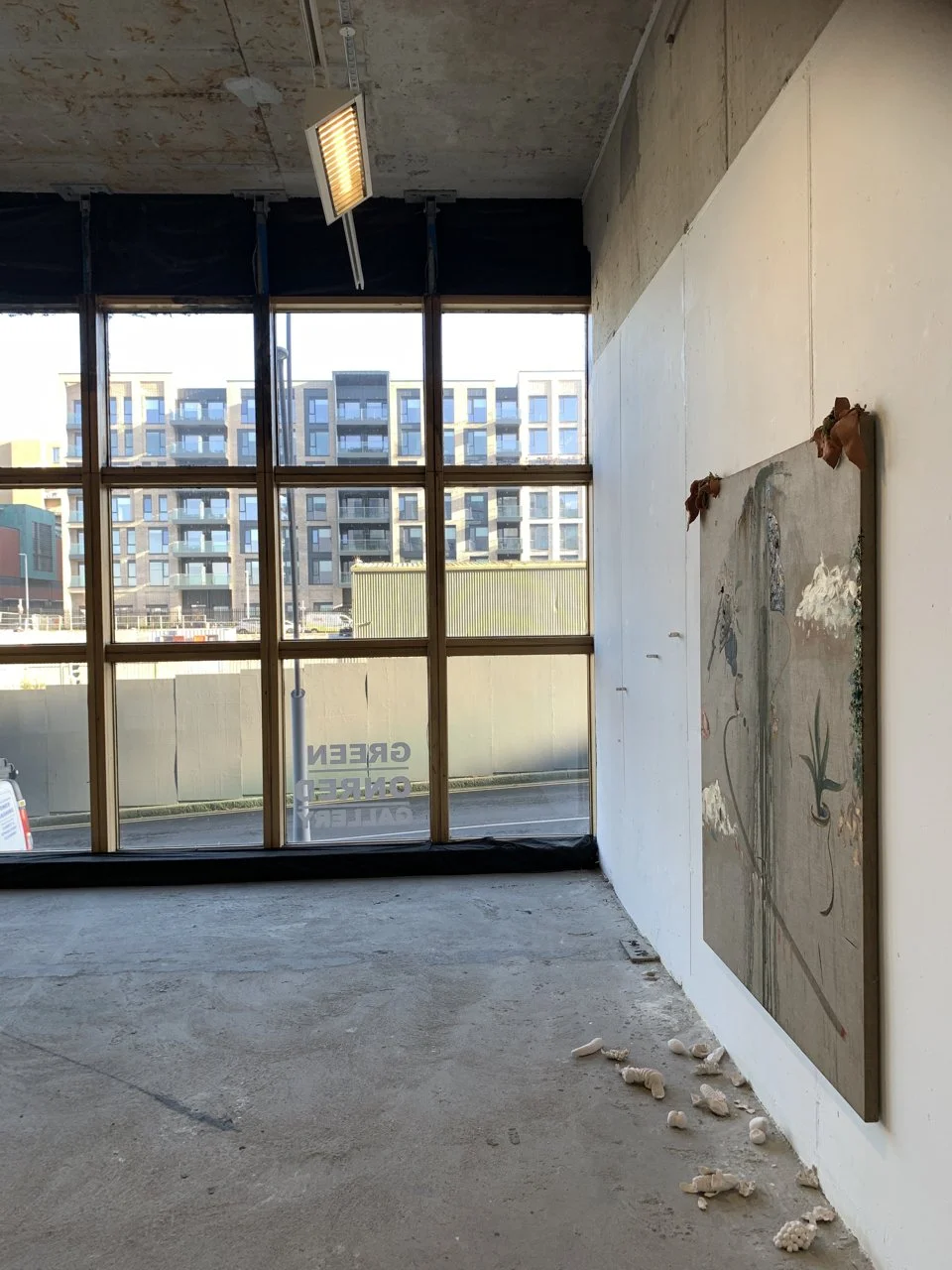
Today sunlight flashed the space like the most shameless streaker. There was a feeling that the world within and the world without were not so separate, as the excoriating sunlight shed the space of a softer skin. Revealed: the pockmarked walls; the patched-up floor; the rusty brown-orange scrawls on the ceiling, as if a metal bird had tried and failed to escape. SQUAWK! More and more I believe the setting for art determines its capacity to be more than its individual parts, more than a showroom or window display for the penniless artist, looky-loo consumer or loaded collector.

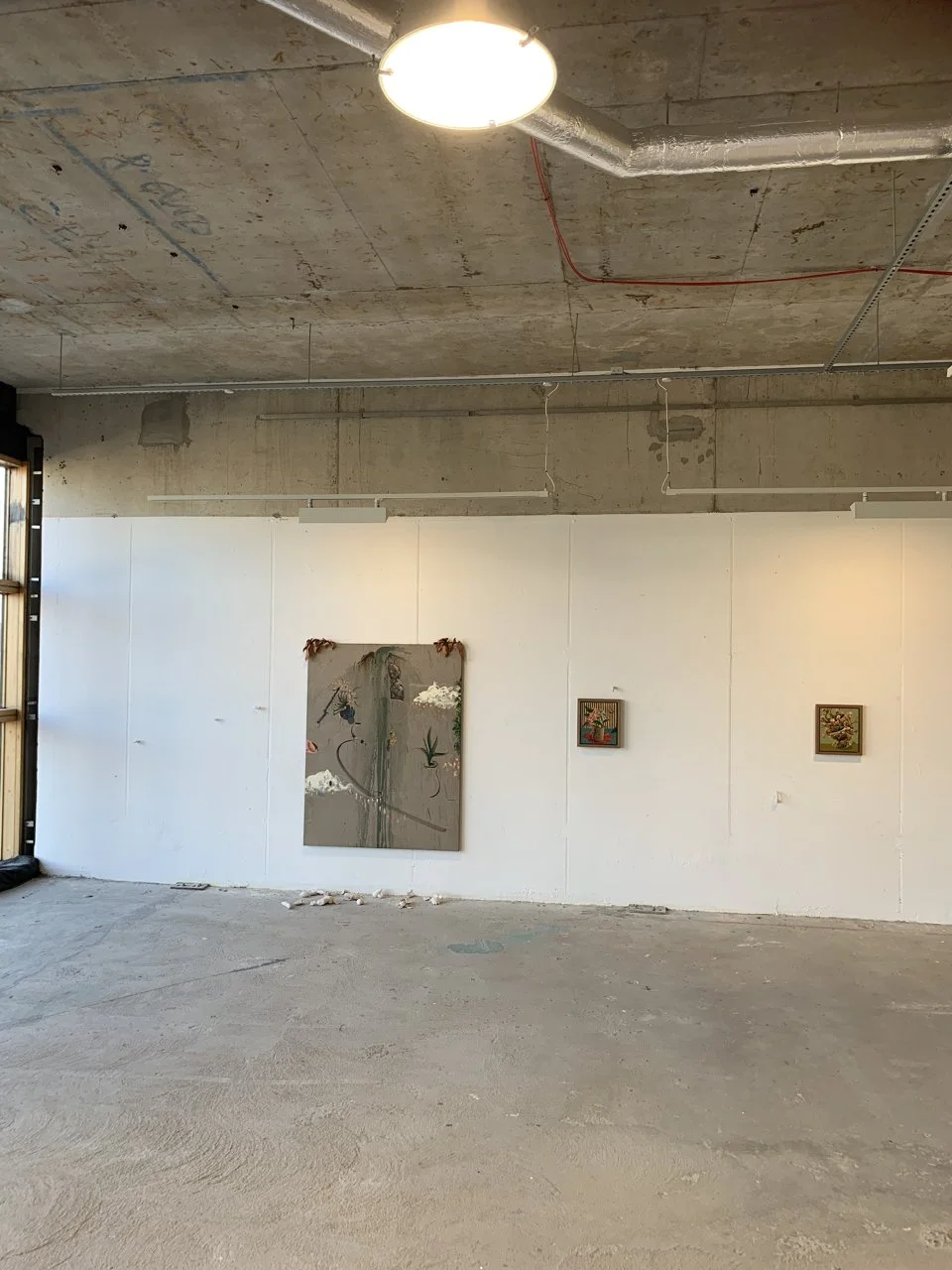
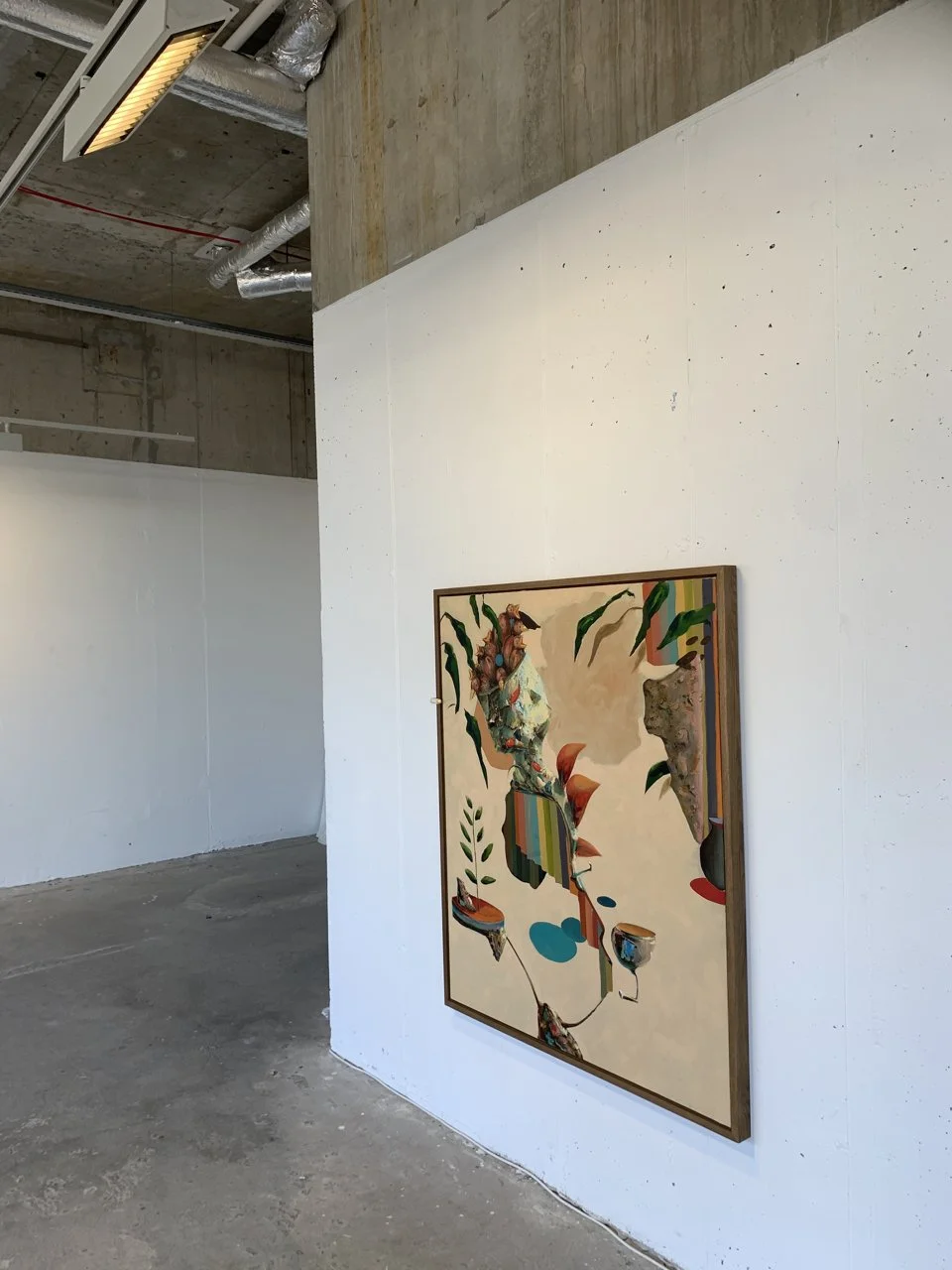
Against and within this setting, Flood’s paintings infer ruined civilisation from the vantage point of the lively wilderness of painted forms. But not just from an objective looking down from the concrete and conduit rafters of Green on Red, but ruination from one painting to the next. As I enter the gallery, paintings are full and fat with colour and paint, but gradually recede and disintegrate to end in a withering and anaemic painting at the far back wall, with bone-white broken sculptures of fruit and veg sprinkled on the floor beneath. 

Green on Red’s crumbling — but never fully gone retail potential — helps with the culture-cum-civilisation simpatico between Flood’s work and the space. They know each other. Standing here I think of culture as always coming while simultaneously disappearing from view. I think of culture as not permanent; a flash in the pan. Its power not residing in the archive or the record. In this space, among these paintings and painted things, the idea of culture becomes one of momentum and transition. Green on Red, like culture, is set in the dusty concrete of its own decay. The gap-toothed walls held together by the braces of a hollow building waiting for commerce to save it, not culture to sustain it. Green on Red (with art) is more representative of culture than civilisation. Filled with Flood’s work it feels like I am standing in the ruins of Pompeii and Herculaneum with triple glazing. It is more 2010 artist-run than 2020 artist-run. The white and polish of commercial spaces and art museums was never my thing anyway, and less and less so these days. I have come to think of them as agencies of consumption and control. 

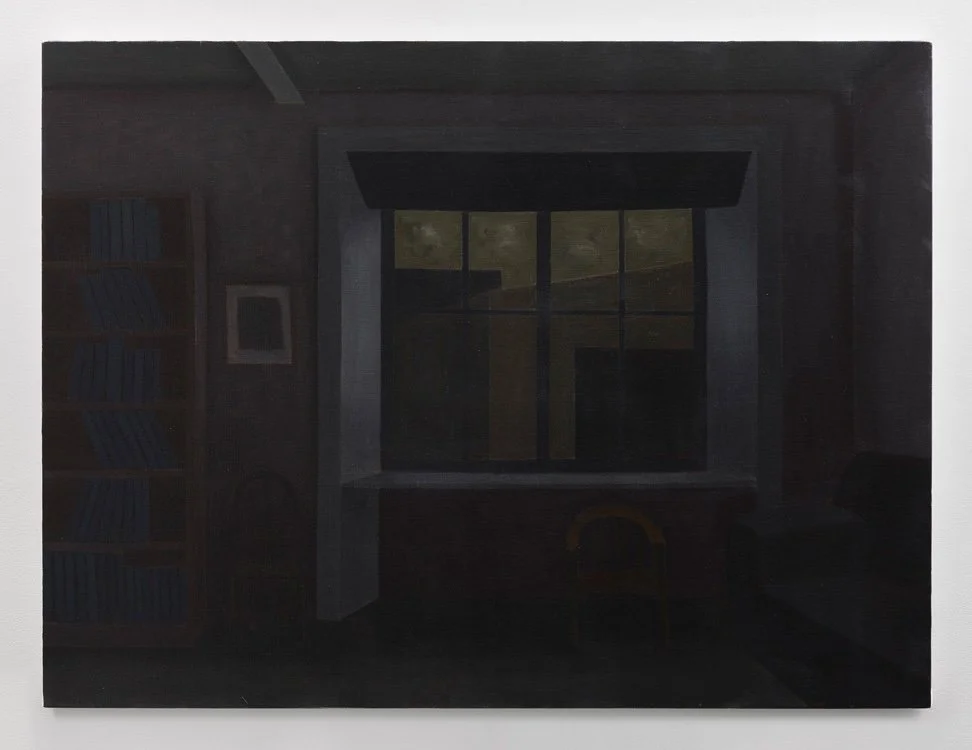
Flood’s project also makes me think about time, especially how, outside and inside the gallery, the low winter sun and cloudless blue expanse, frame and suffuse the work with light and colour. It makes me think of Einstein’s Theory of Relativity when it came to public attention, if not public understanding. When, up to its publication, philosophers were engaged in a metaphysics of space-time á la Henri Bergson et al. Why I think of Einstein and Bergson here is because the transition from a philosopher’s theory of time to a scientific theory of time is documented in Katherine Waugh and Fergus Daly’s film I see Darkness, screened concurrently down the road at the Museum of Photography Dublin. In a debate in New York in 1922, Einstein asserted that there was “no such thing as a philosopher’s time”, and that Bergson’s version of it was merely “psychological time”. In some ways I feel Flood’s paintings lean towards Bergson’s psychological time. There is something about the ‘last’ painting in the gallery that is suggestive of the last painting Flood painted in this body of work, or will ever paint. In the same way Stephen McKenna’s darkest painting Large Night Interior exhibited at the Kerlin Gallery is 2017 was literally his last painting, and looked it too. 

Stephen McKenna, Large Night Interior, 2016, oil on canvas, 90x120cm

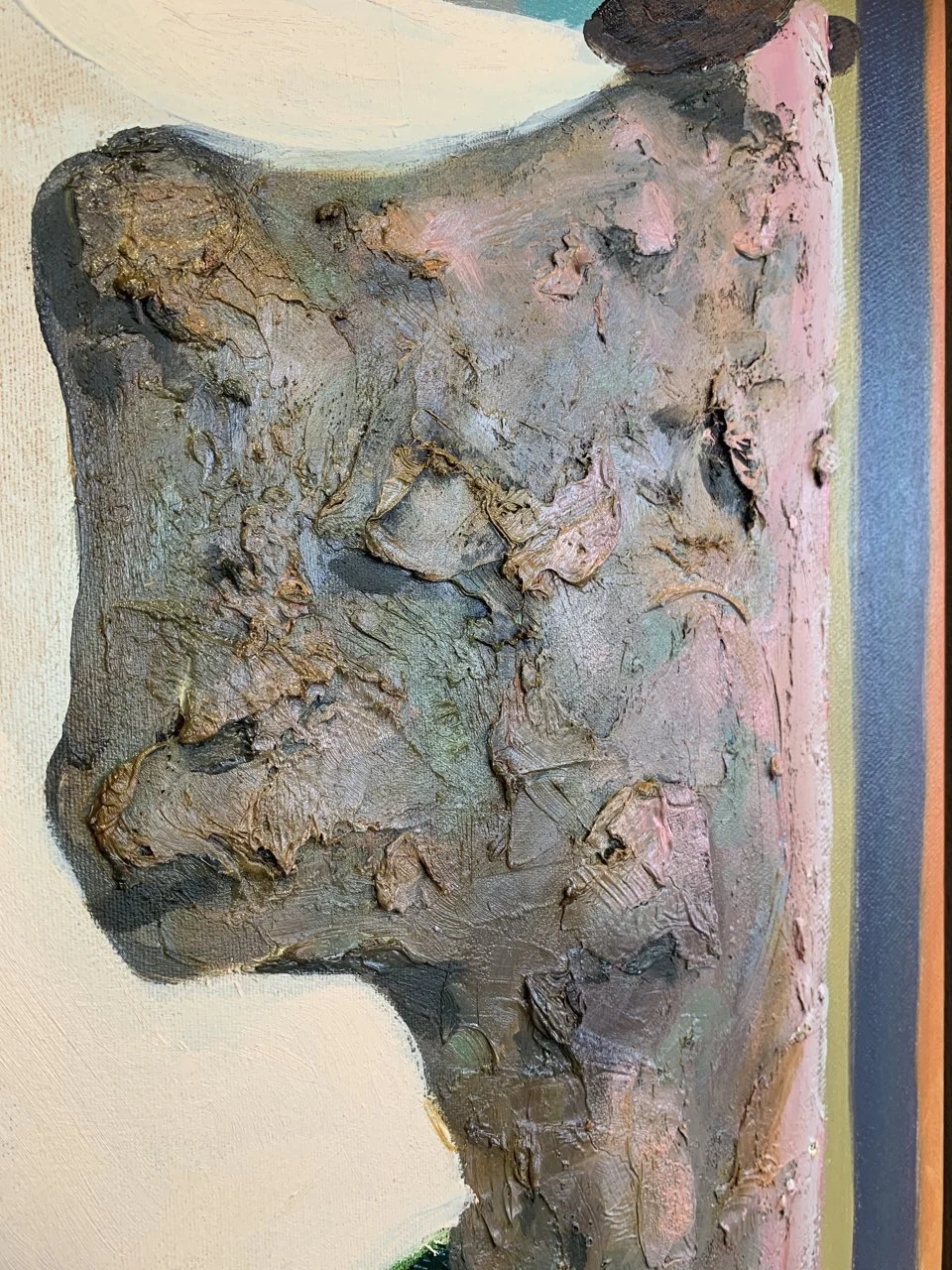
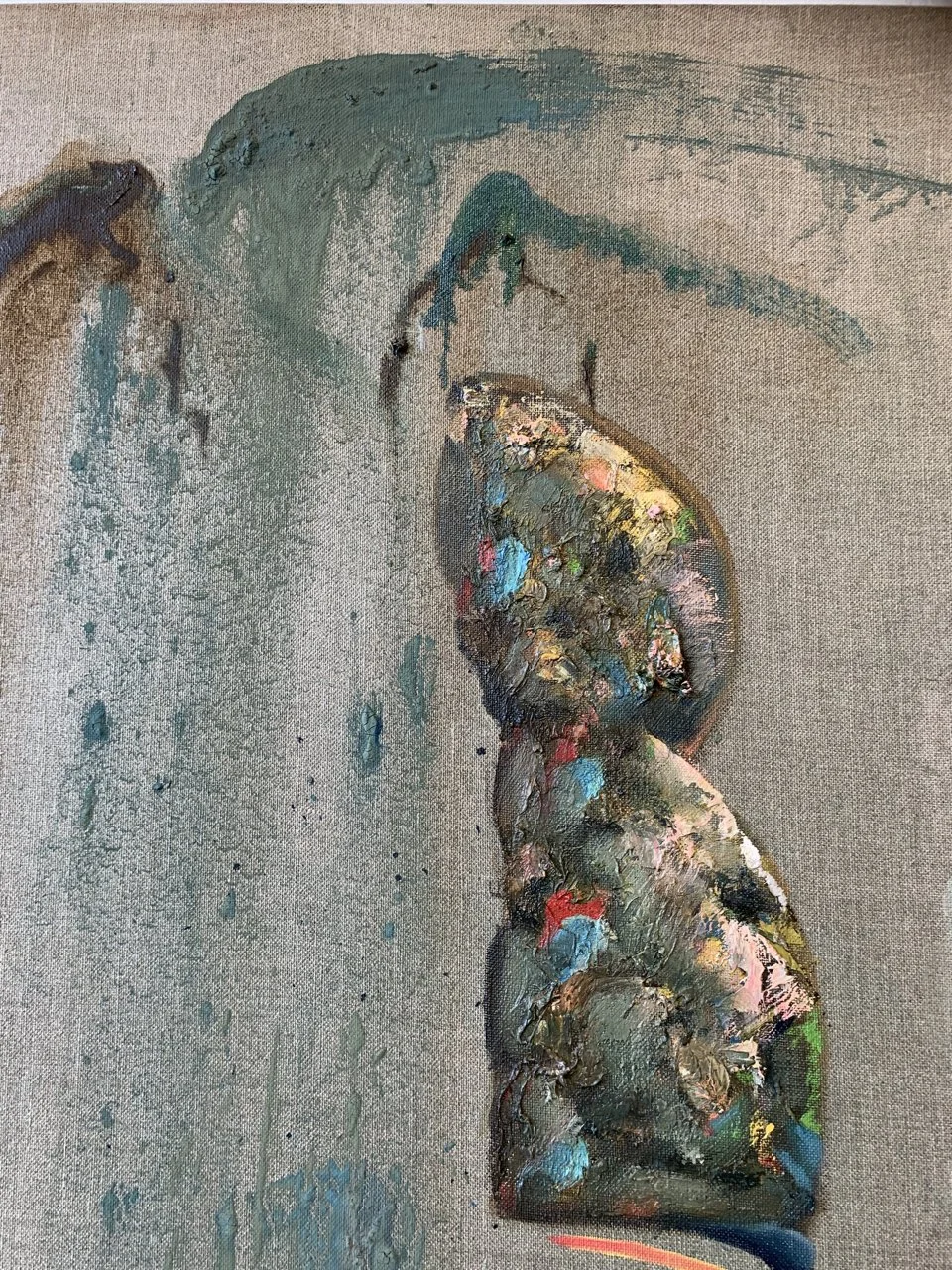
Flood’s paintings (to my mind) are leaden with metaphysical content within a phenomenology of paint. Anselm Kiefer keeps coming to mind. Flood however is a kid-Kiefer, truncating and saturating massive metaphysical landscapes into portraits of body parts connected by the fibrous (healing) tissue of paint. The artist’s scars, and manifest in different ways, different forms.

All this could be read as discontents, especially in person, contra the digital image of Instagram, which tends to colour and compress Flood’s paintings, resulting in graphically readable and digestible images, even desirable images, but sacrificing the minutiae of mess and the particular for the consumable, uniform, whole. Unlike online, I have never been able to digest Flood’s paintings in person. We have two on our walls at home, which are still left undigested after 4000 breakfasts in their company. My gag reflex is always on high alert around them. That’s why art on Instagram frustrates me so much. It’s consumable. Capitalist. Easy. 

Detail.

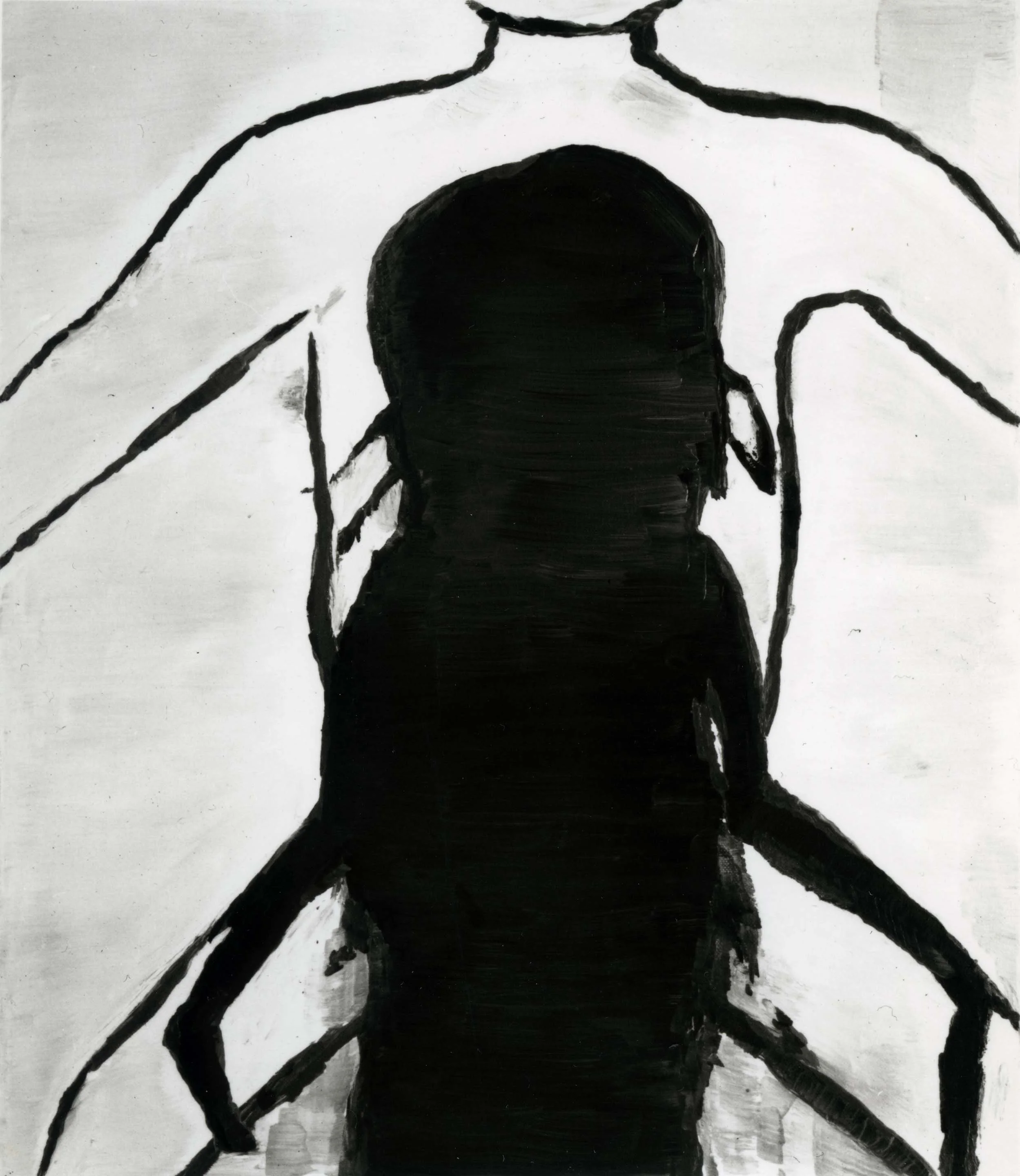
Freud’s Civilisation and its Discontents comes with a bevy of symptoms, fetishes, anxieties, repressions and so on. Flood’s pictorial mythology is not so explicit in respect to either the signification or representation of such discontents, except for the ever-present brain-pan. But there is a new emphasis re the silhouette or tear in the fabric of his warped time-space gradients. In one instance the profile of a vase is substantiated by an impastoed setting without, and a gradient setting within. The vase is a void to be filled.

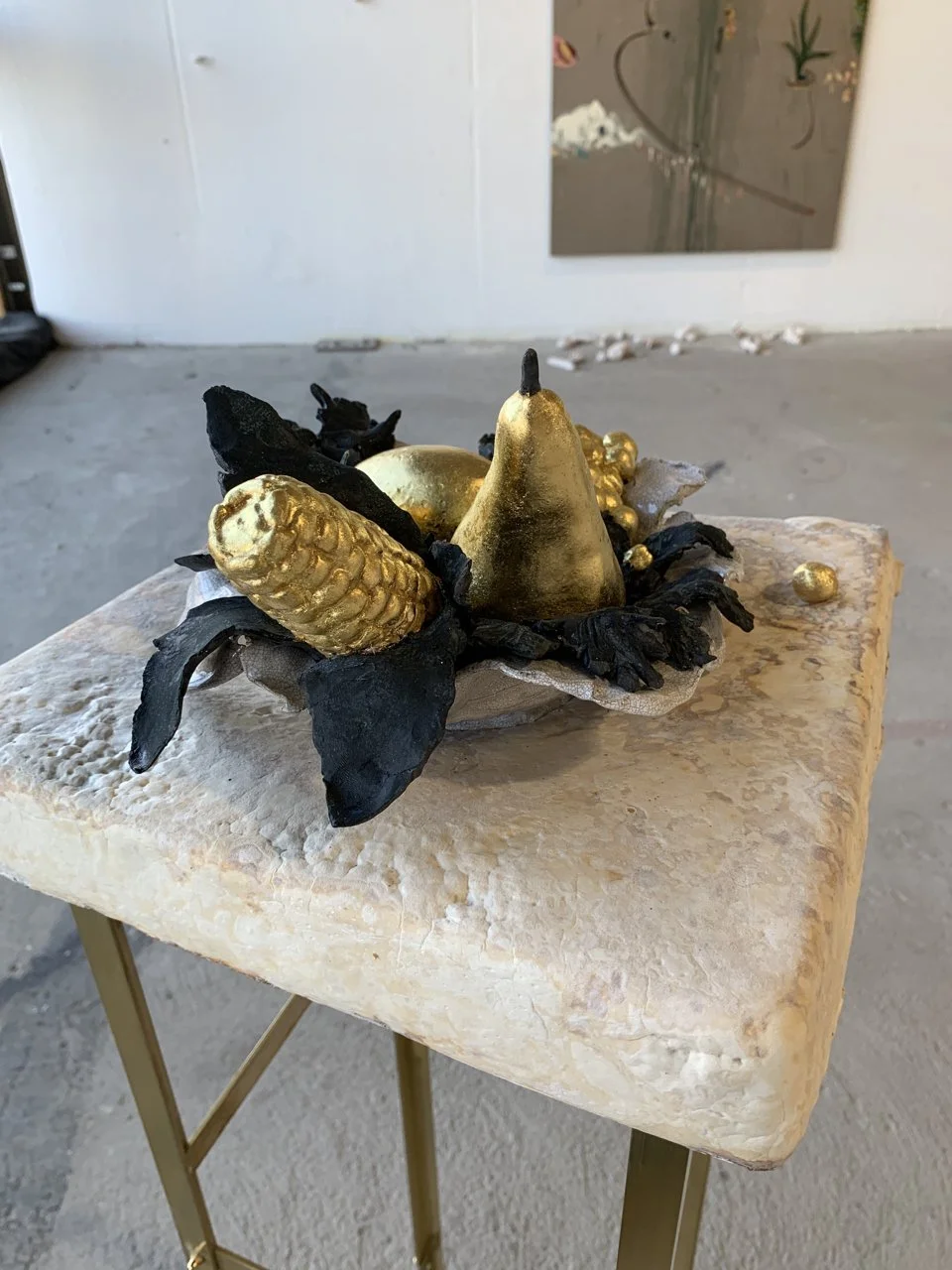
There is a Sisyphean effort in Flood’s paintings that demonstrates a repeated ambition to reach beyond their flat and fenced-in perimeters, like the startlingly weird fingers that flirt and fondle the gallery walls. A fetishistic excess. A social and masturbatory gesture. The artist, symbolically and imaginarily, among others, but realistically, alone. The gold and glazed ceramics of heads and fruits seem to exist out of exasperation, the last death rattle of culture echoing in the halls of civilisation. One last breath before everything turns to stone, to history, to dust.

Of course we can be more light-hearted in our estimation of Flood’s work. Less heavy. Less elevated. Less. His work is deterministic, tacit, in its painterly objective. Raw linen or gradients are the consistent foils for his spoiled paint. After inspecting Flood’s paintings all these years, I find they continue to use the same raw repertoires and transitional effects to balance the neurosis of the clotted and complex builds and weaves of monstrous forms. The other stuff in the gallery, pottery gone bad, is like the cutlery on a well-dressed dining table, where animals toast to civilisation, while stuffing their gout faces with the spillover and excess of capitalist culture. 

So can we digest the paintings of Flood without getting sick ourselves? Are they too much? They are paintings that are determinism to be themselves. They are healthy in their sickness to be, and to be more. They are science-fictions of the past, regurgitations of what was to what could be. Skulls and mountains, death and the sublime, earth and the ethereal still pervade and parade in the work. The lost and found of civilisation finds its home as a cornucopia of forms on the slippery when wet horizon of time and space, belief and heavy metal. It seems that Flood does still believe in illusionistic space, but illusionistic space without all the trickery. Like the farther you stand back from a painting the realer it gets. No. Flood’s paintings look the same up close as they do from afar. 

There is a theory, one sourced from Immanuel Kant and later expounded through psychoanalysis, that we experience reality through fantasy. I wonder if all cultural production is a way of getting closer to reality. That somehow, among these works saturated by the natural low-lying winter sun, and further lit by the uncanny fluorescence of the gallery lighting, that painting, at its best, brings us closer to reality when it is displayed in the lights of day and detritus of life.

Green on Red director, Jerome O Drisceoil, mentioned Edvard Munch today. My brain bristled with identification. Munch is all about death and sickness and repetition, but so what. Death and sickness is commonplace for all of us. What makes Munch interesting psychoanalytically, and by extension artistically, is what he did with death and sickness in his paintings, an example and description that might bring us closer to the florid obfuscation of Flood’s work.*

Damien Flood’s paintings are at odds with themselves — if we can use that pronoun. Landscape wanting to be portraits; lively still lives of nature morte identification. They are undead. Perhaps the nature of all contemporary painting is to become and not to become simultaneously. This is what Francis Bacon did so well, landscape as portrait, and the existential uncanniness of doubling the conventions of art history, whereby past becomes present becomes postmodern in a warped temporal and spatial relationship that would make Bergson proud. A narrowing of the secular landscape for something more sacred — can we say sacred anymore in relation to art? Einstein has left the building at Green on Red. The sun has dimmed. The blue turned to a pin-pricked black. And Bergson has reentered the atmosphere… in flames. We just don’t know if he will survive the impact. I think he will.—James Merrigan


*Edvard Munch lost his mother at age 5; and his sister, who became his maternal substitute, aged 14 — she was just a year older that Edvard. Munch would experience countless other family tragedies throughout his 80 years, and would invest most of his energies in the repeated and periodically portrayals of his sister’s sickbed. Psychoanalysts have called Munch’s painted repetitions of his sister’s sickbed as a “lifelong transitional object” — reflective of the Freudian death-drive — an object that helps the infant transition from the mother’s incubated embrace into the real world. But I think what some psychoanalysts define as a transitional object is in essence a fetish, something that loses its healthy and developmental definition, to one that is more cultural in a corruptive and destructive sense. Recently I have been thinking a lot about Edvard Munch, and at the mention of Munch while at Green on Red, I started to understand Damien Flood’s work apropos Munch. More generally I wonder what motivated Munch to paint what he did and the way he did? There was the fin de siecle permissibility in terms of what a painter could paint at the end of the nineteenth century in respect of expressionism. There were the tragic formative years of his childhood, which we can psychoanalyse, and further label his paintings as life-long transitional objects or perverted fetishes. Leaving Munch behind, what if we ask the same questions of Flood? The fetish is many things, not one thing. It’s anthropological, it’s commodity borne, it’s sexual, it’s an object, it’s a psychic process. Outside of so-called normative sexuality, the fetish can be something more than a stiletto. The fetish can be a hamster. Slavoj Žižek tells a story about a friend of his who lost his wife. Žižek says they were very much in love, but for some reason his friend didn’t show any signs of sadness or mourning for his deceased wife. To the point that Žižek felt his friend was psychotic. Later Žižek discovered that his friend was keeping a hamster, and not only keeping a hamster, but on bended knee, caring and loving a hamster. When the hamster died, Žižek says that his friend was heartbroken in excess of the little creature he now mourned. Of course the hamster didn’t invoke the sadness that his wife’s death couldn’t — the mourning for his wife was just delayed, suspended in the object of the hamster. So the fetish is less an object of a specific aesthetic, and more a fantasy-process that can be fixed to any object, stiletto or hamster, when the world of meaning or emotion is pulled from under us. The fetish is defined by disavowal. That is why I believe that all artists are fetishists. Žižek calls the symptom a partial truth, and the fetish a partial lie. Edvard Munch whipped his paintings; he also placed eyelashes in his paintings. In another sense the fetish is a way of coming close to death without dying, close to sex without having sex, close to the absolute without succumbing to it; close to art without having to make it. As Georges Bataille said, “The fetishist never loved an old shoe more than an art lover loved a piece of art.”


TEXTS

FROM KANYE WEST TO ARTHUR JAFFA AND BACK

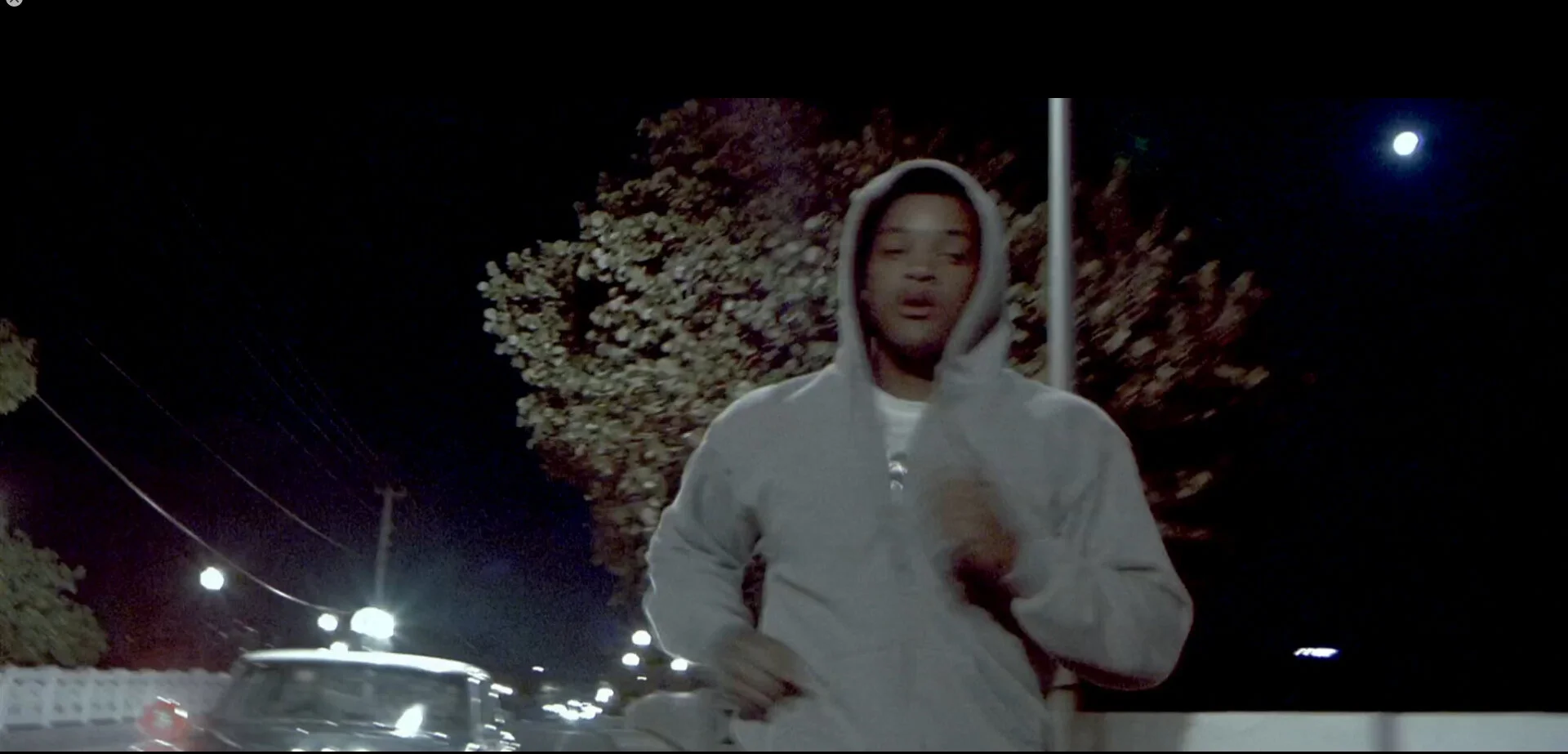
Kanye West & his mother Donda West (from the documentary “Jeen-Yuhs: A Kanye Trilogy” 2022)

I’m acting now, playing a role
— Kanye West (from the documentary “Jeen-Yuhs: A Kanye Trilogy” 2022)
When a giant looks in the mirror, he sees nothing 
— Donda West (Kanye West’s mother)

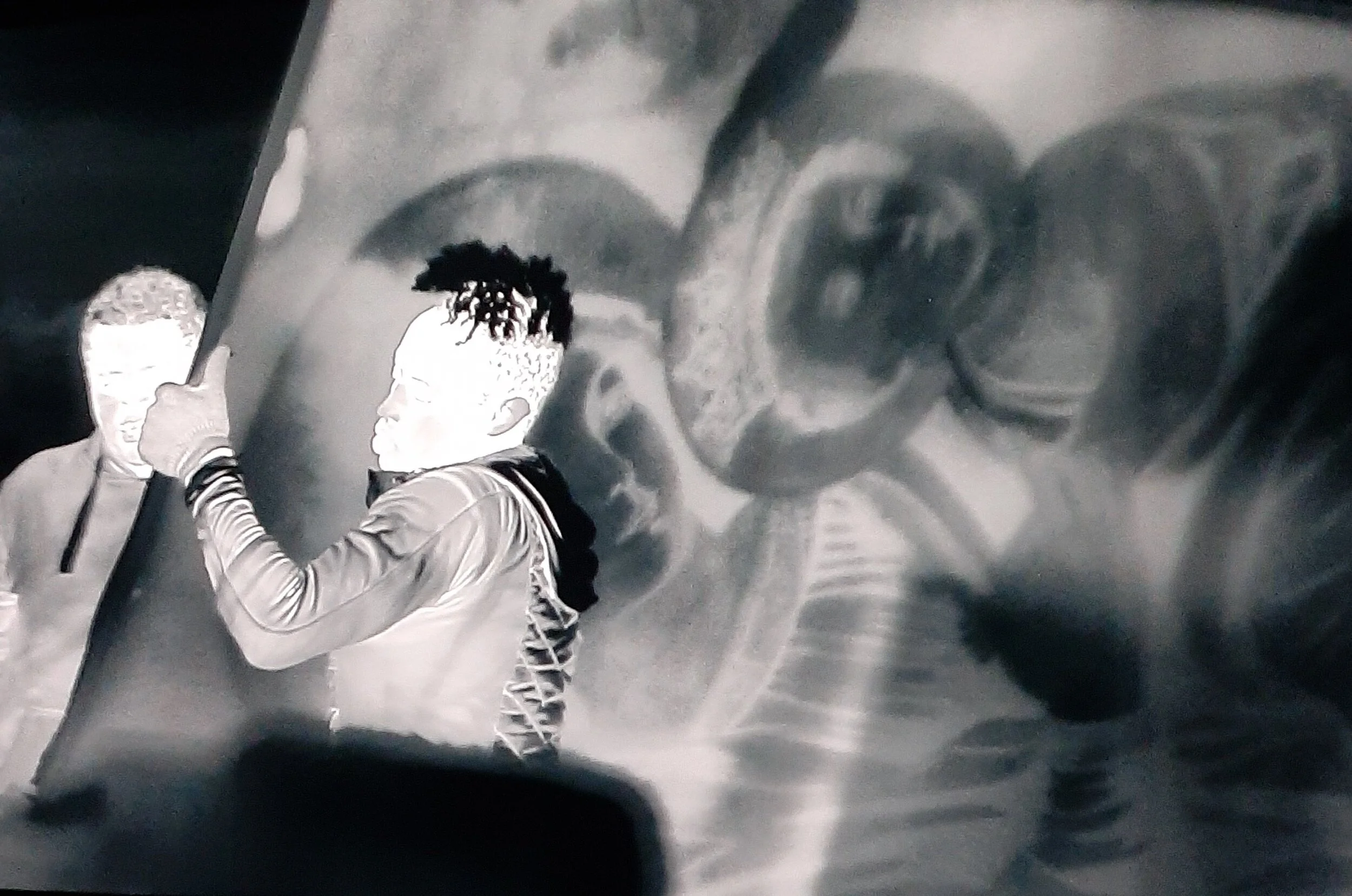
“Amen”. The last word spoken by the co-director and narrator, Coodie, of the 4-hours 30-minutes Kanye West documentary, Jeen-Yuhs: A Kanye Trilogy (2022). So why, at the Douglas Hyde Gallery Dublin, have I ended up in Amen and “Ye” Country? 

Answer: Arthur Jaffa. Specifically, Arthur Jaffa’s 7-minutes slice and splice of black lives appropriated in a jittery matrix of emotions and mess of racial consciousness. Love is the Message, The Message is Death (2016) is a compilation and complication of moving images edited against the unifying music of Kanye West’s Ultralight Beam. Taken from his 2016 Album The Life of Pablo, what one reviewer described as a hollowed-out gospel song within a “maximalist” album, the “Pablo” in the album title refers to the three Paul’s (Pablo Picasso, Pablo Escobar and Saint Paul) and perhaps the things they represent: Art, Gangster and God. As we will see (and as we are seeing in the unfolding media scrum surrounding Kanye West), it’s very, very, very complicated.

The critical reception to Kanye West’s The Life of Pablo seems to correlate and complicate its relationship with Jaffa’s appropriation of Ultralight Beam in Love is the Message, The Message is Death, and Jaffa’s film oeuvre as a whole. I arrived late to the brilliance of Jaffa’s work, in the months subsequent to the artist being awarded the prestigious Golden Lion Award at the 2019 Venice Biennale. It was in Venice, and the film that made Jaffa’s name at Venice, The White Album, that I first experienced his brilliance as an editor, or what Kanye West was dismissively named before becoming a rapper in the minds of his peers, a producer. 

On entering the room wherein Jaffa’s The White Album was screened in Venice, we were met with contrasting belly laughter and cooed offence — thunder and lighting. One person was arguing with another over their inappropriately misplaced laughter. Like bullets, stray laughter can harm. Over the 30-minutes duration of film, the two became heated, but remained UFOs in the scattershot light and dark of Jaffa’s projected film. Huddled among all those people, those strangers, some there because Jaffa won the Golden Lion, others there by circumvented accident (as we were) was invigorating. It was like we had stepped into a film, a delta of people reaching from seats to floor, touching the walls, screen, each other, us. A raft of reachers: Géricault.

The opposite is true of the Douglas Hyde Gallery’s screening of Jaffa’s earlier and much shorter (7+minutes) Love is the Message, The Message is Death. On my watch, it felt like the gallery had been evacuated of all people and artworks: a giant screen left on, audio-visual crates and gear waiting in the aisles for the End. No invigilator. A table full of books on Race standing forlorn where former Paradise was empty. Bench. Bench. Bench. I stood. Seemed inappropriate to sit, like laughing in Venice. 

Outside a raft was needed as Dublin City was adrift in thunder and lightning without a silent buffer (crackle-boom); inside Kanye West’s Ultralight Beam shined and sutured:


I’m tryna keep my faith

We on an ultralight beam

We on an ultralight beam

This is a God dream

This is a God dream

This is everything

This is everything


It is gloriously whole: visuals and beats. This dissonance, what one commentator calls “affective proximity”, is what Jaffa is celebrated for in the artworld. When both Jaffa and West, or West and Jaffa come together in Love is the Message, The Message is Death at the Douglas Hyde Gallery, dissonance rhymes. It’s a cavernous chop shop: Kanye’s chopped-up gospel beats against Jaffa’s chopped-up clipped clips. The screen is huge; cater-corned . Large, flat wall speakers, minimal square and grey, but ever present. The gospel according to Kanye brings bass drum, reverb, satanic inverse organs and choir to the panoply of Jaffa’s moving images, that suck and move and sample under the weight of their motivation: to affect through the close proximity of their diametric emotions. Once again, it is gloriously whole: joy abuts injustice; the everyday sparkles in the light of the extraordinary; and in terms of art-making and art, originality comes under the permissiveness of appropriation. And yet I am left with questions: Where does Kanye West end and Arthur Jaffa begin in Love is the Message, The Message is Death? Or does it matter? 

Kanye West, The College Dropout, 2004; Kanye West, My Beautiful Dark Twisted Fantasy, 2010 (censored cover); Kanye West, The Life of Pablo, 2016.

Afterwards, I went home and listened to several Kanye West albums. I had left the gallery with Kanye on my mind, not Jaffa. I wanted more. I got more. 

Later I learnt that, as in both Jaffa’s visuals and Kanye’s beats, there was also a dissonance in the reception to The Life of Pablo on its release in 2016. Not just in opposing reviews, but within single ones. Rob Sheffield wrote presciently that “West just drops broken pieces of his psyche all over the album and challenges you to fit them together.” Jon Caramanica opined West "has perfected the art of aesthetic and intellectual bricolage, shape-shifting in real time and counting on listeners to keep up", concluding "this is Tumblr-as-album, the piecing together of divergent fragments to make a cohesive whole”. Ray Rahman (with the conflicting addendum “glorious whole”) criticises and commends “an ambitious album that finds the rapper struggling to compact his many identities into one weird, uncomfortable, glorious whole.” 

It is this dissonance and dialectic between Jaffa and West, visuals and beats, that brings up the question of appropriation. Where does appropriation end and art begin? Did Marcel Duchamp just fall in love with the urinal, like perhaps Jaffa fell in love with Kanye West’s Ultralight Beam? As I have. Is appropriation in art just a love letter rather than a conceptual conceit as Duchamp would like us to believe. Lest we forget “Appropriation in art and art history refers to the practice of artists using pre-existing objects or images in their art with little transformation of the original.” It is the “little transformation of the original” in the definition that sticks. If more than a “little transformation of the original” takes place in appropriation, does that mean the art is void? Is there a limit to too much or too little transformation? Like Duchamp signing the readymade urinal “R.Mutt”? If he signed it ‘M.Duchamp’ or a variation thereof, would that have been too little or too much transformation? If he signed it in red instead of black? What then? Too much or too little? The bottom line in appropriation must be the retention but also subjugation of what went before in the original. Obviously the artist who appropriates has to survive the appropriation, to use and repurpose, but also overcome the object or image appropriated. Or does the artist need to survive their appropriation of the other?

I don’t think Arthur Jaffa’s Love is the Message, The Message is Death survives without Kanye West. In other words: I can imagine listening to Kanye West’s Ultralight Beam in the Douglas Hyde Gallery with its loaded beats and lyrics addressing faith and race, but I cannot imagine looking at Arthur Jaffa’s Love is the Message, The Message is Death without Kanye. It may be a dumb negation in respect of Jaffa’s mode of art-making, dependent on editing and curating appropriated content, but bear with me for a dumb beat. 

I listened to Ultralight Beam countless times after my experience at the Douglas Hyde Gallery. I became obsessed with it: entranced. The dissonance, pacing and timing. The sampling of the child exorcising the devil and imbibing God with grandma’s overheard validation is both medium and message: Art. These are all the things that Arthur Jaffa’s work, especially The White Album, is acclaimed for, and aspects that speak volumes in Ultralight Beam and Kanye West’s work at the height of his creativity and production. 

There is another thing that should be critically confronted, and that is the current media storm surrounding Kanye West’s very recent anti-Semitic comments on social media, proclaiming on Instagram just weeks ago, his interest in “going death con 3 On JEWISH PEOPLE.” When experiencing Jaffa’s Love is the Message, The Message is Death, which is so dependent on Kanye West’s formally integrated Ultralight Beam, can we separate out Kanye from the experience of the artwork, especially considering the fundamental message of both Jaffa’s and Kanye’s work is a criticism of racial prejudice? This is an affective proximity that may be too much for some people to bear. 

The Kanye West documentary Jeen-Yuhs, where I started this very speculative criticism, is about survival: surviving being black, surviving prejudice, surviving peer dismissal, surviving mo’ money mo’ problems, surviving God with a capital G, and surviving Kanye West, which continues apace with his antisemitic remarks, and follows years of questionable affiliation with Christian and right-wing policies regarding pro-life, pro-Trump and criticism of Black Lives Matter movement’s over-emphasis on black trauma in terms of history.

Against this often times absurd, dangerous and painful discourse propagated by Kanye West, I am left with the genius of his music in the Douglas Hyde Gallery, and the enigmatic back story courtesy of Jeen-Yuhs. Such as the scene in which Kanye walks into rap royalty’s Jay Z’s Roc-A-Fella Records, slots his CD into the office stereo, and raps along to the beat, to be ignored, and then to do it again in the adjoining office. The ambition, self-belief, nerve, it’s wonderful to witness. (Even though this self-belief was to become absolute belief – “Jesus Walks”.)  And then there is the death of Kanye’s mother, Donda, at the height of her son’s fame. The one who told him that “When a giant looks in the mirror, he sees nothing”. It was all forecast or feared by his mother; “Ye” the antagonist was born on the day of her premature passing at 57.

This notion of affective proximity is not just performed in Arthur Jaffa’s Love is the Message, The Message is Death, or Kanye West’s music, lyrics or his recent interview on the Lex Friedman podcast aired yesterday, or Coodie’s and Chike’s documentary Jeen-Yuhs. Affective proximity is also performed in the sense that a Kanye West song is being played in a public gallery. And not just for obvious reasons regarding copyright, which usually prevents visual artists from appropriating the music by artists of Kanye West’s market stature. But just because it is Kanye West being played on full dial in the Douglas Hyde Gallery. I can’t help but enjoy it. Like the affective proximity of the thunder and lightning outside, amidst the high-hat rain, love and hate, the beats and beef goes on. In the end, when all is said and done, it all fades to black.

Appropriation, at its best, is when the artist disappears under the cultural weight of the material appropriated. Arthur Jaffa has to disappear for his appropriations to be heard and seen. But sometimes those appropriations are so loud that they silence everything in their wake. Listen. See. —James Merrigan
PETER SCHJELDHAL (1942 - 2022)

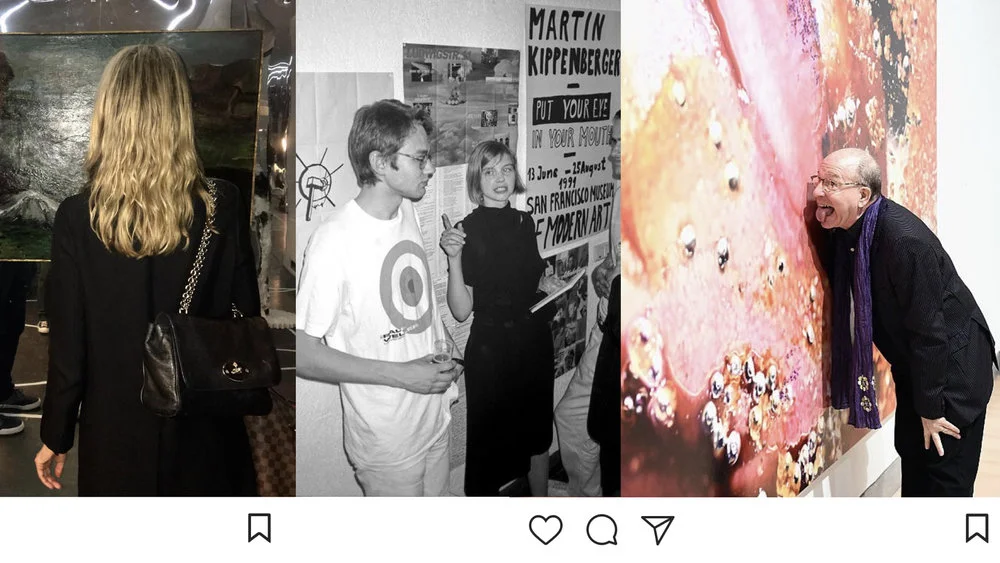
🏴He sometimes reminded me of Marvel Comics Stan Lee, not just in looks, but as in his auteur appearances in the New York artworld, pulling the virtuoso verbal strings. Pulling my strings. Every trip to my brother in San Francisco, I went to my favourite place in the world at the time, the Berkeley second-hand bookstores, with my future wife, & scavenged for art criticism & philosophy for hours. Every plane trip back I would read him. He was an away ally at a time when there were no home-grown ones. I quoted him a lot in the early days. He was definitely formative. Scrap that: completely formative.  And weirdly, I quoted his less assured speaking voice over his magisterial prose. He could be clipped at times, when the poet & critic came together at a sharp point. Lingering beauty towards incision was his dance. And sure, he was autobiographical, & personal, and as Katy Siegel called him, “a feeler”. So what! He didn’t like art with a backstory. So he was a painter’s critic above all else. His “Seven Days” & “Village Voice” years were his urgent best: like Saltz; Indiana; Visceros-Faune. His New Yorker years institutionalised his writing into what can only be called live obituary. And although I still read & enjoyed & stole from him, unlike Pulitzer Saltz, he had transformed from a critic who wrote for the artist to one who wrote for his readers. In a Q&A following his lecture “The Critic as Artist” over a decade ago, he admits regret that he can’t write weekly due to the New Yorker having more critics than pages &, with less emphasis, the legendary editorial process of the magazine. His exclusive subject became the big artist, the big show in town. When I read his piece “The Art of Dying” in 2019 I was sad, & ever since momentarily waiting for the day to come, which was yesterday. His advice for artists in art school: “form a group”. His advice for art critics: “live in a big city where you can afford to lose one friend a day”. But he also said: “When you live in a cosmopolis, you have to learn to dance.” He was a sensualist-realist.—James Merrigan
WE NEED TO TALK ABOUT PAINTING?

🏴Every now & then the question of painting’s position in the contemporary context of the artworld is posited, as if painting & painters are in an orbital crisis of identity or abandonment. And yet we never have seminars about sculpture’s position, or film's position, forget about art criticism’s position, and lest we not forget photography's position. Perhaps the riff on the infamous “We Need to Talk about Kevin” is appropriate here, in terms of identity, abandonment & a “need to talk” with mammy & daddy contemporary context. 

Over the years I have curated exhibitions about painting, but tried, & sometimes failed, to avoid discussing its position within a contemporary context, which only leads to neurosis. My discursive engagement with painting has been directed at the painter, not the contextual setting in which painting is both the originary source & popular/capitalist definition of art. Such discourse emphasises the asymmetrical distinction between painter & artist: the painter vulnerable & needy, the artist assured & fluid. So will it be a metaphysical or critical series of talks on painting? Hopefully Schwabsky’s easily quotable noun/verb wordplay re painting/painting is not repeated. 

Painting’s position in the contemporary context of Instagram & art fairs is as the art commodity par excellence. Just look at the current Frieze Art Fair posts that crop painted experience into individual loves — “Love is violence” (Zizek). The best painting exhibitions I have experienced are ones wherein I have forgotten context & been enraptured by the setting in which a room full of paintings has been incubated or a room full of paintings incubate. IE: Matt Bollinger’s paintings currently at mother’s tankstation is a very different animal to let’s say Matt Bollinger’s paintings at Kevin Kavanagh Gallery. For painting to subvert its objecthood as commodity, we need painting exhibitions that dissolve their singular objecthood into a buttery all-over spread that dis-plays an equal amount of irresolution & resolve. The setting, not context, determines painting's transcendence from mere commodity into fantasy.—James Merrigan
Matt Bollinger’s America none-the-less

It’s 4:30 A.M. on a Tuesday

It doesn’t get much worse than this

In beds in little rooms in buildings in the middle

of these lives which are completely meaningless

Help me stay awake, I’m falling...

Asleep in perfect blue buildings

Beside the green apple sea

Gonna get me a little oblivion

Try to keep myself away from myself and me

— Counting Crows, Perfect Blue Buildings, 1993
fantasy is not the object of desire, but its setting
— Jean Laplanche and Jean-Bertrand Pontalis, 1986

There’s a story that Slavoj Žižek tells, well a Freudian case study, about a woman who recounts a dream from the previous night. While in the thrall of telling the dream, the woman admits to being muddled about certain details, so she skips over them. Žižek says that Freud has a brilliant insight with regard to the muddled parts. He doesn't diagnose the missing or muddled parts of the dream as muddled or missing parts, but part of the dream content itself, and so part of the interpretation, which involves repression. The woman is muddled because she is repressing content. Further, Freud claims, the muddled content is integral to the more lucidly told or translated parts of the dream. Žižek adds to Freud’s insight by saying the muddled content is called the form of the dream, whereas the more lucid parts of the dream are the content.

Form and content, in Freud’s universe, are one and the same thing, two sides of the same coin, a mobius strip, and so on. Susan Sontag, who, in her 1964 essay “Against Interpreation” critiques our Freudian drive to exorcise content from cultural expressions in cinema, literature or visual art, posits a new era of “an erotics of art” to replace the never-ending hermeneutics of art that continues to plague third-level humanities to this day. Contra-Sontag, who saw content and form as separate, or binary, Freud’s indivisible content-form insight is the best definition of contemporary art I know.

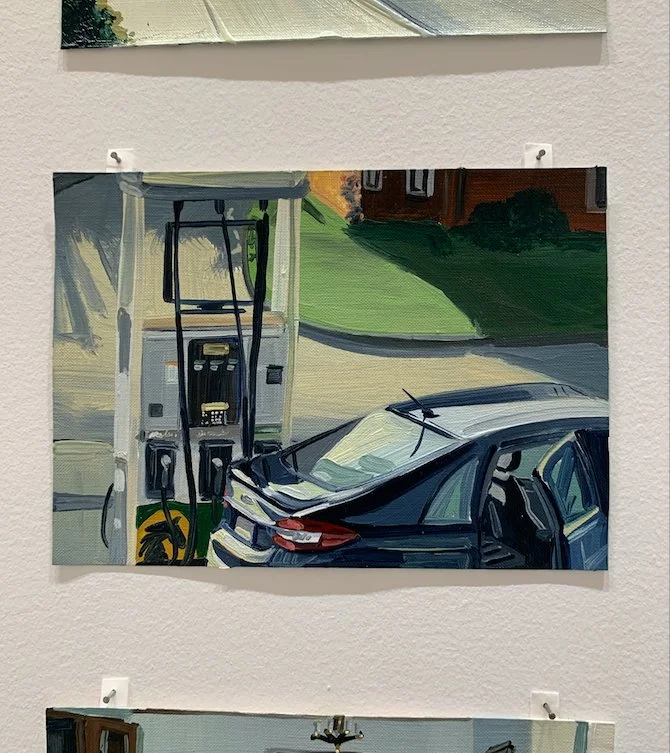
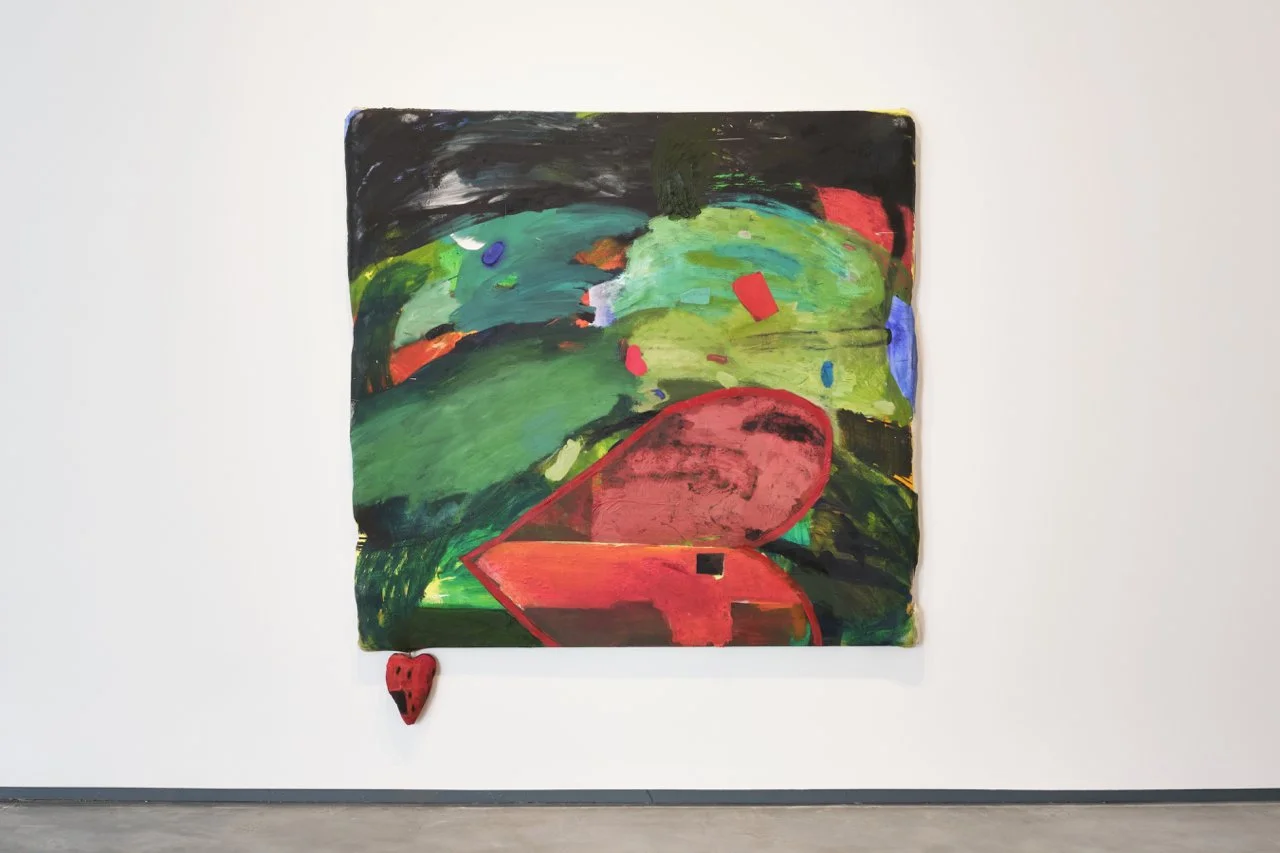
This all comes to mind on the day I give a lecture on “the gaze”, followed by the experience of American painter Matt Bollinger’s paintings and painted animations presented at mother’s tankstation Dublin. If we were to transpose Freud’s insight apropos form and content onto Matt Bollinger’s work, where would the relationship between form and content stand? First, as Sontag advises, we would need to describe, not interpret. But, to put it mildly, in descriptive terms, there’s not much to describe in Bollinger’s work beyond what is in plain sight. 

By the public pool; by the petrol pumps; by the ice box and slush puppies; by the weeds, Bollinger’s universe is a universe of by-and-by. Before long, something may happen, like the embedded subplot of the “school shooting” in the 3X3 minute painted animations presented in the anti-chamber before you enter the gallery proper; liquid expressions that provide a backing track of voice and music to the whole exhibition. And whether by grim prescience or service to the present, the newspaper headlines are clear here, but not conceptual: guns and oil, NRA and Russia. But before then, before the terror and slow aftermath of nothing, then something, Bollinger’s universe clocks on and clocks off, day and night, night and day. It’s a shit-storm without the storm, mostly. 

On the train journey home I see Bollinger’s forms all around. Heavy-set forms. Forms that have volume and ennui. They sit across from me in the train booth, empty vehicles that enliven my subjectivity the more and more they show their dumb volume in the scattershot fluorescence that paints the carriage yellow and blue. It’s like what Sartre or Lacan said about the gaze: for us to imagine ourselves as thinking subjects, we have to see other people as objects. Objectification is not only the plight of women, it is the plight of humanity in its warped relationship with the other. 

mother’s tankstation stove

So we look, and we look again, noting that Bollinger’s characters do not look at us, but look askance. Light-sabre blues and button eyes cross streams, directed at a spot on the horizon, that is not there, just memory. There’s no future here. They are here in form but not here in spirit. Bollinger seems to want to monumentalise the not-noticed or ignorantly ignored ignorant. His characters are monuments. Monuments that, when we try to imbibe their natures, fill us with nothing. They stand there, squat there, sit there, slack-jawed, poised for a photograph, not even reluctantly, while the pink dusk slices through blue Tuesday P.M; waiting statues that hang around long after the photograph has been taken and the photographer gone, nobody telling them to move on. The slush puppies long melted. 

They remind me of a cartoon I watch with my kids, Steven Universe, set in a kind of parallel small-town America, inhabited by super-power infused gem beings, against a backdrop of small-town fast foods and fat disappointment. Bollinger’s universe is Steven’s universe without the superpowers. This is a world that runs on empty: fuel and calories. It’s Ozark without the Byrdes; Springfield without The Simpsons; Smallville without Superman. It’s fucking depressing. But it is paint. And Bollinger may not love the lives he paints, but he loves paint (or, he is in love with the lives he paints, if love is the violent choosing of one over the many). Nevertheless, his love of paint is absolute, especially paint that describes such a depressing lifeworld with such fractal light. Bollinger paints chiaroscuro with colour. And the same goes for Bollinger’s weeds, which he imbues with an élan vitale that his humans don’t possess. A dandelion tries to mimic the outline of a love heart; a garden fire spits fire; a trapeze traffic light singles red on the high wire. None-the-less (never was a word so fitting), Bollinger’s Masaccio forms, signify, by way of form and content, a small town America that is God-made and American-made, and where faith has been given up to Medusa’s gaze.

Matt Bollinger anywhere else in Dublin but here wouldn’t have the same effect on the nervous system. Here, his indie world is incubated. Incubated from the world at large, and larger for it. This is a world within a world that denies the next tragedy because things like that ‘don’t happen round here’. And yet, amongst this nothingness, something appears. The liveliest figures in this ___ville of despair, are the glimpses of hands and arms that open the Auto Parts door or attend to the nothingness at hand, within. The uncanniest is spotted in the bowels of the shop, beyond the shelving with the plump gallons of oil. A person of interest who makes no attempt to stand in the light of the shop window, but stays hidden for all to see, in plain sight. Neither being looked at or looking, just gazing into nothing. —James Merrigan
SEAN EDWARDS: FAULT OF STYLE

You have to squint your eyes to catch the conscience of Sean Edwards’ art at TBG&S Dublin. When you do, eyes dilate to a Local world that, through a series of micro-expressions, twist and turn the nature of looking and feeling. 

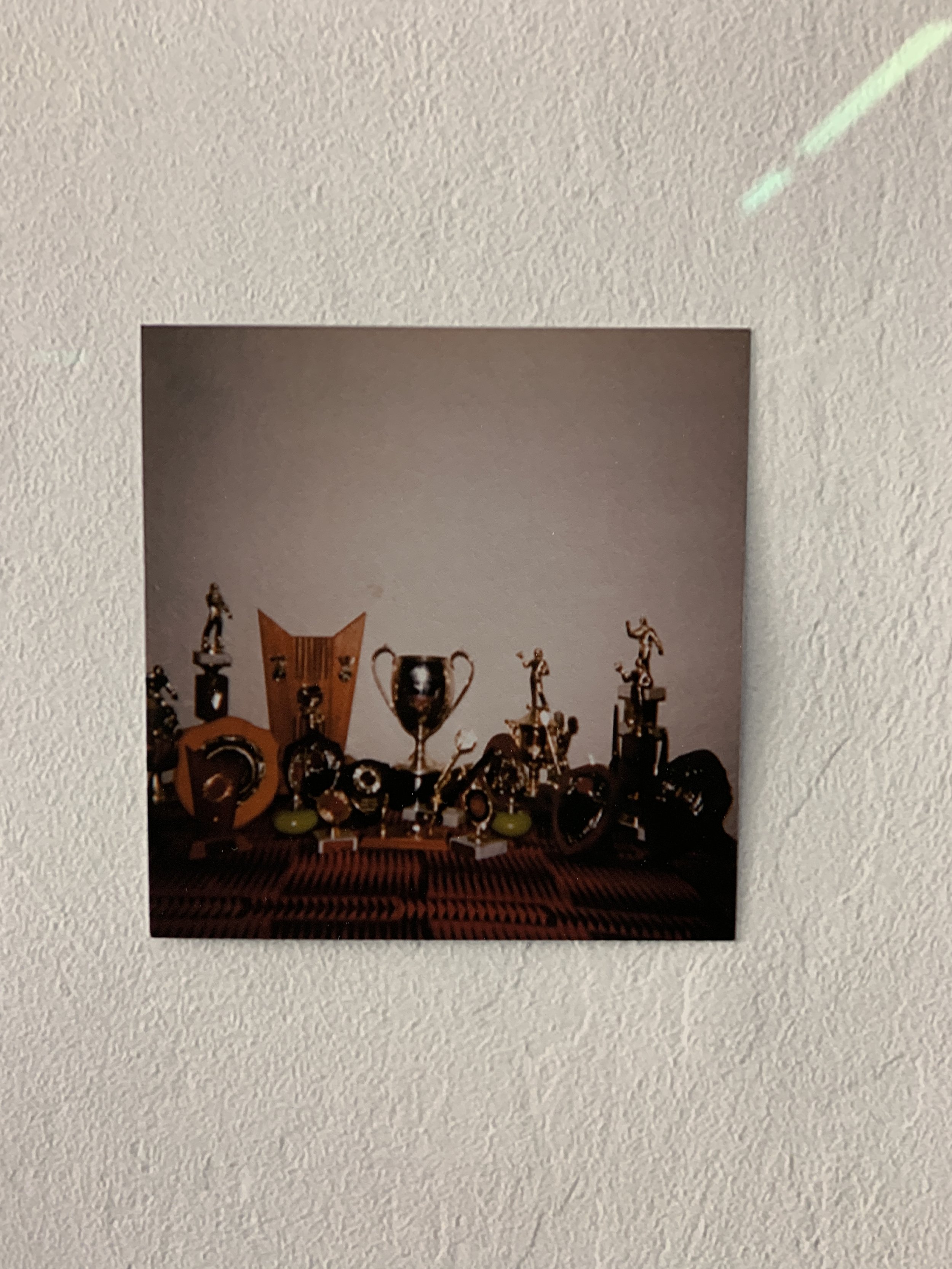
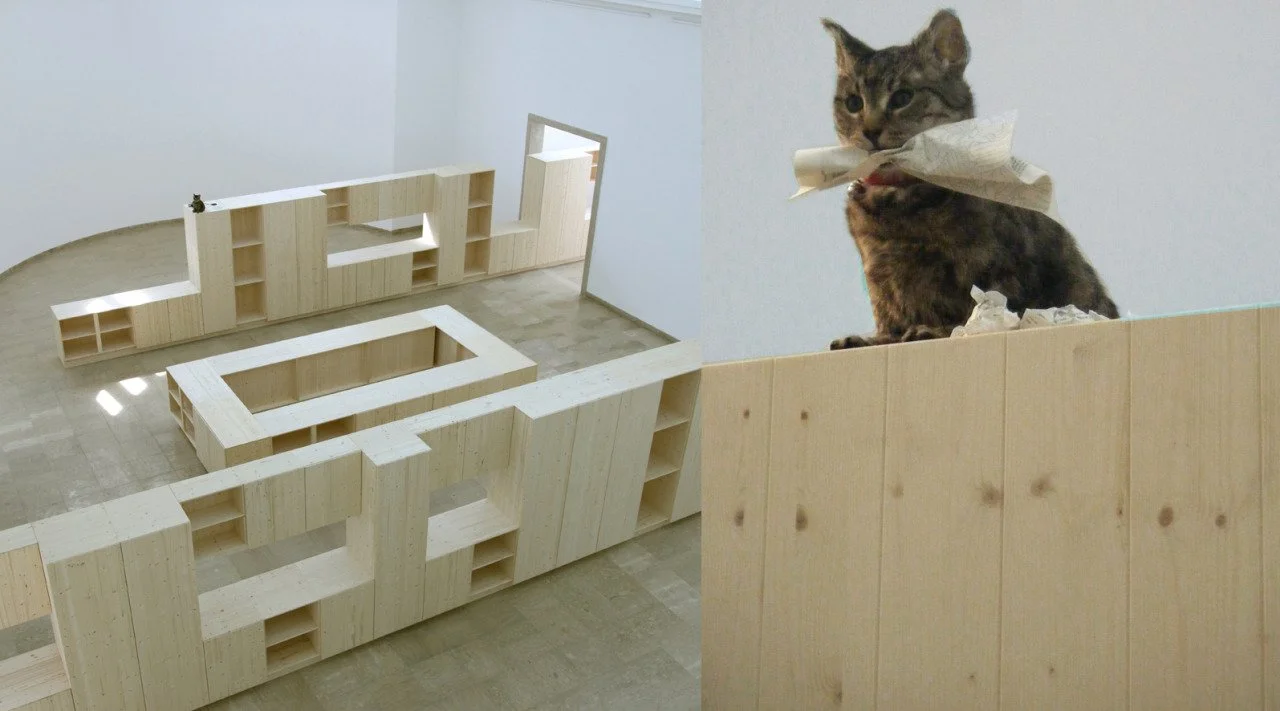
It seems grim nostalgia was already creeping — almost too soon, too young — into Sean Edwards’ aesthetic attitude in his early 30s, when he made Dream of Him (2010), a small, personal photograph of childhood trophies inset centre-stage and square within a large photograph of the adult artist’s studio wall. The juxtaposition is weird: the small photograph reeks of a 1980’s sitting room replete with the itchy, damp and brown-yellow accoutrements of a 1980’s sitting room; whereas the large, white, anaesthetic backdrop of the studio wall looks almost lunar in topographic comparison, intimating great polar distances in space and time, adult and childhood, life and art. Like Duchamp, Sean Edwards appropriates the dinge and dirty of society, mixed with a conceptual architecture that, at first, comes across as arch or decorative, but up close, smells of stale alcohol and gambling BO. Perspective is the making and loss of this exhibition.

It’s the perspective shifts between small and big, close and far, single and double that stabs you in the back here. That is, If you stay for a while — most don’t. Most glance at the objects in their formal doubling and singular entendres, uncannily reproducing themselves to dizzying and decorative ends.

Sean Edwards' work is far from pure decorative. And yet his dioramatic constructions have enough pattern, repetition and symmetry to slow interpretation to a concentric rhythm. But reading between the veneer and the disturbed geometry, the artist has something to say beyond the decorative, whether that message is distilled through a stained sherry glass or the grafted imagery that sidewinds and fractures the formalist resolve of his art.

It’s like this: Sean Edwards sadistically slices and dices his memories of Wales, and then sadistically and masochistically puts them back together again like humpty couldn’t; and then sadistically and masochistically puts everything out there in plain sight for you to discover in incremental, insect-scale ways. Conceptual woodlice.

We also have big things here, like the Richard Deaconesque Stations, fabricated from veneered MDF that loop, contort and repeat bookmakers’ Logos (LADBROKES etc) on their ribs. The gallery attendant hands me an off-cut of the same logo-infested rib, like someone might in a flooring shop, in anticipation of me monkey-bar swinging on the 14 sections that range across one wall of the gallery. Sean Edwards’ objects provoke touch or rearrangement by hand or imagination. Others before me have been pawing his ribs hence the existence of the spare rib. I hold it in my hand; a cane to offset my stutter and stumble.

In my other hand is the gallery handout, which does a lot (too much) describing and explication, so to repeat here, like the rest of the cut-and-past promo reviews to follow, would be another tautological exercise. So let’s not do that. Tautology, in a manner of speaking, is the definition of nostalgia (to superfluously repeat or relive what has been said or done before). In that respect, Sean Edwards’ dioramas of times lost, loved, forgotten and remembered are tautologies. That said, as defined in mathematical logic, “a tautology is a formula or assertion that is true in every possible interpretation”. 

Sean Edwards’ warped perspective is sourced from an isle close by, but an isle drifting farther and farther away as time goes by, as current geo-politics oscillate and escalate between cohesion and separation, tolerance and war. But this is smaller than all that big stuff. This is very much Local, very much micro in its expressions. So much so that a lot of squinting is needed in extrapolating the explicit but easily missed minutiae of Sean Edwards’ formal vis-a-vis conceptual contortions. 

1980’s Wales, not unlike 1980’s Ireland I guess, is a time best forgotten, and certainly not relived through the sophisticated and purging display-case of the contemporary artworld, a world that forgets, fetishises and commodifies better than it remembers. Sean Edwards remembers for all of us, especially those who don’t want to remember. Like me.

Much later I think to myself that, by accidental context or ruthless unconscious, this is a post-Brexit exhibition: an exhibition coloured by past political separations and present emergent Kingdoms and Empires; an exhibition that evokes — amidst the gallery cleanliness and godliness — stale carpets and tobacco-tinged walls of working class homes and gambling houses; an exhibition that smells of memory, recession, emigration, mining strikes, not the distracting and hurtful perfumes of nostalgia, mourning or melancholia; an exhibition that bottles and battles stagnant time, standing still for the artist, but broad enough in the re-representation of forgotten and found paraphernalia to elicit a time in us that we, or our parents, experienced, but a time, thank god, that has now past. A time so stilted, damp and dark that it is best left repressed and denied as a joke or a stain, not a trophy.

12 years on from Dream of Him (2010), Sean Edwards is forty-something now. As a forty-something artist, and parent as the press-release and double text work makes clear, the past begins to weigh heavier than the future. This can amount to a formal contortion as the past becomes a source of form and content, and perhaps comfort for the artist. Especially considering how artists generally contort themselves into a möbius strip of tautological form and content. That said, “tautology” is sometimes defined as a “fault of style” (e.g. they arrived one after the other in succession). Contra-style, which superficially defines art in theory and market, “Fault of style” could be the very essence of art. —James Merrigan

Through 12 November 2022


TEXTS

THE ART OF MAKING IT

Velvet Buzzsaw, 2019

Jerry Gogosian, this anonymous entity, is one of the very few places where there’s a cut in the top of the pie to let the air out of how fucking ridiculous the corporate for-profit world has decended, on this thing that used to be bohemian, radical, underground, and actually totally cool because it was those things.
— Helen Molesworth, The Art of Making it, 2022.
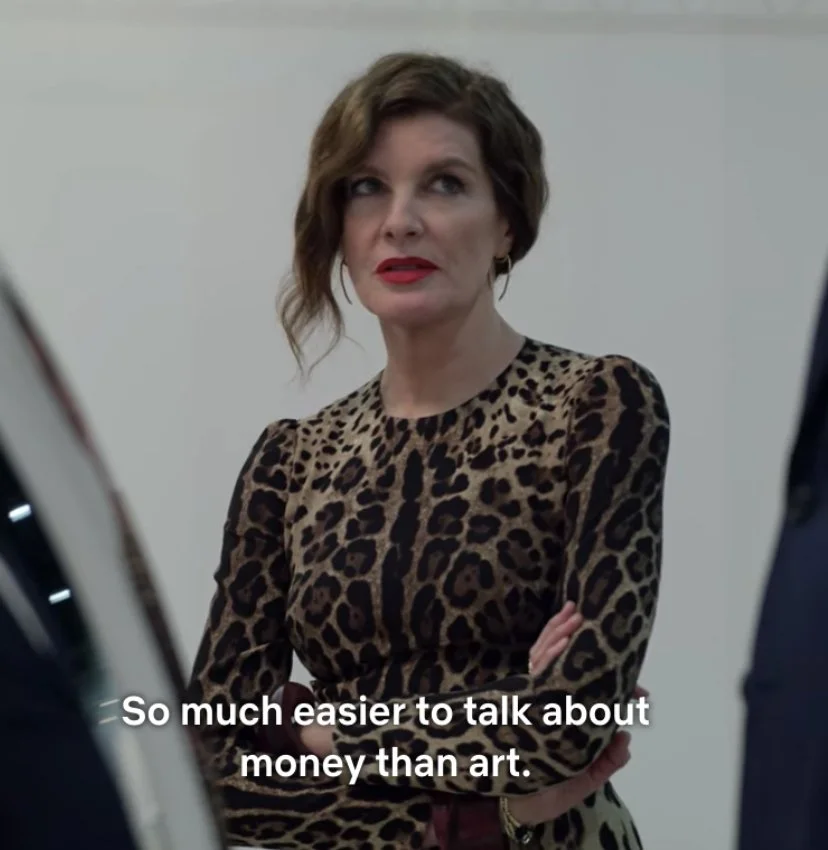
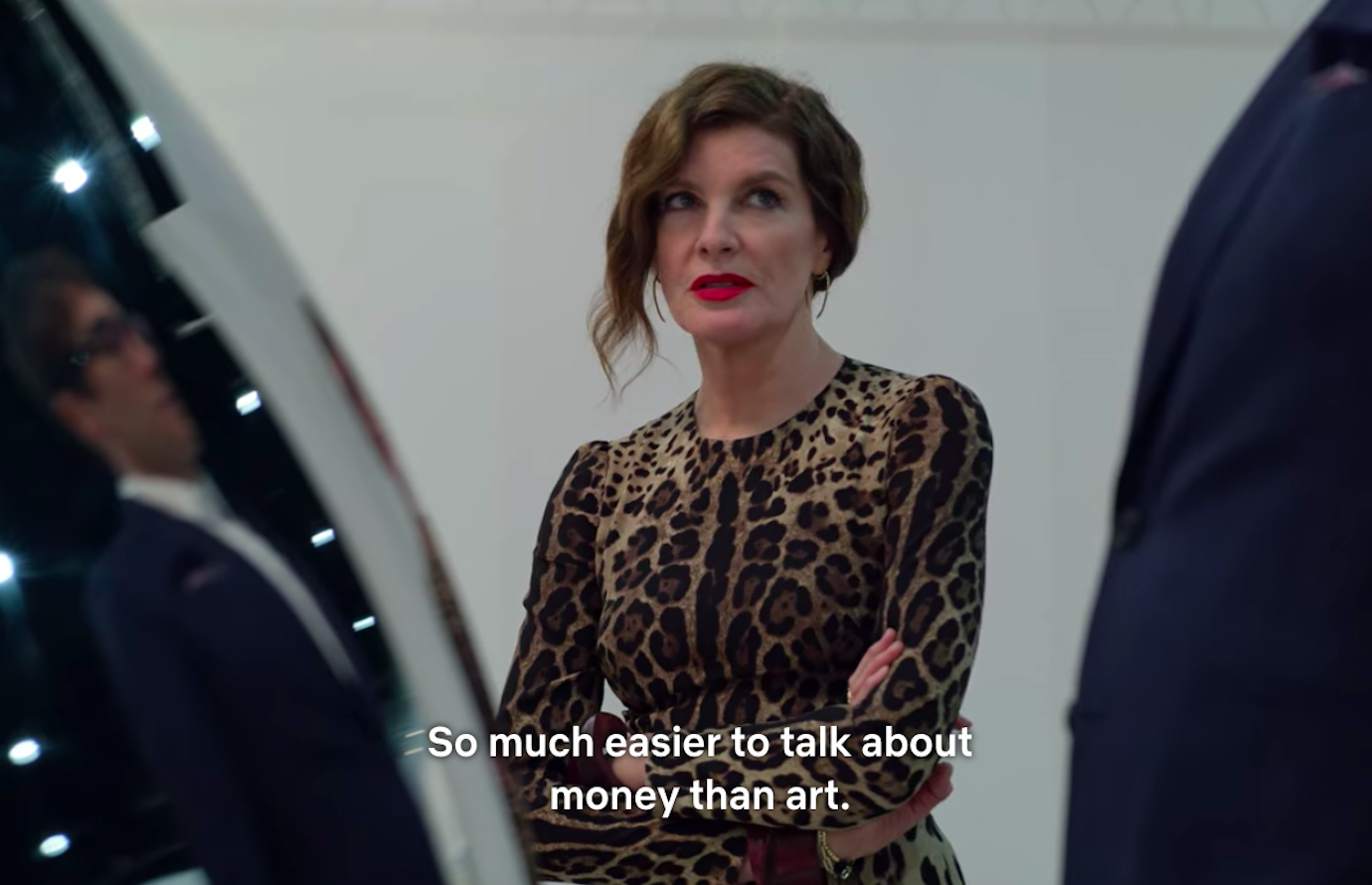
So much easier to talk about money than art.
— Velvet Buzzsaw, 2019
Art, at a certain point in its history, was thought to be a humanistic study, because of its ability to expand the ideas and the knowledge of the world. It wasn’t thought to be a career. We have to rethink how we deal with a discipline whose main purpose is to produce ideas, not to produce consumer objects.
— Charles Gains, From The Art of Making It, 2022.
Art is not bought, it’s sold.
— Dave Hickey, From The Art Of Making It, 2022
...commodity fetishism is a definite social relation... that assumes the fantastic form of a relation between things. The value of a certain commodity, which is effectively an insignia of a network of social relations between producers of diverse commodities, assumes the form of a quasi-natural property of another thing-commodity: money.
— Slavoj Žižek's ‘Sublime Object of Ideology’, How did Marx Invent the Symptom?, 1989
But I love the art world…” (Jerry Saltz)

“I love it too!” (Jerry Gogosian)
— From The Art of Making It, 2022.

The Art of Making it is a 2022 documentary on the North American artworld, starring such Instagram-famous artists as Jenna Gribbon and Jerry Gogosian. The “Making It” in the title refers to the career objectives and trajectories of the U.S.-based contemporary artist, from MFA graduate (Yale School of Art) to Mega art gallery (Pace Gallery). It is yet another documentary on artists trying to “Make It” in the big bad artworld of mega art galleries and art fairs. It’s not exactly Velvet Buzzsaw, and not nearly as entertaining, but it’s the same old story told time and again, with new actors to replicate the same advances and withdrawals from the artworld that went before. 

This time race, non-profit, education and even Native American art is thrown into the intersectional mix. But their edits feel obligatory not critical. Dealers, and in particular art educators, play the most central and complicated role in the documentary, made complicit and guilty by the art-student debt they perpetuate as actors within university profitable, but student fleecing, MFA graduate programmes in the States. Whereas sociopathic dealers seem to feel nothing at all; their wry smiles curled with knowing rather than emotion. Closer to Velvet Buzzsaw I guess.

Even though most of the artists profiled in The Art of Making It have committed to making it in the artworld, whether via MFA or Instagram, the artist testimonies of how commodity driven or racist the contemporary artworld is, in contrast to the dealer who replies to the question:

“Do you think it’s as tough as it has ever been for emerging artists, or do you think it’s tougher?” with,

“I don’t know, it always seems tough”, is telling.

Nothing has changed or will change because generations of artists are hellbent on trying to make it in this capitalist mode of making and thinking about art. There’s no alternative in their eyes, if the ivy-league education and gallery gatekeepers to the art market is your prize as an artist. In the eyes of the art establishment things haven’t changed, that’s why they are the establishment, hence “it always seems tough”. Artists new and old to the workings of the artworld establishment end up hating it, but also want to be part of it, which makes them hate it and love it all the more. 

The narrative arc of The Art of Making It hinges on one artist, Chris Watts, who is accepted to Yale School of Art, presumably aware before applying that Yale is the gatekeeper to Pace, Gagosian, Hauser & Wirth et al. He is dropped from the programme for reasons that are not made clear in the documentary. We are told he “turns up” and “experiments”, but perhaps too fast, too soon. A Yale lecturer corroborates Watts’ testimony when she, after first egotistically listing the artists who went Mega under her watch, admits those artists that made it weren’t the best students, but they understood the market and how to market themselves. It’s all relayed in a matter of fact manner by the lecturer, which makes Watts look either very naive or bitter, especially considering that he must have known what Yale could do for him in terms of marketability when he applied. 

Velvet Buzzsaw, 2019

The artworld described in The Art of Making It is a very distant and different cousin to the one we have here in Ireland. In the first few years of being an art critic, I was in splendid isolation. I was a local art critic. I wrote critically about what was happening around me, specifically in Dublin City. I was cynically productive or productively cynical. I knew what art was in relation to art history, and in terms of the experiences I had in the local art scene, which I navigated week on week through words. Sometimes I went abroad to experience art that was less cerebral or more visceral. I got to know the social patterns in terms of institutional partnerships between galleries and artists, curators and funding, education and galleries. When I noticed an artist could exhibit twice in one year at two spaces in the city, commercial or public, and this was a pattern repeated year on year, I began to question the consensus. (The absolute consensus among dealers surrounding an artist in Velvet Buzzsaw is not rational, it’s viral). When I noticed the rise of the profile of the curator in terms of financial and cultural cachet, I began to question the hiearchy between the art administration (curators) and the artist. But, thinking back, I was getting caught up in a democratic discourse, in which artists, unfortunately, think being an artist is a career, like the curator, a career that could sustain them economically in a country without an art market. “Art is not a democracy” (Gore Vidal). 

Jerry Gogosian meme

Writing critically on our little art scene sometimes feels like whipping a puppy into submission. There are no real bad guys or good guys here, just opportunists, careerists and narcissists like everywhere else. Artists are just trying to make art in an art scene supported by public money, funding that helps to get art made but not lives lived. Artists elsewhere are telling me to stop complaining at this point. We’ve got it good. And we do. Those that benefit from it.

But what does a publicly funded art scene look like? Without a private art market artists learn how to write proposals for public funding. It’s a skill, one that is graded in terms of a growing institutional reputation and dependent on a web of the institutional support structures and planning already laid out in advance. Dealers aren’t the only ones who build a stable of artists, so do freelance curators. There is a lot of meaning-making in the public funding process, which can cripple some artists who are in it for the pure pleasure or need. In a sense, public funding feeds back into the institutional architecture of the art scene. It’s a funding feedback loop based on specific criteria and public outcomes. The Irish art scene is primarily a publicly funded art scene, not a privately dealt one — the obverse of New York or L.A. “Annually, U.S. government funding for the arts totals less than $5 per person.”  Once again, we have it good.

Outside of painting, a lot of the art made under the rubric of public funding can be equated with PhDs in art practice, where artists do a lot of research into marvellous and hidden histories, which manifests into artworks that look nothing like their research, or worse still, look like research. Artists, from art school to public funding, are conditioned by the eminent obstacles of meaning and context. Art is full of meaning here, and it has nothing to do with sentimentality. There’s no dumb Velvet Buzzsaw art. Painting is generally smaller here, and thus more commodifiable, ending up on the handful of commercial gallery walls or basement racks of those few collectors who can afford a basement rack. Failing that, as an image on Instagram. And that’s okay!

A publicly funded art scene is, on paper, a beautiful and fair thing. But critical questions, speculations and imaginings abound. What if a private market of mega galleries and fetishistic dealers suddenly flourished in the city? And those galleries and dealers were as contradictory and complicit with the fluctuating market place of the corporate elite as the ones profiled in the The Art of Making It or Velvet Buzzsaw? Would art made under such capitalist hedonism be more reflective of the world we live in, rather than the marvellous excavations into the past? We have a good art scene, and we have good artists, but sometimes too good. Sometimes the art made here lacks presence and prescience or pure dumb risk.

Yale School of Art.

In The Art of Making It, it is not surprising to hear artist and educator Charles Gaines say the following (even though he is represented by one of the mega galleries Hauser & Wirth, and whose work fetches $100k plus): “Art, at a certain point in its history, was thought to be a humanistic study, because of its ability to expand the ideas and the knowledge of the world. It wasn’t thought to be a career. We have to rethink how we deal with a discipline whose main purpose is to produce ideas, not to produce consumer objects.” Gaines' lucidity in terms of his perspective on what art is and is not is forthright if contradictory. You can imagine MFA students being spellbound by his message. We make ideas to challenge consumption not objects to perpetuate consumption. The artist of today is able to compartmentalise their contradictory roles in the artworld through a cognitive dissonance that accepts rather than denies the conflicts inherent in the mismatch between being an artist and existing in the capitalist realist world of commodities. No matter how rhetorical or dissonant, Gaines is criticising the commodity driven artworld from his role as an educator, not as an artist represented by one of the biggest commercial galleries in the world. Artist and educator Andrea Bowers plays the same role in the documentary, who, after asking a studio assistant what kind of college debt he has — $400k — admits to quitting teaching “a couple of semesters” because she “cannot — literally — strap my students with that kind of debt”. 

That is why the interview with Pace Gallery CEO Marc Glimcher is so funny. In that he comes across as someone who was mistakenly rolled out by the Pace board, to then proceed to openly discuss the manipulative mechanics and material hedonism of the architecture of Pace, from the gallery door costing $120 million, which he doesn’t confirm or deny, to the private viewing room where “we give you tequila”. Hilarious. It’s telling that Glimcher chooses poor and tragic Van Gogh’s Letters to his Brother Theo as his favourite book among the hoard of blue-chip artist catalogues that crowd one wall of the white mausoleum. This episode is in high contrast to the non-profit art space The Mistake Room, the director of which reflects on how much he should disclose about the subject of race in the artworld. What might be perceived as Marc Glimcher’s endearing openness, is power at play. He is on top of the pile. Everyone knows what’s going on. We shrug at Jerry Gogosian’s memes because, as curator and writer Helen Molesworth says, Jerry Gogosian “is one of the very few places where there’s a cut in the top of the  pie to let the air out of how fucking ridiculous the corporate for-profit world has decended, on this thing that used to be bohemian, radical, underground, and actually totally cool because it was those things”.

Pace Gallery CEO Marc Glimcher

A critique of Pace Gallery or the Gogosian is as pointless as a critique of capitalism — it goes on. Andrea Fraser, who propagates an institutional critique of the artworld and its institutional mechanisms, is always meta in her delivery, delivered as it is within the very institutions that bear her criticism, while ironically applauding it. Once Fraser said “the artist is an institution” as a corrective to being too literal in terms of big white buildings and black-suited agents in her critique. And yet Fraser is short sighted, or just narcissistically stating her own position as an established artist. Fraser is an artist that has become an institution by being accepted by the institution she critiques: the artworld. Only those artists that become institutions by signing up, or being accepted or sold by the artworld are institutions. Everyone knows the artworld at the levels profiled in The Art of Making It is full of contradictions and corruptions. But so is every other industry at those levels. You just wish it wasn’t the case with art. But business is business. 

Helen Molesworth’s nostalgia or mourning for the bohemian art scene of “cool and radical” is also something to be questioned. Is that what it was, cool and radical, rather than the corporate and professional artworld of today? Or was it underground because it couldn’t be mainstream… yet. As Mark Fisher says, Joy Division didn’t want to be identified as a subterranean alternative to the Beatles, “Joy Division wanted to be the Beatles, that’s what made them special.” In other words, Joy Division was competing with the mainstream. They had a bright North to compete with, even though the underground, the cult, would be the dark south from where their music and legacy would spring forth. Subcultures bathe in the shadow of the mainstream audience, a subterranean shadow that depends on the bright lights of the mainstream to colour its deep shadows.

Towards the end of the documentary, in a conversation between Pulitzer Prize winning art critic of the New York Magazine, Jerry Saltz, and Jerry Gogosian (aka Hilde Lynn Helphenstein), both admit to loving the artworld. I get this, even though the artworld is a fantasy from this distant perspective. But perhaps it’s a fantasy for all those invited too. To read too deep into Jerry & Jerry’s outpouring of love for the bad artworld, considering the context, is, in this instance, helpful. It underlines how contradictory and institutionalised the actors (artists, curators, writers) are in the artworld. Without the artworld (as it has been since the 1980s), Jerry Saltz and Jerry Gogosian’s brand of art criticism, which typically focuses on the negative market mechanics of the New York Art World, would never be. Cultural critics aren’t born, they manifest out of a collective discontent with the workings of culture vis-a-vis capitalism. Jerry Saltz and Hilde Lynn Helphenstein are bad artworld products. You don’t pick your Mammy & Daddy. Shit. You don’t even pick your name.

Hilde Lynn Helphenstein (aka Jerry Gogosian)

The Art of Making It opens with Sebastian Errazuriz’s horrible installation of 3D-printed Greek sculptural parodies of Elon Musk, Jeff Bezos and Mark Zuckerberg entitled “The Beginning of the End.” Towards the end of the documentary the disembodied  narrator, who adds a few ideological words from time to time, claims “There’s no society without art. It’s not because we like pretty things. I believe it’s because those societies that have been able to remove art, haven’t cared about art, never made it, they extinguish themselves.”  It’s a strange thesis, one that places the burden of civilisation on the shoulders of culture. No.

This is an old idea, not a new one. Even though religion has been subjugated by capitalism in terms of cultural patronage, its dissemination and reification in the homes of the elite, culture’s promise, in the eyes of those institutions who value it — the gallerists, collectors, curators, Jerry Gogosian — is to create a foundation for civilisation to live on and them to live off. Jerry Gogosian was crowdfunded to visit the Venice Biennial this year. On hearing this on an Instagram post, one person commented “I thought you were independently wealthy?” Jerry’s reply: “Shouldn't I be paid for my hard work?” Fair enough. In The Art of Making It Jerry Gogosian, in defence of the artworld dealers, says, “we also need people like them”, and then references the Renaissance banking and political dynasty of the Medici Family. 

Jerry Saltz with a Jenna Gribbon, from The Art of Making It, 2022.

Culture, at its most civilised best, is to lay to rest in the museum. One commentator in The Art of Making It claims that art is the only thing left after we are all gone; another claims that those societies that “remove art… never made it”. Both claims are inflated and sweeping. Societies or governments have always made choices concerning what art is, what art is not, and what art should represent a society by way of the vagaries of taste, the market or censorship. Adolf Hitler chose Greek and Roman art over “degenerative” art, but he didn’t remove art tout court. Art had a place in Nazi Germany, albeit to propagandise his war machine. Art always has a purpose. 

Art is the ticklish subject that unsettles and unnerves the foundations of civilisation; art is not the foundations of civilisation. Yesteryear an artist was accepted, today they are not. Art is undead. Art is not a thing that rises its head from the grave of civilisation to one day, some day, shoulder civilisation in the museum, where is stays still in a contextual paralysis, only to be recontextualised in dusty history books by dustier art historians. The discontented of civilisation have always been artists. Artists are either too soon or too late, premature or tantric. They never really wanted to be in a museum in the first place. All they want is the present, a present that recognises their efforts to shake the institutional foundations that ignore their liveliness until they are dead. Artists don’t tell the future, they tell the present. It’s just that everyone else is in the past. Catch up. 

James Merrigan

TEXTS

On Mourning Mark Fisher Mourning Culture

MARK FISHER

Strumming my pain with his fingers
Singing my life with his words
Killing me softly with his song
Telling my whole life with his words
Killing me softly with his song
— The Fugees, 1996
Much of listening to dance music consists of trying to recover a feeling.
— From 2019 New Yorker article on the music of Burial
…mourning is always already political…
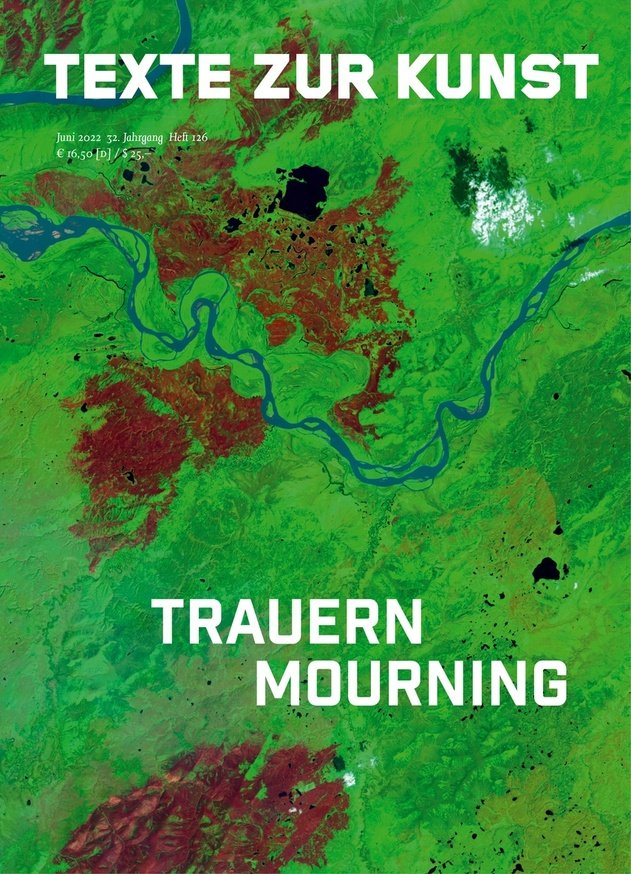
— From the current (June 2022) issue of Text Zur Kunst with reference to Judith Butler
They say, the problem with nostalgia is, that it makes us overrate the past. But I think the problem we have is overrating the present, and underrating our own dissatisfaction with the present.
— From Mark Fisher lecture 'The Slow Cancellation Of The Future'
I don’t want meaning… I just want things to work better.
— Mark Fisher, DOCH lectures, 2011

Cultural critic Mark Fisher’s self-reflexive question in a seminar over a decade ago, seems a pathological question to ask today. “Can one make negative judgments about the present moment? Or is any critical judgement being exercised about culture somehow inherently oppressive?” Mark answered with the following: “Certainly one can make negative judgments about the present moment. And to pursue this dialectic loop to its full extent, the reason why culture is bad is because there is not enough negativity.”

For the past few months I have been rereading and listening to Mark’s particular brand of awkward, intense and open criticism of culture, voiced under what he perceived and felt was the overwhelming pressure of capitalist realism, and his mourning — not nostalgia — for what was.

Looking back on the capitalist realism of Mark Fisher (aka k-punk) there is a real sense of disenchantment, melancholy and mourning for what was, what is, and what will be… or never be. His writings and lectures show a deep and concentrated effort to confront the impossible present with an equal measure of criticism and emotion, but cognitive and weary of nostalgia to substitute or obfuscate action in the present. He described his writing project in toto as: “Revealing the inherent negativity of the moment in which we live.” What a slogan for our times! With little to valorise in respect of cultural resistance or criticism in the times we live in, Mark’s impassioned and heartfelt plea for an alternative seems even more relevant today, five years on from his death by suicide.

Before I continue, it is important to clarify the difference between nostalgia, that psychological phenomenon of the good past that arrests our attention in the terrible present, when we can’t face the contingencies and uncertainties of the present; and mourning, which like melancholy, is something we feel and carry (over time) at a deeper and heavier level than nostalgia. Mourning is both individual, collective and “political” in Judith Butler’s terminology. Mark could be accused of nostalgia for the UK punk and post-punk periods, when cultural resistance was part of the dress code, lyricism and rhetoric. So we must be careful here in respect of nostalgia and mourning, and to not conflate the two. Nostalgia stems from negativity, but always negates negativity, whereas mourning embraces negativity. Nostalgia is fetishistic disavowal at its most pernicious, where fantasy and defence dance around the negativity of the present without confronting it head on. Mark confronted negativity head on. He is a mourner.

As a cultural critic and naturally consistent mourner, I have empathy for Mark’s project to reveal “the inherent negativity of the moment in which we live”. Truth be told, I am looking back at the art scene with less social mobility and energy for the other in terms of art criticism as a father of two young children. You give a lot of yourself as an art critic. It’s not a sociable condition. Especially when you approach and broach negativity. But as Mark says: “The motor of culture is negativity and dissatisfaction.” 

You can find countless definitions of Mark’s capitalist realism online, such as this suitably fatalist one: “Fisher proposes that within a capitalist framework there is no space to conceive of alternative forms of social structures, adding that younger generations are not even concerned with recognising alternatives.” And yet, countless times in lecture theatres around the world, Mark repeatedly admitted that a definition of his notion of capitalist realism is always out of reach or date, adding that the word capitalism is not a word that the general population use to define their place in the world. In a sense, Mark’s difficulty in defining capitalist realism is the definition of capitalist realism itself, as something so deterministic, tacit and naturalised in society, that it consumes and conjures itself while we consume and conjure capital through it. Capitalism is self-perpetuating. Capitalism is the parallax gap in subjective judgement.

Mark supplemented his vanguard assault on the wall of the present with music. Music set the mood and tone for his lyrical klaxon call for change or, at the very least, a post-capitalist alternative, whatever that could be... Music was his way into a distracted, disenchanted and disenfranchised generation (him included). Music equates to mourning in Mark’s awkward lyricism. Sometimes he introduced a lecture, not with an academic quote, but with songs from the electronic, dub-step, garage, drum and bass, or ambient genres. “Much of listening to dance music consists of trying to recover a feeling.” There was something impassioned about his approach and plea. One heartfully and artfully attached to the idea of change or release from the techno-capitalist time he found himself unhappily thrown into, but still eager to have a dialectic relationship with, even though, on the retrospective face of it, it hurt. He wrote towards an alternative to the growing cultural malaise, but always with Fredric Jameson's remark whispering bracingly in his ear: “It’s easier to imagine an end to the world than an end to capitalism.” Mark Fisher hung himself in 2017. He was 48. 

Mark comes to mind now because I find myself listening to a growing playlist of disenchanted songs that he used as a sonic backdrop to his writings, from Burial to The Caretaker. I think it’s an age thing, and something Mark (and every cultural critic worth their salt) comes up against time and again, in his critical articulations of the present as an ageing theorist, from a transitional generation – vinyl to digital – in the accelerated time of the internet. Once again, he found himself in the gap between what was and what is. He wasn’t able to surmount the contingent uncertainties of the present, no matter how he tried. And he tried. He really did. 

Mark was caught in what one of his favourite philosophers to cite, Slavoj Žižek, calls the “Parallax Gap”, a temporal and spatial gap between what Kant referred to as the phenomenal world (how we perceive the world through time, space and causality) and the noumenal world (the world separate and not dependent on the human to perceive it). It is in this gap where philosophy disembowels itself; a subjective space where the internal world vis-a-vis the external world is obscured by the very subjectivity of the one trying to see. We are in our own way most of the time. We are all internally blind to the external present, and great insight is always blinding. And when you throw history and emotionally charged attachments into this philosophical architecture, as Mark did, the eyes in your head become two pinpricks in an infinite universe amidst a dilating night sky.

My growing playlist of Mark Fisher and electronica comes at a time of personal disenchantment and distance from the local art scene. This disenchantment has many sources and perspectives: not living in the city; co-curating an artist-run space on the periphery with a dwindling audience; looking at the art scene through the lens of social media. From these warped perspectives and distance, the art scene looks like it’s receding into a virtual homogeneity, that is always moving towards something, producing something, being part of something, winning something, looking forward to something… something… something… some  thing. Perhaps online is Kant’s noumenal world made manifest.

The only moment in recent times we had a reprieve from this forward-moving virtual onslaught toward something — always good — was during the pandemic, when artists retreated into nostalgia on Instagram, which, in a manner of speaking, was just another mode of phantasmic production. You have to wonder what all this production and waste is for, or goes toward. Indeed, artists are the best producers. Content, in their hands, becomes a sublimation of living. Marcel Proust’s 4000+ pages epic In Search of Lost Time is an ironic testament to that fact and fate. The artist’s life is a life of looking intensely at life while fearing living it. Memory and mourning is all that remains for the living. 

Living has always been the capitalist crux for the artist. We live in a society that feeds off culture but is unwilling to feed artists. Instagram’s positive-production does not tell the story of artists barely able to sustain a life in an untenable economic urban environment in terms of living and studio spaces in the city. Artists are leaving the city. There is a cultural loss in their exodus. Artists are always better, artistically and psychologically, together, as in art school. Mark Fisher described this positively as the cultural concentration of the city. That said, the artist’s lifeworld has always been conditioned and shaped by society and capital, by the shifting housing market in the city. Mark mourned the collective no-wave moment, which effloresced in the empty capitalist husk of New York in the late 1970s. I myself return to 2011, during the financial crisis, when the original Basic Space Dublin made collective and solo excavations in the city with enigmatic and dialectic ambition. Perhaps we all have moments that define culture at its peak and trough. 

Underground, 20/11/2011, Basic Space, Vicar Street, Dublin 8

The recent exodus of artists from the city and real life has led to a trenchant individualism, as artists become dispersed in the countryside, to only find a phantasmic community and solace on social media. In this respect, the property market is the determining factor of the fate of culture, the artist and possible resistance or alternatives in the city. Mark was speaking about the cultural ramifications of high rents and new laws against squatters in the UK long before the rise and fall of the economy; and how the idea of “public has become pathologised” (like criticism) before the exodus of artists from the real world to Instagram. Although Mark did warn “it will only get worse” in terms of our physiological and psychological dependency on social media, I don’t think he could forecast how bad it would become in the preceding years after his death. 

I emerged from art school as both an artist and art critic during the global financial crisis in 2008. Even though public funding for the arts was obliterated, art centres temporarily closed, and our long-standing visual art magazine Circa was no more at the very moment I started writing for it, there was an efflorescence of damp and wall-crumbling artist-run spaces. DIY culture replaced capitalist realism for a moment. Artists made exhibitions in their city bedsits; artists became collective and unnamed in exhibitions. The momentary glitch in capitalism in 2008 forced artists into urban cubby holes that had no in-house graphic designer or aspirations for vinyl on crystal-clear gallery windows. Framing was not a thing like it is today. Things were desperate, even depressing, but they were exciting too. Raw. And this is not nostalgia, it is mourning. I wrote about my excitement and the possibilities at the time of Basic Space, without the fantasy or defence of nostalgia. The present became a future possibility for an alternative. 

Today, especially through the lens of social media, there is a constant, libidinous, low-level negativity that never reaches a peak of outburst under a suspicious self-satisfaction. Negativity is not allowed on Instagram for fear of disturbing the status quo of passive closed smiles hiding rictus rage and envy underneath. Well, that’s what I imagine instead of the perhaps more likely settled inter-passivity. Artists exist on a feeding tube of virtual highs and lows that prevent any change or alternative from taking place in the real world. The world is flat.

The momentary exodus from Instagram to VERO last month was a case in point. It showed a real want for an alternative in terms of social media platform. But in a sense, such a migration, same for same, is replacing one goofing off for another goofing off. We cannot imagine an alternative to social media in the real world because it doesn’t exist. Real life is hard work, awkward and embarrassing. Sometimes you can’t remember the name of somebody you meet, or the word for something IRL. Real life is pathological in comparison to the fluency of online, where everything is known, not guessed or imagined. The so-called democratisation of culture has led to a levelling, where resistance (what Mark called in his punkish terminology “war”) is not on the protest cards. We are unwilling to risk our individualism or identity politics for the fantasy of we. 

The state of play in our own city sees a new-wave of commercial gallery gambits, with painting (as always) as their pawn. Atelier Now’s mission statement opens with a line that is both a criticism and commandeering of the idea of the “art world”: “The Exhibition Programme at Atelier Now throws open the doors of the art world”, obviously inferring the art world is a closed shop elsewhere. The words “welcome” and “accessible” is the new branding argo for commercial galleries like Atelier Now and Hang Tough Contemporary, where ‘sleek’, ‘vibrant’ and vinyl-clad windows is the aesthetic. Dublin’s locally established galleries seem sacrosanct in comparison to this new sleek and vibrant vision, where clean and big gallery windows look out onto the streets, rather than turning their backs on plebeian pathways. 

Atelier Now and Hang Tough Contemporary would have been viewed years ago by ambitious art school graduates (like me) as a particular type of gallery that represented artists, primarily painters, never mentioned in art school, but who sold paintings. However something has changed, what Mark cited as the “threshold of relevance” has been reached. Hang Tough Contemporary is now on the tip of young art-student tongues, whereas the critically and commercially reputable four or five galleries in the city are viewed unattainable, detached and elitist. Today artists are open (with the usual trepidation) to exhibit in such low-concept galleries, where a premium is placed on the quantity of framed artworks on walls over some high-minded conceptual conceit, that creates anxiety in the mind of the visitor rather than “well being”. Now galleries like Hillsboro Fine Art look high-concept in comparison. The claim that Instagram has democratised the art scene has bled into the physical art scene, where a hybrid blend of conceptually canny artists and others can be seen displayed together in formal inclusivity with no dialectic at play. 

Voicing such criticism these days feels like conservatism. “Can you make negative judgments about the present moment?” I am not denying the existence of artist and curator-conceived moments of formal and conceptual invention and risk taking place in the city and beyond, through publicly funded Bursary or Project Awards, that are not concerned with oak frames, or art objects for that matter. But there was never a time, on my watch anyway, that a commercial gallery like Hang Tough Contemporary got this much attention by high-concept artists, or reached this “threshold of relevance”. Perhaps there is nothing to lose and everything to gain? Except enigma.

What was not fully resolved, and perhaps more enigmatic for that very reason, was Berlin Opticians, which lapsed its hybrid activities as an online and offline gallery with a stable of 10 artists in 2021. Not since Basic Space, a decade earlier, had a visual art entity activated a truly dialectic moment, one that independently changed how art could navigate and negotiate the dialectic world of art, from online to offline, concept via market. It was perfectly weird and contradictory.

I think in these contingent and uncertain times of art making and its dissemination online, artists that question their art's existence in terms of criticality, antagonism and resistance (and not to forget erotics, what both Mark and Susan Sontag claimed was missing from art both in formal and descriptive terms respectively), is art at its best and most necessary. Berlin Opticians was an entity that did just that, as it reflected the present moment, when art has become as much an online experience as an offline one.

Berlin Opticians was less punk than those critically self-reflexive and complicit New York iterations (Andrea Fraser’s for-profit Orchard Projects or John Kelsey’s Reena Spaulings), which were and are art spaces of ironical resistance to and compliance with the artworld market, that recycle market critique for its own promotional and monetary needs. Berlin Opticians was a brave move, and it took a curator to make the move: Marysia Wieckiewicz-Carroll. In 2018 it opened to a wave of crowded and curious anticipation. Curiouser and curiouser, it closed its doors online and off in 2021, while the streets were pandemic empty.

Today, the commodification of art seems more commonplace. Artists are always busy — a word I hate coming from the mouth of an artist. Busyness/business smacks of everything that Mark Fisher thought was wrong with culture. The perception that art school is for slackers should not be a snide remark borne on envious transference, but the truth. The romanticism that surrounds 1990s slacker-artist exemplar Laurie Parsons, is based on the fantasy that an artist can say “I prefer not to,” rather than continually proving their worth and value in the face of their parents or society through high production. What does it mean anyway when artists say they are busy? For what? For whom?

The artist’s need to fit in while being out of joint with society is the paradox of the artist’s lifeworld. But that’s what makes the artist special: the dialectic that takes place in their work and their place in the world. Within the figure of the artist, an inherent resistance and criticism exists in their work and their lifeworld. The artist embodies an alternative, they don’t need to profess an alternative; they are resistance embodied.

Mark Fisher undoubtedly staked a critical claim in his neoliberalism and social media bashing. Even though he made a self-reflexive effort to be dialectic, like Žižek, who “would prefer not to” take sides in the self-perpetuating paradoxical gaps of his own making, Mark took a side, sometimes to the point of one-sidedness. But he truly felt and believed theory could tremble the foundations of society so culture could emerge again in its antagonistic form. That is what set him apart: his intimate relationship with the words that trembled from his mouth and onto the page when the tempo of his criticisms sped-up to catch the conscience of culture. That said, Mark was fighting a losing race or war against the present, where and when the tracks of capitalist realism were already laid down well into the future, lying silently in wait, undisturbed by the vibrations of Mark’s voice from the past. 

What makes culture culture, and civilisation civilisation, is culture doesn’t survive its momentary explosions and efflorescence in civilisation. Today’s cultural worker’s obsession with archives, history, conservation and legacy is on the side of civilisation. Mark Fisher was on the side of culture. And culture, at its best, is something that evades appreciation in the present, but haunts as mourning in the future present. 

Thank you Mark for making culture tremble. 

James Merrigan.


Other words on art

VERO

So. Here I am, testing the waters. Night swimming in turquoise-cobalt blue with no horizon, islands, or stars in sight. It is the 1980s; After Eight. The deep blue future of Blade Runner finds itself under a fluorescent lamp. The airport duty free sells perfume & pop. The icey neon from the nightclub reflects in the hum of the wet-backed streets.

Even though VERO has a smudged lipstick & slinky-clad aesthetic, the word “vero” is Italian for truth. This dreamy landscape is the veil that Squarespace photographers like to filter their images through. Images flirt for attention here, even though the dopamine echo has not returned yet from the ocean coloured by my disembodied profile image.

Why here? Why now? A few tentative posts by artists on Instagram got me curious. We have come to tolerate & depend on Instagram as artists out of a perceived necessity to be present without being physically so. It is a metaphysical & existential problem that we haven’t yet fully faced. Blaming the algorithm is just a fetish, but one that might free us from the fetish that has become an obstacle to experiencing the ugly whole.

I’m here, but not here, wondering if this is another bad migration. First it was Facebook. Then Twitter. Next Instagram. Now VERO (kind of). What is this? What I have learnt is: a chronological feed replaces the algorithm of the Facebook empire; no ads; if the migration grows, subscription fees are eminent; clickable links & more allowed in posts; no push notifications; hashtags still exist; control over who sees particular posts through the “Close Friends, Friends, Acquaintances, Followers” categories. You can even choose a profile image for three of your multiple personas.

In 2018, during the Facebook leaks & probably lots of other reasons to do with the drifting & suggestive social media herd, VERO user numbers climbed from 150,000 to over 3 million in just one day (VERO has been around since 2015). Four years on, the murmuring of a current cobalt-turquoise wave is, from my algorithmic artworld perspective on a very localised level, significant. Artists are talking. The research and criticisms will come later & become more politically transparent if the platform becomes more popular: the accusations of Russian developers of the platform years ago will resonate more today; not to mention the Saudi Oger claims of migrant atrocities under the family name of VERO CEO and co-founder, Ayman Hariri.

Two days ago, artist & art critic Matthew Collings wrote: “Get onto VERO, it's supposed to be good, might be a solution to algorithmic disaster afflicting ASP people on Instagram.”

ASP stands for “Artist Support Pledge”, through which artists sell their work for €200 or under. The pledge part involves the selling artist pledging to buy an other artist’s work at specified sales milestones. On the ASP website they share their algorithmic grievances:

“The new format and algorithms are not working, and we have had enough. The old Instagram worked, that’s why we used it. It fueled business and allowed us to connect with friends, family, and colleagues from all over the world, regardless of nation, race, gender, or wealth. It allowed us to speak openly about things that mattered and things that didn’t. It was our choice, and we enjoyed and prospered from this freedom.

What we want

•Equal status for photos and reels (let us decide what we want to post and see).

•Give us back the old algorithms. The new ones DO NOT accurately connect us to our audience.

•Remove the suggested reels. They have made IG unusable and stopped our followers from making meaningful connections.

•Remove the black background and text overlays. They’re ugly and confusing.
— artistsupportpledge.com/

The “ugly” criticism is interesting here, feeding into the whole capitalist mode of seduction. And maybe the algorithms & reels are a perfect fit for other business models, modalities or manipulations…

So what does this mean for artists? I think Matthew Collings emphasis on the marketing & selling of art, even if ASP is not as explicit as Jerry Gogosian's art-market obsession, is the wrong reason to migrate elsewhere. Instagram, ironically, has objectified art into a commercial fetish rather than experience. Marx, not Freud, was the orginator of the fetish.

Before I thought Instagram was bad for artists but good for art criticism. Once you could survey the explicit institutional & curatorial affiliations & hyper-networking by artists. Now the algorithms are so persistent & self-inflicted that the cavity of the echo chamber has been reduced down to a wall with barely enough space to stand.

It takes a lot of willpower to leave Instagram. Matthew Collings response to the comment “Are you leaving Instagram?” under his VERO post is telling: “no not yet.” Not never! He’s presumably selling, & with a network of over 10k followers, sold. Instagram has become more instrumental to being an artist than exhibitions in the lifeworld, which have become empty showrooms that promise reality without an audience.

So here I find myself swimming but drowning in Why’s? Why do we need to do social media as artists? Why are we doing it to ourselves? If it is a shop, then fair enough. If it is to feel or imagine you are part of a community of like-minded people, who find themselves outside the societal & institutional system so you can imagine allies in the virtual mist, wonderful. But I don’t think any of these reasons are the real reason.

Against this localised & nebulous backdrop, art experience in the lifeworld is starting to look a lot like the awful Katharina Grosse exhibition at the Louis Vuitton Espace in Venice I experienced a few months ago, where a large pearlescent blanket was found draped over the gallery walls, floor & some barely perceptible readymades, under the watch of two uniformly dressed-in-black invigilators, adjacent a shop of gross (pun intended) books & video promotion staring Hans Ulrich (again) Obrist.

Installation view of Katharina Grosse Apollo Apollo at Espace Louis Vuitton Venezia, 2022.

Artists excuse Instagram for its so-called democratising effect on the artworld, where artists achieve visibility & agency through a well-crafted image, even though it is a fantastical augmentation & enhancement of the real, ugly & awkward thing in the world. The only exhibitions that sell to a willing audience these days are the ones that promise an experience. That is why commercial gallery exhibitions with a 70-30 percent ratio of white to art objects is a thing of the past. Instagram is the new commercial gallery.

It is strange that it has come down to a decision between social media platforms rather than an outright dismissal of social media. There is no escape from the algorithmic loop even if it is chronological. Of course, some artists continue to make art without a dependency on social media, but it's rare, considering those who are visible in the physical art scene, more often than not, have an Instagram account, no matter how many times they profess to “hate” Instagram.

If we have decided that we need social media in our art lives, for whatever twisted reasoning, then VERO (or similar, as the exodus currently takes place after the Saudi Oger & misogyny claims come to light ‘again’) may be a good alternative. But if we decide to give it all up, would we make greater efforts to experience art in the lifeworld, or seek out non-avatar allies to make art once again a social, discursive, critical & physical event, that is not archived, documented or dopamine infected through empty symbols? Or is this just ideology or nostalgia speaking, as the artist cannot extricate themselves from the attention & validation they so clearly think they need since signing up to this thing called social media. “True Social” is a scary slogan to begin (and end) with.

James Merrigan
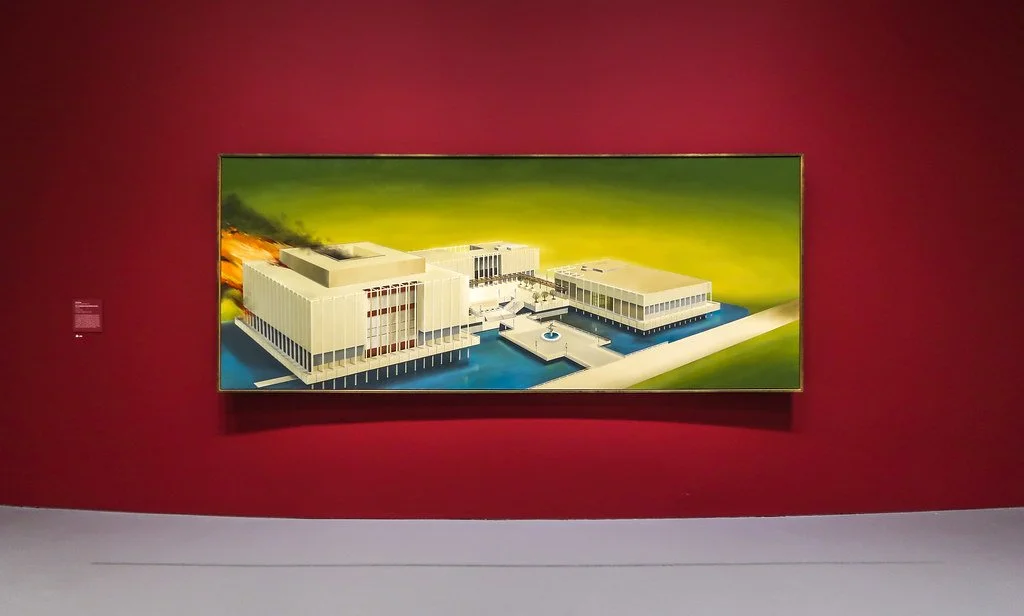

PREVIOUS

SEEDIISM

Editions Lutanie (Instagram post: July 7, 2022.

It’s 1986. An art critic is sharing his opinion of another art critic with another art critic…

“…..The other thing I think is important about Rene Ricard is that he represents a kind of sordidness that it’s important for the art world to believe that it is still capable of. The art world is supposed to be alienated, to be on the periphery—and it’s not. In fact, it’s very much integrated into the mainstream of culture. It’s not that most people like art; rather, it’s that the art world has found a secure place in ordinary life—which goes against all the avant-garde’s claims to being adventurous and in opposition. At a time when artists bring in architects to design their lofts, a flaky character like Ricard is very important. He makes it more believable that art is odd and weird and challenging.” (Carter Ratcliff in Janet Malcolm’s A GIRL OF THE ZEITGEIST—II, The New Yorker, 1986)

That was 1986; this is 2022: just saying.

Now… in all the years writing art criticism I have never once used the word ‘seedy’: believe me I’ve checked. From childhood to adulthood I remember coming across seedy situations without the vocabulary or experience to name them; situations when you cross the threshold of quotidian cleanliness to dirty diabolical, innocence to experience.

For instance.

In the village I grew up in, there was this back-alley video store that I hung out at, day in, day out. Culture was thin, and not on the surface. In hindsight the video store was super seedy on the spectrum of childhood innocence. You could spend hours there reading the blurbs on greasy-backed VHS video cassettes with their tacky images and tackier textures; those sheepish customers that you never heard asking for the under-the-counter-porn, but were edging in the aisles building up the seeds and courage to ask: desire beats denial every time.

The word ‘seedy’ came into my sights when I was trying to organise a location for the book launch of Madder Lake (2016), what one IMMA curator referred to on the night of the launch as the Irish art scene’s first book of porn. One of the artists involved suggested a nightclub or sex club in keeping with the tone of the DEEP—SEATED series of public and private conversations that took place in 2016 at Limerick’s Ormston House, Cork’s Crawford Art College, and Dublin’s Temple Bar Gallery & Studios. Long story short, psychoanalysis undergirded the conversations which led us into all matter of things sexually and critically charged. Even though the events where public, we were mostly sitting by ourselves, confessing our private desires under the white page of our artist statements.

There was something else too.

I had recently read an article in The New Yorker—circa Down and Out in Beverly Hills(1986)—that follows the trail of Rene Ricard. Ricard was a mover and shaker in the New York art scene after emerging from the Warhol Factory fabulously scathed. He was also a maker through his writing, as well as cavorting with such bluechip artists as the One whom everyone loves to hate, Julian Schnabel, and the One whom everyone seems to love, Jean-Michel Basquiat. Beside all that, Ricard was blessed with a Wildean wit and equipped with Cupid’s bow to deliver a line that kissed the mind and bit the lip. The author of The New Yorker piece gives us an image of the 1980s New York scene along with Ricard:

“On this night, the Palladium has been turned over to a party for Keith Haring, and it is filled with beautifully and/or weirdly dressed people from the art world and its periphery. I come upon Ricard in a room that is apart from the discothèque proper, called the Mike Todd Room, which has a large bar, small marble-topped tables, and wire-back chairs, and is where the celebrities of the art world like to congregate. Ricard, resplendent in a white sharkskin suit, is sitting at one of the tables, in a state of high, almost incandescent excitement.”

When you go a little deeper into the world of Ricard, his exploits (and prose) have a dirty romanticism to them when contrasted with the wholesomeness of, for lack of a better known quantity, our very public, albeit virtual, art scene. Saying that sounds like I’m placing some value on seediness for its own sake, and that the art scene is a big ivory boner, always auto-polishing itself to appear publicly toothy, but underneath, privately decayed. Maybe…

The only time the artworld is branded seedy is when, in the global news media, there is a corrupt gallery director or art collector involved in some shady dealings. “That, sadly, is a market at work, and suppressing it would only bestow the seedy glamour of the underground.”

Taking into account that the meaning of words change over time, especially in a time of word hijackings for the protest and pronoun economy, ‘seedy’, even when #seedy is used on Instagram as the personification of being #dirty/#sexy, the word still retains the essence of those handed-down meanings, from originally defining a flower that has lost its vibrancy after shedding its seeds, to being the adjective that loiters around sex shops.

Personally I’ve never personified the word seedy in casual speech; the word has always been embedded in a setting rather than a person, like the word ‘uncanny’, i.e., David Lynch’s seedy undertow that threatens to take you away or save you from the shore of hyper normalcy. TV taught me everything.

I am still not certain why I have decided to side with seediness here. Perhaps it stems from seedy not fitting in; that seedy is another aesthetic that art cleanly rejects or lacks. Strange thing is, I would call a lot of Bruce Nauman’s art seedy, but Paul McCarthy’s less so. Bruce and Paul get me thinking about how art students sometimes embrace seediness, but if they graduate into the art scene proper they generally clean up their act. Maybe seedy, like it’s namesake, is small, undramatic, private, contained within a pod until its efflorescence as a public, natural ornament to consume.

In my case, it could be the case of being around too many white walls and artist statements so that seedy emerges in the cracks of my consciousness as something lacking.

The DEEP—SEATED discussions of 2016 opened up a discourse that was less concerned with discipline and impressing on the public a notion about art and the artist being public and wanting to be public. In a sense it was about reigning it all in; not shedding the seeds so the vibrancy and potency remain contained: “sub-cultural” intimates underneath culture, not flagrantly for all to see. There’s something intimate and close quartered about seediness that can’t go beyond the width of a video store in some back-alley in some backwater village.

I think what Glenn Frey of The Eagles said about Hotel California says a lot about continuums of experience and exposure: “It was a journey from innocence into experience.” It’s also like what pornstar Puma Swede says in her memoir My Life as a Pornstar: “Then, while the rest of the [porn] staff was eating dinner, we went over to US Video, a notoriously seedy porn shop…”.

James Merrigan
GENERATION PAINTING

Ciara Roche, Still 12 (after Halloween 2018), 2022, Oil on paper,15 × 21cm.

IS [‘PAINTING’] A WORK OF CIVILISATION OR A WORK OF CULTURE? IF IT IS A WORK OF CIVILISATION, COPING AND ADAPTING SHOULD BE THE AIMS OF THE WORK. IF IT IS A WORK OF CULTURE, WE HAVE SOMETHING VERY DIFFERENT... CULTURE IS MORE SPONTANEOUS AND…..UNRULY.
— JAMES HILLMAN, LECTURE, SANTA BARBARA, 2005" ("PSYCHOANALYSIS" SUBSTITUTED FOR "PAINTING")

THE IMAGE of a large rock hitting the surface of a lake in slow motion. The splash and arc of the water that follows, forming a glass bouquet — transparent, still, something from nothing displaced. Suspended in mid-air, released from its liquid democracy to become visible and naked at its gush crest, a flower that drinks itself… and then everything is as it was: FLAT. This is my best effort at verbally visualising the abrupt and temporal efflorescence of culture in words, or more specifically, the artist’s emergence, visibility and inevitable disappearance. The questions posited after the splash come like a flood. What does it mean to be part of a Generation of artists: the old, the new, the forgotten or the legacy artists (those artists who are reputationally and institutionally embedded into an art scene, artworld or even civilisation without question)?

This question of Generation resurfaced first when watching the Netflix limited series The Andy Warhol Diaries (2022); and second on the occasion of the group-painting exhibition currently running at the Butler Gallery Kilkenny entitled “Generation” (more on that later). In the first instance, Generation is a question that lies in the stellar space between the shrinking stardom of Andy Warhol (a star that still shines) and the protostardom of Jean-Michel Basquiat, where the practices of sexuality, identity, fame, money, artworld and love all play out. So why this question of Generation and not the other more pertinent questions? 

Generation is a question that comes with experience and age, a question that can be diagnosed as an effort to look back in order to move forward. As the past gets bigger and the future gets smaller, we often nostalgia-trip to a place where idealisation threatens to swallow us whole, as we take both eyes off the present. The longer we live in the idealised past the more alien the present becomes. We literally end up missing a beat, then another, then another, until the heart and veins harden to the present culture that is not our own anymore. We are removed.

We can believe that the past was better than the present, but we have to question that belief. Was it really better? Was our art better? Was the art scene better? Was naïveté the thing that made us into artists in the first place, and experience the thing that unmade us? Did we just grow up, become disconnected from the heartbeat of culture, when the social informed our art, and our art informed the social, and somewhere between we managed to exist as artists in absentia. Art was everything back then… wasn’t it? Or was it? It seemed to be? Nostalgia tells us so, right?

This question of Generation has another source too, in the figure of James Hillman, a Jungian analyst, who had very interesting and insightful things to say about the human psyche in relation to the archetypal images in Greek Mythology that possessed their culture and society for (to his mind) the better. Hillman made an offhand remark in a lecture theatre in Santa Barbara California in 2005 concerning the difference between culture and civilisation that twisted my idea of Generation. In the Q&A a member of the audience observed how the culture of 1968, from Paris to Chicago, was an active culture, one that effloresced in both art and protest, but one now lost to a passive and therapeutically determined culture. Hillman immediately picked up on the nostalgia of the person’s critical observation, the same nostalgia we place on the innocent and creative child. He elucidated that culture, as opposed to civilisation, is not forever. The minute the artist thinks about their legacy — a construct of civilisation — they are done. According to Hillman, culture erupts and blossoms at particular moments in time, but then withers, perhaps the reason for the person’s nostalgia for something now lost in the image of 1968, substituted for something seemingly less in the image of the politically apathetic and distracted youth culture of the present. A mourning takes hold. It must be noted that the person from the audience who made the 1968 observation was not of the 1968 generation, but was activating his nostalgia and idealisation of 1968 second-hand, transforming the remark from idealisation into fantasy. 

A recent precursor to “Generation” at Butler Gallery occurred late last year when Pallas Projects directors Mark Cullen and Gavin Murphy were invited by an artist-run institution in Croatia to select and curate a group of Irish painters for the Biennale of Painting in Zagreb. The curatorial and conceptual device for the Biennale was “the city”. At the time I critiqued its arbitrariness, and viewed it as a way to pragmatically “define and demarcate painting practice within a given national art scene.” It doesn’t need to be said that the curatorial edit has to start somewhere, no matter how strong the feeling of critical exclusion that follows afterward in this inclusive age. There are so many painters and communities of painters out there as opposed to other artists that the edit does have to start somewhere. But so does a critical commitment, no matter how absurd or John Hutchinson arcane (which I miss btw because of his esoteric specificity in terms of painting) that commitment may be. Painting is already an arbitrary and polymorphic field of process and content. Those who wield the white cubes need to take dumb and absurd curatorial positions in terms of the edit of painting practice. Especially positions counter to the commercial gallery tastemakers in Dublin, the centre position from which influence spreads out into the Dublin art schools and trickles into the broader and more confused national art scene, best exemplified in the RHA Annual Open Submission, where painting holds court. 

In our time it is easier to get a sense of what is happening in painting in Ireland on Instagram than it is in the physical world. With few commercial galleries and fewer and fewer artist-run spaces, the landscape of painting in Ireland has become more virtually visible and democratic online, and seemingly more elitist and conservative in the real world. The white cube, specific to painting practice, has lost its white veil (no matter how lace and white that veil always was), a veil that concealed the business of selling individual objects orphaned from the curated body and exhibition of art, a body of work orchestrated by the artist as a gestalt not a window display of singular objects. Galleries today do not reflect the art scene in toto, but reflect and propagate a particular elite of tastemakers who are tied to the business of meeting the demands of the art market and the whims of the dinner-party rich, where artists are invited from time to time for truffle-infused flattery.

“Generation” is curated by the Director of the Butler Gallery, Anna O’Sullivan, who curated (among other contemporary art slaps to the face) the brilliant Mary Reid Kelley & Patrick Kelley 'In the Body of the Sturgeon' in 2017. It is a survey that “is not… a survey” (in her words) of contemporary painting in Ireland today. In the press release there is no mention of any curatorial positing behind the exhibition. In fact there is a distancing from any objective intention. O’Sullivan writes: “My intention when curating this exhibition was not to mount a survey of painting but to reflect a personal observation of the quality of painting I saw happening around the country. The works are hung salon-style, embracing the height of our Main Gallery while providing space to view the work of the twenty-six artists on show.” “Personal” perhaps, but as Jung diagnosed, the personal is a measure of the collective. It’s a strange curatorial position to take, especially in a time when there is a curatorial arbitrariness and excess to painting practice. Postmodernism may be anything goes, but we need something to talk about, and believe in. And believe me, local painters are talking about this exhibition, and the question on their minds is: “Why them and not me?”

Emma Roche, Essential Worker, 2021, Acrylic paint on rug canvas, 40 x 70cm

Sinéad Lucey, In the Garden at Le Pont de Moeurs, 2021, Oil on canvas, 70 x50cm

Salvatore of Lucan, Maya, 2022, Oil on canvas, 50 x 60cm

Susan Connolly, over+over, 2020, Acrylic paint, canvas supports, sterling board, steel supports, 180 x 223 x 80cm

Sheila Rennick, Zero Perks, 2020, Oil on canvas, 100 × 76cm

Twenty-six Irish painters presented in one room. A sizable posse, if curatorially cut and paste. Absence of painters not here is palpable due to no theoretical framework or red lines to limit the sprawl. Paintings go up; paintings go across. Two free-standing partitions shoulder-in on the space and the paintings. It’s crowded, salon, tossed-salad Instagram, or no. There’s an industrial hum in the rafters. A drippy-trippy forest by Cecilia Danell leans against a wall, waiting to be not hung— a metaphorical lean-to for the paintings that float above, on high. A Brian Harte landscape reverts to a neo-expression argo of jotted notations of paint as illustration as Basquiat as Paddy Graham. Emma Roche’s racing greyhound of threadbare viridian, ochre and greys is a pure meditation of knitted paint without the mediation of the brush. Susan Connolly’s violent cuts á la Lucio Fontana lived in a house that Gordon Matta-Clark built. Sinéad Lucey’s lush enclosed and tonal woodlands utilise open and wet brushwork lavishly. Ciara Roche mediates moodily Hollywood film stills from Haddonfield to Mulholland — her Halloween is an internalised Ed Hopper for our estranged Netflix age. Mollie Douthit’s outsider perspectives levitate above dreamscapes that a child would recognise but an adult might dismiss as childish. Salvatore of Lucan’s splitting into two painting genres and geographies, from sixteenth-century Mediterranean to Alice Neel’s Harlem, gives permission to those young artists to paint from where and when they like — his scratched MacDonald’s pillar in an otherwise varnish-smothered painting, smells of fries and urinals. And Sheila Rennick! Say it again — Sheila Rennick’s grey, empty office, an administrational nightmare of Kafka-cum-Working Girl-cum-Bacon yawning architecture proportions, makes you smile and awe all at once. Fab.

Looking at the stats, this is an exhibition that speaks broadly not specifically, but is still a representation of the central art scene I know and recognise. Surprisingly, Molesworth comes out on top with five gallery artists represented here, Kevin Kavanagh second with four, and others, like Kerlin, Taylor and Oliver Sears with one artist a piece. Gender — a word that has lost all emphasis due to its over-emphasis in culture — leans heavily towards female artists, while gallery and non-represented artists are evenly matched. The age bracket is broad too, and — ignoring the philosophical painter’s adage that all painting is abstract — figuration tops abstraction. Canvas is the preferred support, and any expansive trends are limited to the walls. And not to forget, Instagram followers goes to Brian Harte at 36.5k. 

Besides these dutiful and dumb demographics, the Irish art scene represented here in paintings is one that is colourful, diverse, popular and object-resolved. There are few explicit enfant terribles present — painters that covet real mess over contrivance, politically or aesthetically. Marcel Vidal’s fluorescent orange sunburst wedged in one corner with two paintings of blown-up and blown-out teeth, find an uncanny realist resolution compressed as they are in the thumbnail images on the gallery handout. Whereas Helen Blake’s pure geometric repetitions have their laces untied in the moments when paint, due to successive layers, pleats like a folded napkin. Yum.

For the most part the painters presented already have a visibility that has been presumably hard-earned through protracted art education and other networks, online and off. I recognise the majority, especially those who are represented by galleries, or those who have at least exhibited in Ireland in the last decade. No other painters should be here if we take the press release at its word. However the title “Generation” is one of those big words, like ‘contemporary’, that the public will read as a defining statement in terms of exclusion over inclusivity. And the public should read this exhibition that way. This is an exhibition conceived and curated by a respected high-profile curator at an illustrious public art institution – any painter would covet a solo exhibition at Butler, and there are three or four painters that I can visualise solo here. The nature of curating a group exhibition exclusively dedicated to the medium painting, the most popular contemporary visual art medium in the galleries and online, will always haunted by those painters that are absent from the edit. And yet, the diversity and populism displayed here is perhaps the perfect reflection of our age, and to critique such diversity and populism is a symptom of being part of another Generation. This is very likely, and this exhibition may stir the Generation of painters to come, but in what direction?

If absence pervades in this crowded room in Kilkenny, then revelation fills the gap. For lack of a better description, there is too much framing, framing that somehow — forget commodifies, as that is intrinsic to our capitalist and Instagram mode of consuming painting as an object — objectifies and limits the possibility of painting as something more than its fenced-in object. It’s the sameness of the framing that compounds things, and separates those paintings with and without frames. At least in the seventeenth-century salon they framed with the bonkers of the baroque. Perhaps that is what Marcel Vidal is riffing on with his raw meant maws set against a toxic cheddar sunburst. For me the frameless evince liveliness, whereas the framed intimate its burial. The helpful paper handout that details the particulars of each painting, including price, also distracts from experience to one of object and commodity. Can painting be more than its object? And what is the “more” that I am getting at here? 

It must be noted that a group painting exhibition that broadly represents a moment in time — as the title “Generation” intimates here — is a curatorial absurdity. It’s understandable why O’Sullivan has not posited anything beyond the “personal”. Without any curatorial posturing the viewer is left to formulate their own ideas, which can be fun, and also tick the democratic box. On my watch as an art critic, artists have come, gone or hung on, one generation substituted for the next, for the new. If I had hung on as an exhibiting artist I would have certainly felt the full force of that relegation and resignation years ago. Nevertheless, I have felt that relegation and resignation bi-proxy artists that, at one point in time, crested the wave of attention for three to four years. Andy Warhol’s “15-Minutes” is not a slogan but a relative truism.

The word blossoming, as in beauty and its fleeting nature, may be helpful in confronting the nature of art in all respects, as a temporal and transient expression or expulsion in time, making it potentially anti-civilisation in respect to ideas of progress, history and the continuity of civilisation. The archive (and the frame) is the death of culture and the birth of civilisation. If you are cultural you will have deleted all your Instagram posts at one time or another. Culture comes and goes, erupts and recedes, lives and dies; civilisation lives on, even when dead. But art can resurface from time to time when the time is right. So, in some respects, art is eternal, even though it's immortality — what some refer to as its legacy — is primarily a sleeping one. The word “Generation” in an immortal context becomes irrelevant.

More than ever it is the job of public art spaces (and curators with a vested interest in the critical place of painting in contemporary art) to make critical, not just personal commitments to painting, before painting gets devoured completely by the market as both object and image. What can painting say about culture today beyond a culture of collecting? Is painting merely cannibalistic? I believe it is important for curators (and painters) to make strong statements about painting today in Ireland, no matter how absurd or performative those positions may be. I want to experience group-painting exhibitions by painters; perhaps curators are the wrong people for the job. The curated exhibition of 2009 Artists Younger than Jesus (with our own Jesse Jones) was criticised mainly for its absurd agism. But for me its absurdity defined the absurdity and necessity of focusing on a particular trait in culture at a particular time. Although the “personal” is a reflection of objective and collective society, painting needs the collective more than the personal today for it to be valued more than an image on Instagram, more than a commercial pawn among conceptual knights in the commercial gallery, more than a pretty picture, more than a view above the mantelpiece, more than a norm to the exception: more. Painters need to stake positions so that the generations of painters to follow have the precedents and permission to make bold and experimental moves in painting in the future.—James Merrigan 
GIRLS GIRLS GIRLS

Luo Yang, Jian San, photograph, 53 x 80 cms, framed Courtesy Luo Yang / Migrant Bird Space.

The girl brings into play the flexibility of adolescence, often defined as an indeterminate state that reprises many of the conflicts of childhood while attempting to navigate a path to an adult maturity that is primarily represented by social conformity.
— Lori Waxman and Catherine Grant (Eds) Girls! Girls! Girls! in Contemporary Art (2011)
When I say “adolescent”, I mean less a developmental stage than an open psychic structure. Just as biologists speak of the ‘open structure of living organisms that renew their identity by interacting with another identity, it could be said that the adolescent structure opens itself to that which has been repressed.’
— Julia Kristeva, The Adolescent Novel, 1995.
I’m trying my hand at fashion photography.
— Francesca Woodman, written on gelatin silver print on two-sided postcard, 1977


Art, at its best, subverts.


In 2004, the fourth and last year of my fine art degree, I submitted my thesis Sex, Violence and Desire: Concepts of Carnival in haute couture and the work of John Currin. It was a philosophical mouthful; a juggernaut of ambition over meaning. I wanted to crash fashion into art. If I were to adumbrate through the lie of memory and emotion, its essence was… in one word — subversion! Not only subversion within John Currin’s painting or John Galliano’s, Alexander McQueen’s and Vivienne Westwood’s haute couture, but also subversion in the sense of ‘to subvert’ by placing two cultures distinct from one another on the same playground, art and fashion, albeit tellingly in two separate chapters.

Art and fashion may be commercial bedfellows but they are not on the same playground. Nonetheless their collision (and collusion) can be heard louder than ever in the recent Dior handbags adorned by Genieve Figgis, or at Château La Coste right now, where the paintings of William McKeown are curated by British fashion designer, Jonathan Anderson. I use the word collision because art and fashion can collide, but what survives the collision determines whether art or fashion emerges from the crash. Genieve Figgis’ Dior handbags are not art; Jonathan Anderson’s curation of William McKeown’s paintings is. The line isn’t fine. 

In her own words, the curator of girls girls girls at a Lismore Castle Arts, Irish fashion designer Simone Rocha writes: “I wanted to invite a group of artists who inspire, challenge and engage with femininity and its subversive characteristics, reflecting a female viewpoint today.” The two words that gasp for air in this aspirational statement is “femininity” and “subversive”. It is how the two words ironically “inspire, challenge and engage” with one another that creates the oxygen to go beyond such protest and confessional hastags as #girlpower or #metoo, to something more subversive and transformational in respect to the figure of the girl in contemporary culture. 

The word “femininity” as opposed to girl, is almost a derogatory term in how we define and don’t define gender today. If we were to re-envision, or refashion femininity in relation to subversion, then we would have to redefine femininity all together, from something stereotypically soft to something subversively hard. And in such a refashioning does femininity just become the antonym that it defines itself in opposition to: masculinity? Does it just become about sexual difference rather than what Julia Kristeva describes in relation to adolescence as an “open structure”, neither this nor that but the potential to be everything and nothing. Does femininity become too self-conscious vis-a-vis its subversion? Contra feminist or feminine, which holster theory, critique, grotesque and so on in academic circles, femininity is defined as the “qualities or attributes regarded as characteristic of women”, whatever they are. Girl, however, is less definitive in terms of gender. The girl doesn't exist in Freud’s terminology, and for that matter, general artworld discourse. Female and mother do. Girlhood is just a byway to womanhood. Bad girls are destined to become good mothers, or “good enough” mothers according to Winnicott.

girls girls girls, Lismore Castle Arts, installation shot, courtesy of Lismore Castle Arts.

With a title like girls girls girls (even if led by a regiment of low-hanging g’s) we immediately approach the photographs, paintings, textile, sculptures, film at Lismore Castle Arts — by all female artists in name if not gender — at a political distance. Even if the girl naturally transcends gender, we cognitive misers will generalise this exhibition as by girls and about girls. Others, who may have experienced art exhibitions in the last decade of feminist waves as curated vehicles for girl power and patriarchy signalling, will perhaps say that it is a little late to the revolution. Or perhaps girls girls girls is just a catchy name, a name to catch the conscience and sensitivity of a “female viewpoint”? Or is it all a neon signifier, one that signposts to the subversive red light district or a performative vaudeville? The posturing abounds, provoking questions that wouldn’t have been elicited by a more poetic, abstract or archetypal oxymoronic art exhibition title. Where’s the fun in that, or dialectic rather.

Francesca Woodman, Self-portrait talking to Vince, Providence, Rhode Island, Gelatin silver estate print, 1977 Image size: 13.2 x 13.1 cm, Paper size: 25.4 x 20.3 cm, Courtesy Woodman Family Foundation and Marian Goodman Gallery

Sian Costello and Sharna Osborne, girls girls girls, Lismore Castle Arts, installation shot, courtesy of Lismore Castle Arts.

It is with girls girls girls in mind that I made my way to Lismore Castle Arts to experience Rocha’s debut curatorship of contemporary art. I expected taste. I got taste in the curatorial consistency of the female gaze and Harley Weir’s same-sex suckling of a nipple, a large-scale photograph that meets your gaze from across the room on first entering the gallery. Weir’s fertile and appetising photograph — Rocha’s curatorial statement piece — visually partnered with Sharna Osborne’s pelvic thrust, sets the lip-slapping tone for a series of seductive images and objects, that tastefully articulate a sensibility that leans towards fashion magazine gloss, but arches its back towards art in the textural textiles of Eimear Lynch & Domino Whisker, and the paintings that dot the gallery here and there. It’s a fine contortion. A beautiful show. A gestalt that surrenders the singular for the whole. 

Eimear Lynch & Domino Whisker (display case), Because it Moved Me, 2022 Linen, embroidery, Dimensions variable

The combos of Lismore and Rocha, art and fashion, heritage and white cube, reminds me of experiencing ‘The Wedding’ at Andrea Rosen Gallery New York in 2012, where and when the Canadian Curator Ydessa Hendeles — known for her grace and taste in stylistically and anachronistically putting things together in a gallery, coined “Ydessa Syndrome” by some Frieze columnist — placed a nineteenth-century birdhouse with church pews at the centre of the gallery surrounded by photographs by Walker Evans and Roni Horn (the latter’s photographs are also at Lismore). Rocha, like “Hendeles makes art works exponential in meaning, yet singular in presence.” You enjoy the works here: their craft and their kinship. You get the sense that Rocha formed a relationship with the works that now dress the walls. But what do they address in meaning beyond their seductive presence as art objects? Is it just an accident of circumstantial cultural contradiction?

LEFT: Petra Collins, Untitled, 2 Framed photographs, Each 87 x 47 cms (framed); Right: Dorothy Cross, Stilettos, 1994, Shoes, cow hide, cow teats

It is difficult to not look through the lens and context of fashion when considering the artworks individually. There’s Dorothy Cross’ 1994 cow hide and teat stilettos that pivot toward fashion and fetish. There’s Sophie Barber’s super-large unstretched canvas The Greatest Song a Songbird Ever Sang that drapes onto the gallery runway. There’s the body posture to the photographs, not unlike the fashion-art hybridity of Roe Ethridge or Wolfgang Tillmans. Petra Collins’s photographs, conjoined and paired (an update on Cindy Sherman’s 1980s mannequin abjection, which artist Robert Longo said was a two fingered gesture to the male-dominated art market) usurp the whispering modesty in tone and scale in the Wishful Self-Portrait paintings of Sian Costello, and the almost too famous photograph by Francesca Woodman, who once jested on the margins of a similar self-portrait that “I'm trying my hand at fashion photography.” Art and fashion, like art and advertising, were once upon a time worlds apart, as artists like Diane Arbus and Andy Warhol found out the hard way. The way they exist together today is in contradiction. 

Roni Horn, Untitled (Weather), 2010 – 2011, Inkjet/pigment prints on paper: 5 black and white prints, mounted on sintra 31.1 x 26 cm each, photo: author

In the raised-floor gallery at the back of the main space, veiled in half light, the inchmeal shifts in perspective of Roni Horn’s sequential portraits and the school girl dress-up of the Cindy Sherman’s, dress down the surface spectacle of the main gallery to one that is more composed and sensitive, revealing a sensitivity towards the inner working of bodies. Not just their seductive surfaces and shapes, but their inner turmoil. The body politic is invoked. Louise Bourgeois, the forever girl caught in the vortex of memory and trauma, is found alone in the circular tower adjacent, sculpted prosthetics that wrestle with the trauma of the body and the mind that contorts it from within. This is an exhibition of bodies that look and lust while being looked at. Femme bodies and minds that stay whole under the voyeur’s and fetishist’s gaze of capitalist consumer culture, that forever desires and devours femme bodies and minds. Capitalism never unloosens its belt.

Josiane M.H. Pozi, 1, 2021, Video, 13.25 min, edition of 5 plus 2 artist’s proofs, photo: author

The film in the adjacent screening room seems detached from the body of the exhibition, but it is a phantom limb that, perhaps, most of all, connects the prosthetic limbs that comprise this exhibition as a whole. A woman (the artist Josiane M.H. Pozi herself) takes a taxi to a hotel. The camera angle is from the position of her breasts, a bobbing upshot that captures the undercarriage of her head and the blond hair that frames it. At the hotel reception she asks about the swimming pool, and then proceeds to her room, preceded or followed by a few out-of-eyeshot and earshot human interactions for directions. It’s a film about nothing and everything. The everything moment (more of a glimpse) comes at the end, when the boob shot gives way to a selfie shot, as she tries to get her best side against the backdrop of the luminous live TV screen in her hotel room. This is followed by a wide angle of the room showing the artist sitting naked, on the floor, in front of the TV, and metaphorically inside her phone. It’s an odd everything moment following the nothing that preceded it. It is a sad portrait of culture, one where people surveil themselves and make big brothers of us all. We are all seized. In that everything moment we are injected into the breast (heart) and the head of the artist who — as artists do at their best moments — distills everything into a shifting glimpse in perspective. 

Sian Costello, Wishful Self-Portrait I, (2020), Oil on Canvas Paper, 21 x 29cm. photo: author

Cindy Sherman, Untitled, 1976/2000, Gelatin silver print, edition 17/20, Each 25.4 x 20.3 cm, Courtesy the artist and Hauser & Wirth

The artworks that monogamously speak the language of art with a capital A feel like private pages pulled from from a diary or snapped in the privacy of a bedroom: Elene Chantladze’s painted scribbles and scrawls on A4 cardboard and stone under lock-and-key display cases; Cindy Sherman’s emotional shifts between coy and brazenness; Francesca Woodman’s and Roni Horn’s through-the-persistent-and-repetitive looking glass snaps; Sian Costello’s Wishfully painted portraits; Josiane M.H. Pozi’s sad self surveillance. Whereas the fashion photographs (including Genieve Figgis’s and Cassi Namoda’s paintings) are a little more exhibitionist. Sometimes art feels shameful in its momentary existence, as if it never wanted to be exhibited at all. 

The title girls girls girls has a precedent in the book Girls! Girls! Girls! in Contemporary Art (2011), which boasts a few of the artists here at Lismore Castle Arts, including the forever girl Francesca Woodman and the never herself girl Cindy Sherman. It is recommended reading on a Psychoanalysis and Art syllabus I put together some eight years ago, and a book I fantasised as an exhibition ever since. girls girls girls is as close as it gets to that fantasy.

My earlier affinity with a fashion of a particular subversion, haute couture, was based around a fascination with a subversion of norms, from something wearable to something performative. Art does not have the luxury of a wearable cousin. Art subverts itself, undresses itself to sustain a vulnerable and shameful state of existence. Aligned with fashion at Lismore Castle Arts, art is injected with the culture of the mainstream, a confident and wearable cousin. It is a good collision, one where art emerges from the crash. That said, art here almost looks like it is shamefully looking out into the world in the face of a fashion that spreads its legs in defiance. Like Warhol, who injected high art with advertising a la supermarket chique, there is something buoyant about inviting high fashion into the local language of contemporary art, a collision that is more acceptable in the private art markets of London, Paris or New York (as they say in the fashion world, and perhaps more casually now in the international artworld elsewhere). Rocha has successfully blurred the lines between fashion and art at Lismore Castle Arts, making art shout a little louder while not sacrificing its enigma.—James Merrigan
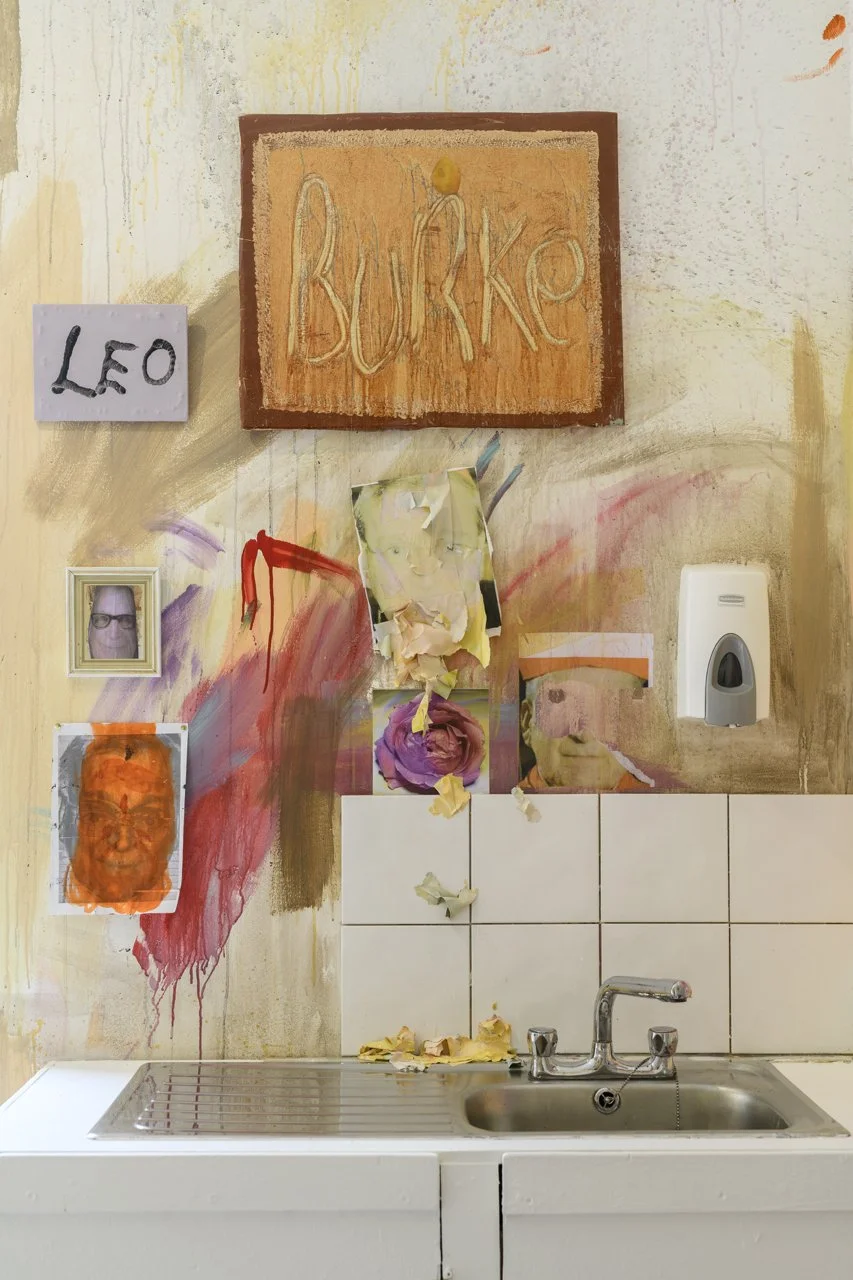
WIP

The transition from knowing artist to learnt artist is a strange phenomenon. The artist starts out from the locus of “What they know”; knowing being a very localised, dumb & urgent knowing. Then they gather experiences & end up making work based on “What they have learnt.” If we generalise, it would be way better if the knowing artist never learnt anything at all. Why? It is something to do with immediacy & risk. The knowing artist comes first, knowing they want to be an artist without knowing what that means or the risk involved. It is the first & biggest risk. Next they make art that dumbly & viscerally reacts to the moment of knowing. In the beginning they risk everything in their approach, appropriation & approximation of culture. Cultural producers need to cannibalise culture to produce culture. It’s a learnt fiction. Doing what is not yet known or learnt. The learnt artist reflects on history. The knowing artist depends on the animal present. The learnt artist reads newspapers, reputations & obituaries in preparation for the End. The knowing artist has the restlessness of youth on their side. The learnt artist inchmeals a practice. The knowing artist is Sontag sensual. Knowing is joyriding. Learning is dawdling. That is why the learnt artist, with age, slows down to dry hump the lap of research. Words like “practiCe” (not “practiSe”) begin to creep into their funding applications. They become nouns that can’t verb anymore. Their practice excavates history for deeper but slower answers. The knowing artist is immediate; the learnt artist turns a blind eye to the present. As they exhaust opportunities the knowing artist retreats from the urgent & dumb of knowing to become learnt, to become known. It’s inevitable. It’s evolution. It’s progress. It’s survival. The learnt artist has learned from their mistakes, forgetting that their mistakes was the art they knowingly left behind. But let it be known that this a learnt perspective not a knowing one.

Image: Ed Ruscha, Hollywood is a Verb,1979, pastel on paper, 58.4 x 73.7 cm.

THE EXHIBITION; DEAD OR ALIVE

When in art school, I was blessed with an accidental and challenging mentor, writer and lecturer, Joan Fowler. Joan had set up a reading group with two or three over-eager students. One afternoon we left our solitary studios and sat down together in her small office to watch a glitchy black and white copy of a recorded performance. 22-minutes later I was laughing to myself in that giddy I-get-it-now kind of way. In 22-minutes the artist-performer Dan Graham gave us everything that makes up the absurd theatre of art, and with a smile. The following text is dedicated to the artist Dan Graham, who passed away a fortnight ago. Although I have been writing this thing in my head for weeks, and only put pen to paper this week, it was that day in Joan’s office, when I was introduced to Dan Graham’s phenomenological artwork “Performer/Audience/Mirror” (1975), that I really started writing towards the relationship between artist, artwork and observer. Thanks Dan. Thanks Joan.

Dan Graham, Performer/Audience/Mirror, 1975, 22:52 min, b&w, sound.

Art that would not have entered life will be inventoried in the Archaeological Museum of Antiquities.
— Alexander Rodchenko
The exhibition presents this random deployment of art in relation to what is not art, this way of approaching the moment when it disappears.
— Jacques Rancière in Conversation with Dominique Gonzalez-Foerster
An exhibition is letting an object present itself.
— Tristan Garcia
A work of art is a stimulus, and should generate and unleash a process. And that process doesn’t take place in the work, it takes place in the public.
— Luis Camnitzer
All artists are alike. they dream of doing something more social, more collaborative, and more real than art.
— Dan Graham
The fantasy is not the object of desire, but its setting.
— Jean Laplanche and Jean-Bertrand Pontalis

You might (as an artist) become uneasy at the claim that the contemporary curator is an artist. “How dare you!” Nevertheless, you might only pause at the further claim that the contemporary art exhibition is art proper, and what is not art is the singular or severed art objects that inhabit or comprise the holism of the exhibition. Art objects, in essence, are the things that people collect after the exhibition is over.

Ironically, if that is the right word, it is the curator that makes exhibitions, and it is the artist that makes art objects for exhibitions. Thus the pivotal intervention of the hand of the curator at the moments of selection and arrangement of art objects is fundamental to what constitutes art today, especially if art is something that becomes art the moment it is exhibited to a public, to a life, to another mind, in order to live. Art objects alone are for crates and hard drives. 

Further, is the exhibition surplus to the artist’s requirements? Not “surplus” in the psychoanalytic sense of orgasmic meaning and desire — although we have more than enough of that in artist statements and in academic settings. Nor in the Marxist and art market sense of surplus value under capitalism. Rather in the fluid and flaccid sense of the spillover of surplus energy and liveliness from the artist’s studio, which now lies flat and dried up on the white walls and polished concrete floors of the gallery, under the direction and thumb of the curator, waiting to be temporarily resuscitated by a human subject before being decapitated by a collector. Or is the art object made in anticipation and for the exhibition and the human subject to come? This is rather obvious. But perhaps not, especially against the virtual social field of Instagram, wherein images of art objects are severed from the physical and human field of the exhibition as we know it. What do all these eventualities (in a world of more and more JPEGs of paintings and less and less experimental and artist-run spaces) say about the artist and art today? Are exhibitions greater than the sum of their parts in a world defined by objects to the detriment of the aesthetic field of form, feeling, relation and physical receptivity that determine the exhibition?

I must confess — after only admitting it to myself in the process of writing this — that this text is an intervention in my loss of attachment, faith, even love, for the exhibition as I idealise in my head. Maybe I am trying to convince myself of the value of the exhibition while simultaneously turning away from it as more and more simulacrums successfully streamline the awkward physical world of art.

Periphery Space, 2019.

Before we continue, here are a few defining prompts concerning the exhibition: 

The exhibition has a life that is necessarily fleeting and residual.

To critically catch the conscience of the exhibition in words is also fleeting and residual and most of the time, fugitive. 

The exhibition is presented as an event that is spontaneous and urgent, even though the exhibition itself has been carefully conceived and curated with a human subject in mind. 

The exhibition is a holism, an object that cannot be broken down into parts, even by the most compartmentalised fetishist, or artist, who only sees himself in the art of others.

The exhibition is judged on the basis it is whole. It is what the Speculative Realists call a “flat ontology”.

The idea that we can love one painting out of a room full of paintings is reductive and short-sighted. We love one painting relative to the rest.

The exhibition is always waiting. It has been laid to rest by the artist in the white evil church. The artist has abandoned it; he only returns to drink wine and talk the talk while ignoring the objects that lay dead on the walls and floor.

The artist’s dependency on the exhibition puts the curator in demand. The exhibition is the nexus between artist and curator; and the human subject is the nexus between a dead art object and a live one.

Art objects are orphans in an orphanage.

The artist is not a fetishist of their art objects.

The artist is a fetishist of exhibitions and other art objects.

The exhibition is an object.

The exhibition is dead; dead until a human subject comes around with intention.

Not the unintentional gallery technician or attendant who switches on the lights and presses ON on the projector at noon. NO.

The exhibition is waiting for receptivity and relation, for someone to say one painting is good and the rest are bad. 

The exhibition is a cap and a handful of clay on the lively and destructive process in the studio.

The art object is a corpse widow the artist has committed to the white evil church of fair-weather believers. 

The exhibition excludes the artist but is inclusive of everyone else, like normal church goers.

Perhaps the artist is the devil, the source of the human subject’s predilections that are now solicited from him in the exhibition. 

The exhibition, at its best, solicits surplus thoughts and feelings. It lives on them.

Without you the exhibition doesn’t exist. 

The exhibition tries its hardest to not be an exhibition. It denies its own existence via its mediation through supplementary lively events that explicate and reinforce its need for nurturing to become the thing it isn't, alive when alone. 

The exhibition, alive to the human subject, is a transparent thing. It is not an object then, it is a subject.

Those who collect art objects as fetishes orphaned from the exhibition are collecting the promise of something alive.

If we determine the exhibition as alive, it is alive to the human subject who is presently alive to it. 

The exhibition illustrates a limit to process where a limit may not exist in process.

What if art were just a process? What if art were a way of being rather than becoming? Why do we need art objects to reify process? Being to become?

The exhibition eats itself; the art object perseveres.

The exhibition is in the wake of a life and a process. It waits.

The exhibition is a sacrifice.

The exhibition is psychological warfare (for the artist)

The exhibition is desperate for a lover; someone to inhabit the space between things. As Dan Graham said, “artists dream of being more social”.

Gene Beery, Artists Paint Themselves, c. 1970, acrylic on canvas, 25.4×40.6 cm

Discourse is a two-way street that is rarely taken in the drive-by narcissistic commentary of virtual culture. That said, I am slowly discovering what draws me back to the exhibition as opposed to the singularity of an art object. It’s the discourse, or the possibility of words therein, that occurs between me and the exhibition. It is not a discourse between two people about art, which, in my experience, gets us nowhere. It is the asymmetry between writer (subject) and art (object) that invokes real art discourse.

The notion of completed and dead art objects activated by the lively exhibition in the presence of the human subject to receive them, like the tree in the forest, stems, on reflection, from the last two years of cancelled, restricted and virtual substitutes for the physical exhibition during the pandemic. That aside, including the satiated and homogenising culture of Instagram, a critique of the exhibition as a relevant or necessary entity for experiencing objects as art was already forming in my activity as a fair-weather curator in a rural setting, where fantasies of a potential audience became an anxiety in the accumulating absence of one. There was also, in recent years, Berlin Opticians Gallery, now lapsed, that combined, like a hybrid car, the virtual with the physical exhibition while acquiescing, albeit with style, to the marketplace of art objects for sale. Berlin Opticians was a virtual and physical pop-up that inhaled the effervescent present in its online exhibitions, but also oriented itself towards the past via the heritage sites where its exhibitions took place offline. It was a civilised enterprise that promised but never fulfilled a meta-institutionalised critique (even if by accident and surplus to agenda).

I must also mention Object-Oriented Ontology’s (OOO) Graham Harmen et al, or more broadly speaking, Speculative Realism. Through my reading of OOO I became excited by something that was counter to the way I had thought about art objects in relation to the human subject. My process of thinking and writing about art privileges the exhibition over the art object, and the human subject in relation to the art object, or more specifically, the continued defence of subjective relation against objective reality in-and-of-itself. However, it must be said that when it comes to art objects, Graham Harmen has said that art objects need a human subject. In one instance the object-orientated ontologist remarks positively and empathetically on the heightened human relations with art objects in the Relational Aesthetics of Nicolas Bourriaud (Relational Aesthetics being a practical theory that seems more important today than it was when I first read the book some fifteen years ago as an art student.) Once again, like Heidegger, art confounds another philosopher vis-a-vis the principals and propositions of their philosophy.

Nicolas Bourriaud. Relational Aesthetics, 1998, Les Presses du réel.

Like the complete art objects that come packed in their crates and hard drives, the contemporary exhibition space is, for the most part, dead, with the potential to “live again” (Evil Dead II, 1987). Towards this potential liveliness, the dead gallery space is first populated by objects, singular objects conceived one at a time in the lively studio of the artist. These singular objects are arranged to activate the dead space and form what we call an ‘exhibition’. The exhibition is a thing that exists between the dead space of the gallery, the dead objects that inhabit the gallery, and the lively human subject with intent to come. This curatorial activation has nothing to do with filling the space floor to ceiling. It is more sophisticated and manipulative than that. It is so specialist we have a job description for it: curator. 

This curatorial sophistication comes with a mime artist’s white gloves, and an awareness and privileging of the negative dead space of the white cube. The art objects are arranged in relation to the negative space of the white cube, which anticipates a human subject, resulting in an inherent anxiety between the non-spaces of the white cube and the art objects that furnish it. Unlike the seventeenth-century salon, the contemporary exhibition stresses the negative space of the gallery. And yet the gallery furnished with art objects is as dead as an unfurnished gallery, as both are detached from their maker, making and most importantly, a human subject to experience them. This is my contention, or discursive constraint for the present thoughts on dead art things and their potential liveliness in anticipation of exhibition and the human actor that receives them in the gallery. 

The privileging of a human agent to mediate and correlate between objects, gallery and art, is a traditional philosophical stance. It is critically counter to the inventor of OOO, Graham Harman, who claims he is defending reality against the privileging of human agents to mediate reality. Harman’s project is to take out the middleman of subjectivity.

(As a side note, you could say “art writing” is a manifestation of OOO, with its habit of writing alongside the exhibition through evasive and subjective meanderings that swerve out of the way of the object for fear of confronting it, head on. In a sense art writing is the process and ambition of becoming an object alongside the exhibition. Whereas art criticism has no such delusions; it is absorbed into the exhibition. Art criticism ceases to exist for the public — in any meaningful way — after the exhibition is over.)

From “theanyspacewhatsoever” catalogue with Liam Gillick, Philippe Parreno et al, 2008.

So what can we say about the contemporary exhibition that hasn’t been already said. This perspective on the exhibition is one that is quite personal, shaped as it is by a context that is as hard to escape as to see. It is entangled with an activity that concerns looking and experiencing exhibitions for the sake of language, of discourse, of words. I am an art critic. I articulate my experiences of art through the personal history of once being an exhibiting artist, one who made work with an exhibition in mind. 

You could say the fantasy of the exhibition is antithetical to the lively process in the studio. If so, the exhibition is antithetical to liveliness. The liveliness that brought the exhibition into being needs to be substituted by an actor that does not act but receives from the soliciting exhibition. Could we say that art is the difference between the exhibition and the human subject? That art exists, not in the art object, but in the negative space that comprises the exhibition, negative spaces statically charged with the presence of an art object, the withdrawal of the artist, and the promise of someone to come?

Martin Heidegger

What I am propounding here, in the same metaphysical language, is art is alive, but not always. It is alive in two spaces: when being made in the studio, and in the negative space between the in-human art object and open-human subject. In these two spaces, art is the perpetual and destructive flux in the studio, or the static space between the closed art object and open human subject that coalesce to form the relationship that is the exhibition. Art is the relationship between closed and essential art objects and open and changing human subjects. Art is both eminent and immanence.

Art is being defined here in a Heideggerean sense of relation and use. Art is something we use. When it is not in use, or in flux, it is a static object minus the friction of change and human relation in the exhibition. When it is in use, continuing to lean on Heidegger, art becomes transparent, like the hurley becomes transparent in the hands of the hurler at the moment of unthinking and unflinching skill. 

Hurler. Hurley. Hurling.

The live studio, contra the live exhibition, is a space of making and doing, experimenting and playing, and disappearing within the process, so the artist and object, both, become transparent in the reciprocal to and fro of lively subject and changing object. Then there's the moment in which the work is done and the fantasy-object of the outside world comes into play, with its agents and institutions, positive and negative spaces, wherein the dialogic between experience and intellect takes place. Art is when private and public collide.

This collision between studio process and exhibition outcome is not a big bang but a protracted limbo. The art work is an object. You could even say that it has an essence, one that is sealed off from the world until that world comes in contact with it with human openness and intention. It is an object that is made up of being and time. It is an object that has rubbed and is rubbing against the world. It belongs and doesn’t belong. It is alive in the memory of the artist, until that memory is infused with the fantasy of the exhibition and the other human subject who will experience it detached from the lively process — now a memory — of the studio.

The second the artist withdraws from the process of making, art becomes an object. Whether stored in a hard drive or a crate, it is a sleeping object, one that is both dead to the world and open to its lively potential. I imagine art objects with sensors, activated by the very presence of a mind and a body that can converse with it in hushed tones and physical gestures in the gallery. In the gallery, when human sensors are blinking red, the art object once again becomes transparent, as it did in the studio with the artist or the hurler in full unthinking and unflinching flow. 

It’s a strange convention, isn't it? the exhibition. This temporaneous event, both dead and alive, is enlivened by the human subject who receives and lives it. Like capitalism, there are no fire exits from this white church of the exhibition. Artificial it may be, antithetical but necessary to the artist’s process it certainly is, transformational of objects that sit outside the official language of art it possibly can, the exhibition democratises art objects into what the Speculative Realists call a flat ontology, wherein the objets d'art collide like billiard balls on a pool table outside the mediating influence of the human subject. I don’t deny that there is something seductive about an object-on-object ontology, especially for artists, who have to speculate on the real subjects that experience their work in the exhibition in their absence. The artist will never experience their own art objects like the other does and will. That’s the sacrifice.

Tristan Garcia

Tristan Garcia helps the case of OOO with his lyricism in contrast to the Gradgrind prose of its inventor, Graham Harmen. There is something democratic about OOO, a levelling of the aesthetic field. And not just as a metaphor for society in its beautiful flatness and speculative democracy. In Tristan Garcia’s Speculative Realism, “showing” and “exhibiting” are very different phenomena: showing being a gesture that includes the subject gesturing to the object for your attention; whereas the exhibition “is letting an object present itself” after the subject (artist) withdraws. The exhibition is not natural no matter how hard it tries to be. It is a setup. It is an arrangement. It elicits suspicion in the human subject. It is a prearrangement waiting to be rearranged in the other’s mind and nerves. There is something collaborative and lively about the demand “Show me your work”.

Painting is a secretive business anyway. [The painter] is someone who’s not suited to the public. Someone who wouldn’t speak up in public, but goes for it here [in the studio] in secret.
— Gerhard Richter
It makes a big difference when the paintings are hanging there like a performance, like an opera you have written on paper on the studio wall, in the dirt. Then suddenly it is there. It was really good.
— Gerhard Richter

I cannot imagine experiencing an exhibition as a non-artist, or without my imaginary semantic friend. The exhibition is a lonely space without the practical experience of making art or the need to transform that practical empathy into words, or what I have defined here as subject-object discourse in the absence or impossibility of human discourse. That said, I still think that the exhibition is a sad rather than flat ontology, the arc of its horizon curving downward towards the liquid ocean of its metaphorical source.

Bruce Nauman in his San Francisco studio with “The True Artist Is an Amazing Luminous Fountain” (Window or Wall Shade)”. c.1960s.

Although for art market reasons rather than philosophical ones, I like how Bruce Nauman contractually forces borrowing institutions to destroy his neon text replicas after the exhibition is over. Should this be a natural outcome of art objects following an exhibition? If so, John Baldessari didn’t need to preserve the ashes of the 10-plus years of paintings he cremated and housed in a bronze urn in the shape of a book. The gesture seems to defeat the statement. Or was Baldessari’s positive nihilism an effort towards a flat ontology between objects and their ashes? In the end I believe art is a way of being a thing not becoming a thing. And more importantly, the exhibition in its attunement to a public in the event of the presence of a human subject, makes art present.—James Merrigan
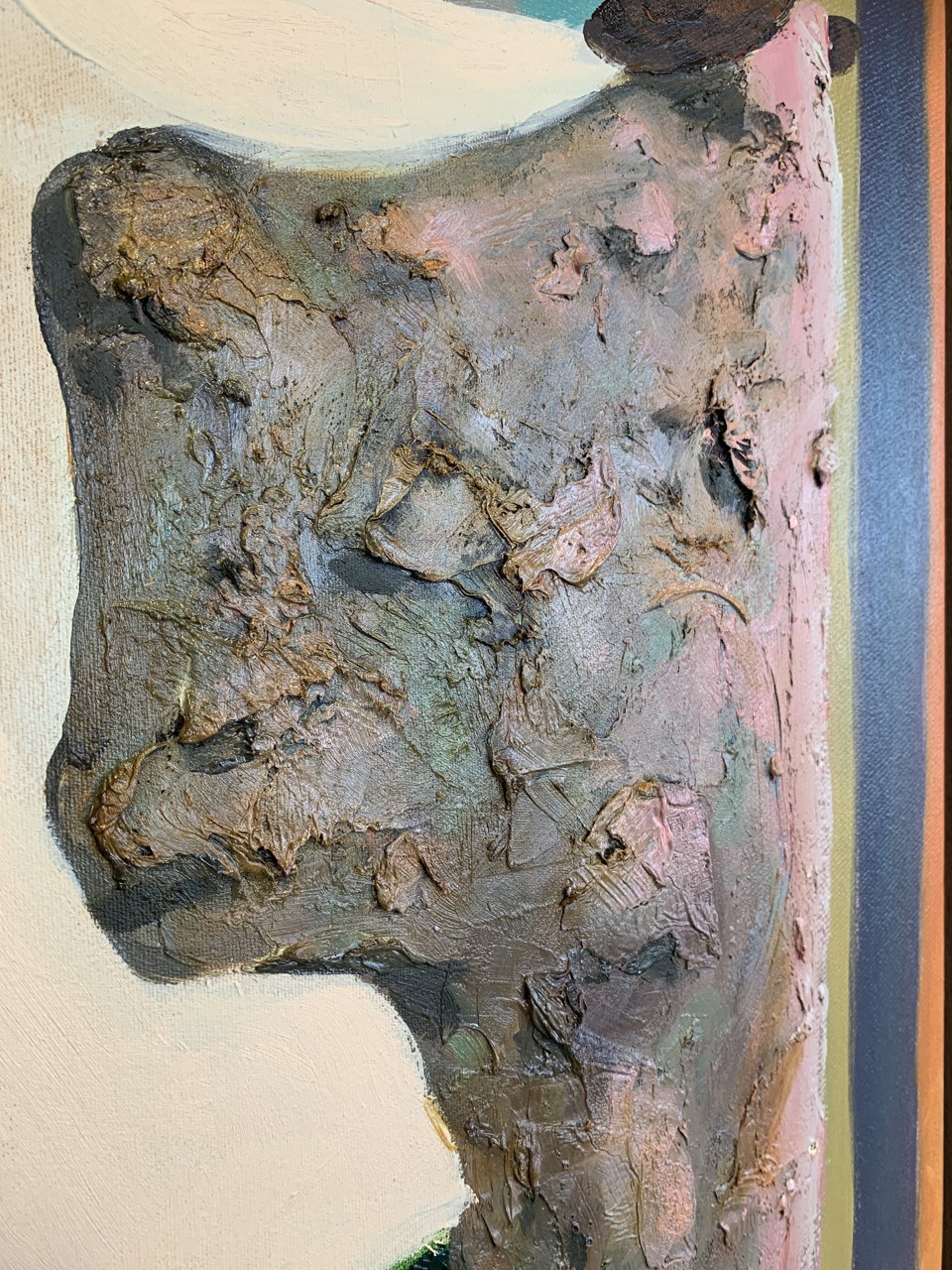
*find out more about Small Night and its forthcoming ART&TEXT project here


FERGUS DALY’S THE MIRROR OF POSSIBLE WORLDS (2022)

Remember the trails of the human hand in mid-Summer; the turning of the heavy head on the long grass to kiss in a slow & seismic submission. This is the localised feeling I get when watching Fergus Daly’s The Mirror of Possible Worlds (2022). Both filmmaker & theorist, Daly distills a lifetime of looking & thinking about the Iranian director, Kiarostami, into 24-minutes of sequential moving/still images, sentient text & an emotive soundtrack. The images localise Kiarostami on the Aran Islands when he visited there two decades ago. From the hot & closed immanence of Iran to the wet & open membrane of Aran, Daly portrays Kiarostami as a mirage of himself & to himself in the biographically severed narration & rich philosophical asides that address the “detachment”, “possessiveness”, “playfulness” & “compassion” of the director & his camera, what we might cheaply call auteur. In this tale, all authors disappear under the mask of indirect words & yearning images. “What is truly deep needs a mask” Daly narrates via Nietzsche. There's something small & local about Daly’s short that is tantamount to a golden pin-prick in the navy-black universe. It is a moment that went unnoticed for the many, & only exists as feeling for the few who stumbled with Kiarostami onto our shores with a camera in hand to stabilise the foreign landing. The word for this moment is localised not intimate. Localised plots the distance between Iran & Aran. And it also intimates the closeness & distance that Kiarostami plots in his filmmaking between the poles of place & poetry, documentary & fiction, world & lens. Perhaps the desperate metaphor of the Summer is a turning away from the present turning towards far away trauma, one that has been abstracted by distance, scale & the yellow & blue stripes of global support. But as Daly narrates vis-a-vis Kiarostami, “You can’t narrate trauma.” Daly is sharing the memory of being with Kiarostami in-person on Aran, while knowing that “sharing a representation is not preserving the sensation of being here, now. It’s a prosthetic memory.” Art, in its depth & breadth of thinking & feeling about place, always has a localising nature. —James Merrigan
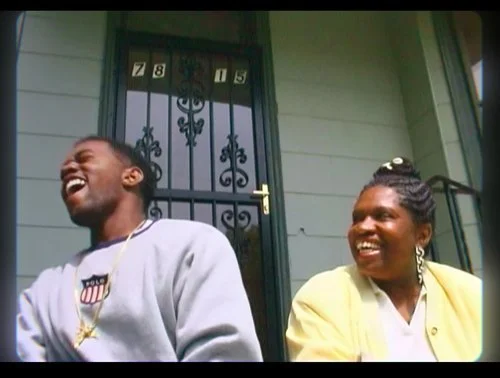

Fergus Daly’s The Mirror of Possible Worlds is free to watch here

NUMBER 10 NEON

What are the politics of the figurative neons? Medium provides one route to answer this question; Plagens writes that if there is ‘a medium seemingly made for political art, it’s neon. Not only is it the nocturnal language of our turn-of-this-century era, but it’s synonymous – indeed near-identical – with sending an imperative message: buy, eat, see, drink, sleep, save’.
— Peter Plagens: Bruce Nauman: The True Artist, 2014

The dark paints the panelled walls in iniquity. Not much to see here on this first floor den at Number 10. It’s a through-way to three rooms, drawing rooms where the light is allowed in and the truth, not really. Obvs. 

Here the light is lampshade canted, spilling downward like spilt milk, curdled yellow with a hint of peach. It’s niche here. Under-the stairs. Less politically poised. Kinda excessive vis-a-vis the reserved theatre where it leads. A shower room. The walls are not too brown though, considering. 

The waist-high lampshades have been hit by a flood of hips flowing purposefully from room to room. This anti-room is unconscious. Transitional. Fluid. Ungendered. It’s a place of holding big breaths before bigger entrances. 

Above one panelled door is a pink neon sign with two words underscored by two strikes that taper to a join. More Passion. It’s fast. A shooting star. About to take flight. Celestial. It’s Night’s Delight and Day’s Warning. A self-conscious signature intended to be read as cursive casual. 

The artist Tracey Emin probably wrote More Passion many times in a notebook before settling on the last attempt. It's rehearsed passion. Insecure in its need to impress its direct quality in a pink cloud. More Passion is an injunction, like “be happy”, an emotion that Emin claims her neon has showered political dignatories for the last decade in office.

In this place where lawyer-politicians take big breaths before saying bigger nothings, what does More Passion mean politically? Not much. Slogans. Rhetoric. The broadest brush.

Like the weather, neon is changeable. It’s one sign upon another sign upon another. It’s synonymous with the street, the one closer to the gutter, not on political high. 

Sensory and sensual, visually and sonically, neon is a gaseous ghost signifying desire in absentia, as the lawyers say. Wonder if they switch off More Passion after hours when its glow kisses the stained streets and mattresses outside in night culture?

Still naughty in its encapsulation of its maker, the short-sighted media — in different words — said More Passion was Tracey Emin lite. And yet the artist is not just one artwork. The artist is everything they have ever made, kept or destroyed.

FYI: Due to the uranium glass in Bruce Nauman’s text and figurative neons from the 1960s breaking down, replicas are made for museums but with the criterion that they be destroyed when the show is over.

SO MUCH FOR THE DISCOURSE

You could work hard for weeks on an essay, put all your intellectual and imaginative effort into reading an artist’s work, and never hear a word about it upon publication — unless the artist or their representatives disagreed with your opinion. So much for the discourse. One famous artist became angry at me at this private viewing for having had the temerity to write that his videos reminded me of film director Andrei Tarkovsky’s work. Another minor player phoned to insist, threateningly, that I should consider committing suicide after a mildly critical piece had been published about an alternative art school he was involved with. I didn’t even write the damn thing.
— Dan Fox, April to July 2020, from Art Writing in Crisis, 2021.

It’s 2009. I’m a recent art graduate. The financial crisis makes every day feel like Sunday. It’s never Friday. My best mate is being headhunted by two Dublin galleries. If envy is a “scumbag vice” Dave Hickey, I’m a scumbag.

I repeat check my email for something. Graveyard. I want it all. Exhibitions. Reviews. Gallery Representation. Those who want know how I want. I want part of the artworld. That island of exclusivity and sameness and bad. Yeah. Desperately Bad. I’m desperate.

I start writing. Not reviews. Critical essays on the local art scene and international artworld like “The Politics of the Centre” and “Why Rancière? Why Not?” I’m pissed and yet pleasured by words. Especially masturbatory, critical ones. Dissent is never decent.

For some Angry-White-Entitled-Man reason I feel rejected and critical of the world I have chosen to wander. PAY ATTENTION MOTHER FUCKERS (Bruce Nauman, 1973.)

If Rancière, Why not me? I wait. I write something while waiting. I wait and write some more. Editors take an interest. I’m both dumb and clever enough to be critical because no one else is. Niche.

I’m edited. I go along with the edits. I learn about me and the artworld through editors. How to tiptoe and jab. I then don’t go along with the edits. Why do I have to use “perhaps” or “maybe” when I know? I know everything because I know nothing.

I feel accepted through words. Peddling words about other artists’ art. Not my art. I think I’m being generous by being wordy about others. It’s hard to give being an artist. You have to take to make it. Silence.

Things change. I get exhibitions. Loads. I’m caught between critical words and local art acceptance. Everything is too local. I write as if “I am still this guy” (Sean Landers, 2017). It’s part performance. Part real. Being an artist in the world is about being many things not one thing. I’m good at being split. The hyphenated class.

First an artist. Then a critic. Then an artist-critic. Criticism is a prosthetic limb to kick-start art from time to time when its spluttering. Mule criticism. It’s all for free. Lanced of money. It’s the way it is. Having fun. Words are fun. The Word is the wound you enter art through. Like bruised artist statement.

Circa 2010 “art writing” appears on the horizon. Its Kinky silhouette. Its perky calves. Its twilight tenderness. Its inky permanency. Its oxygenated self-sufficiency. “The Word is the wound you enter art through” is me being an art writer. Perhaps. Maybe.

Art criticism is in crisis the seminars say circa 2009-2011. Agency is over-powering discourse. Artist-run are less DIY. Art criticism goes out without a whimper. Quiet.

Circa 2022 art writing is in crisis. According to Sternberg Press and Dan Fox and others. Art writing is synonymous with crisis. Always has. Will be.

Dan Fox has been in crisis for some time. He started at Frieze Mag at twenty-two. Stayed there for twenty years. Recently wrote a book on Limbo. Before that on Pretentiousness. Art does Pretentiousness and Limbo real well.

His essay in Art Writing In Crisis is the best of a bad bunch. It’s truly great. It runs through decades of artworld malcontent with a soupçon of reward.

It’s great because he’s telling our story. He definitely stayed too long. Ground it out. Took the hits. The artist egos. The power brokers. Meta-institutional critiques. Curator “messianism”. Problem is Dan Fox mistook and misplaced desire for need. Like us all.

Reading him you realise the centre is not much different from the local. Uncanny. Bad relationships are only bad with perspective. Inside is a different story. The bad is veiled by what Dan Fox diagnoses as “cognitive dissonance”. In other words, self-serving denial. But bad is more fun than good.

It was probably the hand-written letter that Dan Fox received from a grateful artist that did it. Five years into the job the false promise of a handmade book inscribed to him “with empathy.” Fuck!

Dan Fox is not a victim. Neither am I. Nor you. We kinda knew what the artworld was before we entered. That’s part of the seduction. The want. The challenge. The bad. Something we certainly don’t need. Need comes later when we exit. Premature or belated. Gracefully or not. As Dan Fox is discovering. As we all will. Don’t forget to have fun.—James Merrigan
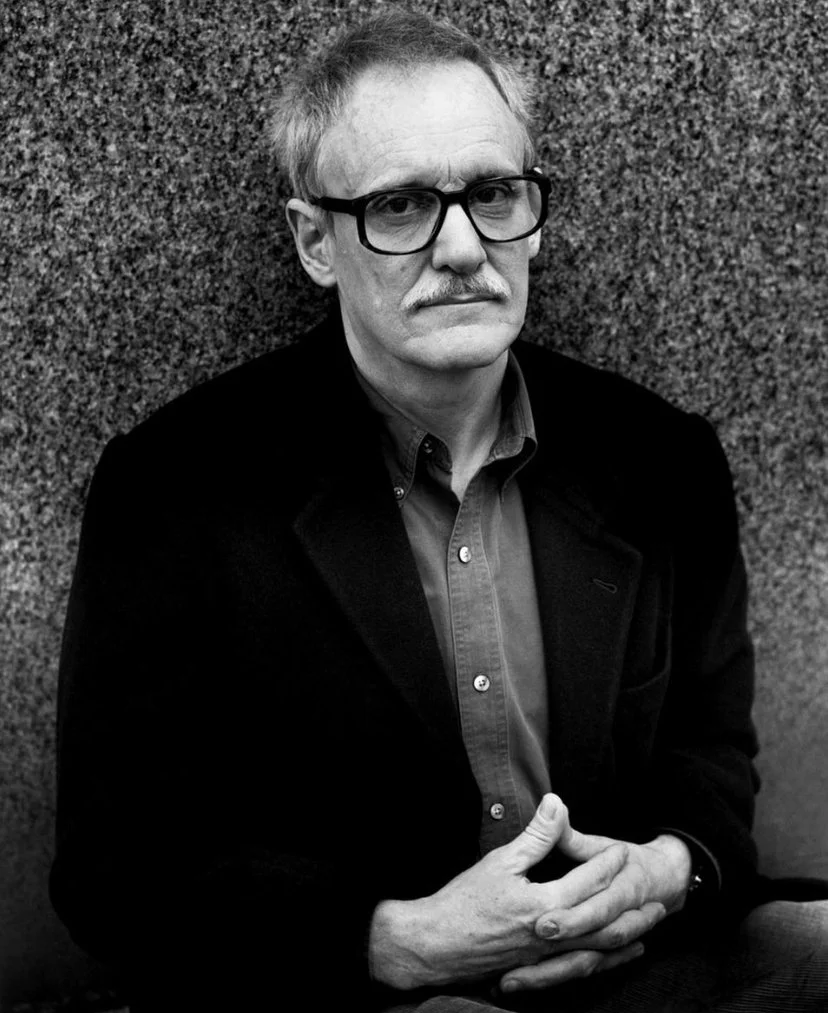
EARTH & WORLD: ART & ARTIST

Luc Tuymans, Superstition, 1994, oil on canvas, 41,9 × 36,8 cm

The earthly aspect of the work of art juts out into the meaningful world.
— Martin Heidegger, The Origin of the Work of Art, 1950.

Martin Heidegger’s philosophy is difficult to decipher, whether in his unfinished magnum opus Being and Time, or his essay The Origin of the Work of Art, from which the above sentence is taken. But reading Heidegger draws out perspectives from the reader that are helpful in rearranging and reconfiguring institutionalised habits and beliefs about making art towards seeing art anew.

What I have gathered from this sentence, helped by multiple sources, including Sean Kelly’s Harvard lectures and Hubert Dreyfus’ written commentary on Heidegger, is the “earthly aspect of the work of art” is not exactly contrary to the “meaningful world”, but dynamically connected and integrated. “World and earth are essentially different and yet never separated.” 

When we read this sentence aloud — “The earthly aspect of the work of art juts out into the meaningful world” — we can recognise the world being defined by ‘meaning’, as the adjective “meaningful” points towards. But what of the “earthly”? What does the “earthly” point towards in Heidegger’s sentence without an adjective to describe its essential characteristic? Where I think the “earthly” can be defined is in the odd verb “juts”, which Heidegger uses to describe how the earthly “juts out into the meaningful world” to reveal both itself and conceal itself all at once, like a feeling or mood that is enigmatic and mysterious, but present. The earth is to enigma what the world is to meaning, and “[i]n its resting upon earth [that] the world strives to surmount it.” 

Earth below world, world upon earth, why is this tendentious duet between earth and world, mystery and meaning, helpful to a commentary on art today? The art world of today is a distant, incestuous cousin to the Greek Temple from which Heidegger’s definition of the origin of the work of art emanates, pervades and arranges the cultural practices of the world around it. The dance between earth and world is helpful due to an evolving questioning (I personally have and perhaps you have) for art practices that sway either too far in the direction of the earthly in their rejection of the world, or art practices that sway too far in the direction of the world in their rejection of the earthly in their work.

Too much earth detaches the artwork from the world to position itself in enigmatic exile beyond the periphery of meaning; too much world removes all formal and intellectual enigmas and mystery from the artwork so it becomes indivisible from the world it is meant to signify, represent and stand out from. The balancing act between earth and world determines what is good and what is mediocre in art. At its best grips onto the explicit world with one hand while veiling it’s grip with the other via the material earth that comprises its essence.

Heidegger's philosophical prose is sometimes all earth and no world in his enigmatic use of familiar words and unfamiliar neologisms, not to mention what is lost in the translation from German to English. That said, his reflections on the work of art and its relationship to earth and the world that rests and tries to surmount it, is symptomatic of what determines and reifies art in the world today. The artist is an agent in the world who is both enveloped by the world and empathetic to the world’s fears and anxieties in the formal and intellectual choices the artist makes in their work. Art making ought not be a retreat from the world for the artist, or the artwork an escape from the world for the viewer of artwork, but a slip and jab confrontation with the world.

Anxiety is the philosophical mood par excellence, the experience of detachment from which I can begin to think freely for myself.
— Simon Critchley via Martin Heidegger.

The artist of today has the difficult task of confronting a hyper-anxious world. A world wherein mood has been commandeered and internalised by the individual. The mood of the technological age is a private mood that only becomes public through the over-share confessions of the anxious-ridden on social media. Heidegger’s mood is a public mood, one that is all pervasive and already there in the world. Mood in Heidegger is something we can’t control in virtue of our receptivity to it in the physical world. Mood is so pervasive that it becomes transparent so we are unable to articulate it in a worldly way. 

I believe art at its best — outside the devoid-of-mood reception of images of art in the virtual field — has a physical and public mood. Mood being something that both presents a recognisable world while also concealing that world through cleverness or formal means. Luc Tuymans’ painting Superstition (1994) achieves this earthly vis-a-vis world mood in both namesake and form, presenting the recognisable body as an unsettling setting in a deathly outline for the lively silhouette of an insect to rise up uncannily before it.

If contemporary cultural sensibility is one determined by indeterminate fear and anxiety, between what Heidegger describes as “nothing and nowhere”, then artists should be committed to the expression of this cultural sensibility. Their expressions ought to give with one hand and take away with the other. The artist of today has to be generous before they can be greedy; committed and critical of the world while uncanny in their sensory articulation of the earth that bears them and the world they are part of and apart from—James Merrigan
TO BE: A PAINTER

Philip Guston in his studio. Photo by Rudy Burckhardt, circa 1960

“I believe it was John Cage who once told me, ‘When you start working, everybody is in your studio—the past, your friends, enemies, the art world, and above all, your own ideas—all are there. But as you continue painting, they start leaving, one by one, and you are left completely alone. Then, if you’re lucky, even you leave.’” 
— John Cage/Philip Guston

PAINTERS’ PAINTER Philip Guston was not certain about his attribution to John Cage for this chimeric observation. It’s made up of an odd accumulation of sentences. In its above version, one that has presumably gone through the tangled and tipsy grapevine that makes authors out of witnesses and poets out of the illiterate, it sounds like John Cage is not telling Guston anything, but describing what happens to Guston, the painter, when he goes to work in the studio. This is especially odd, because it’s coming from Guston’s mouth.
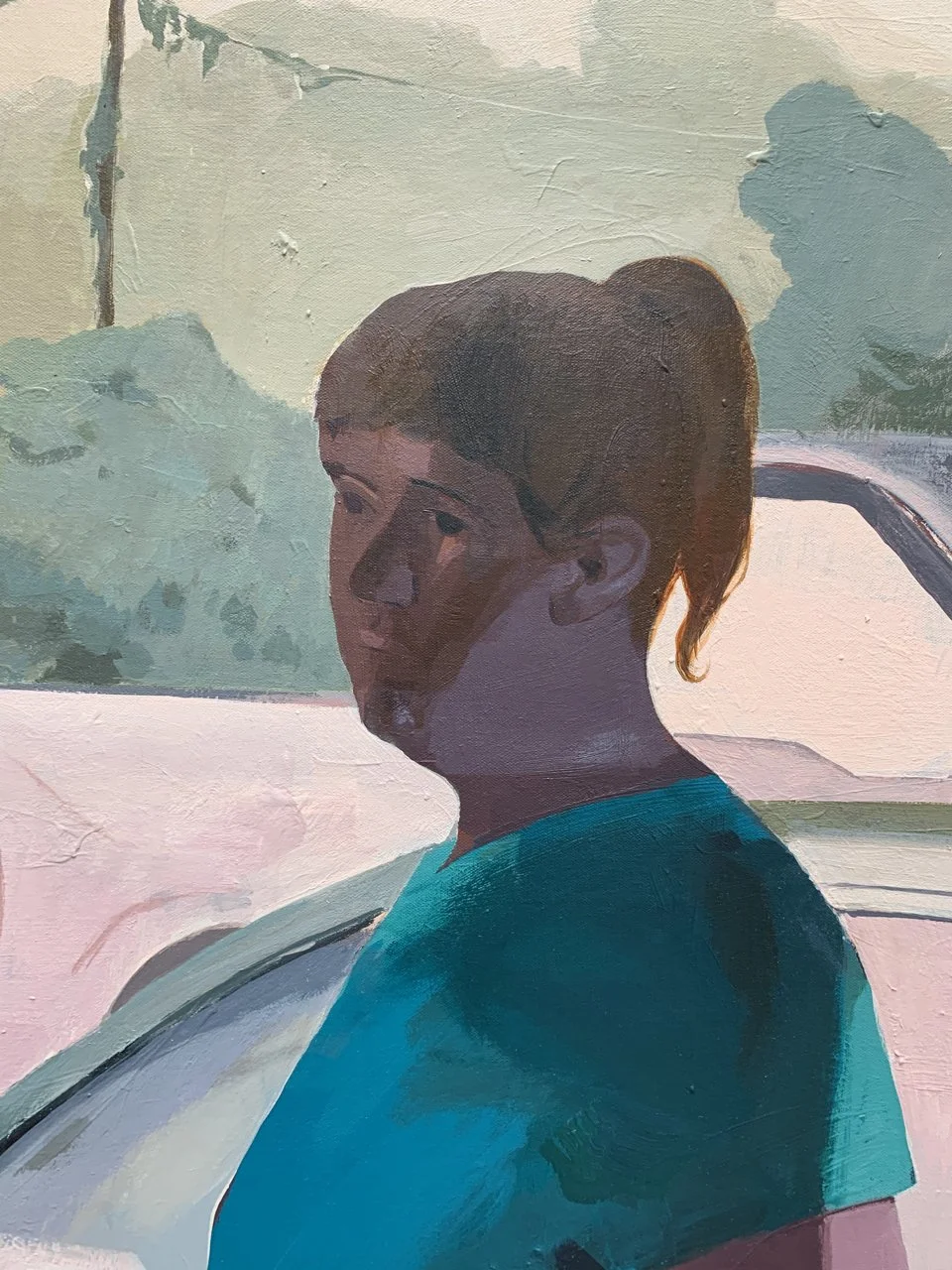
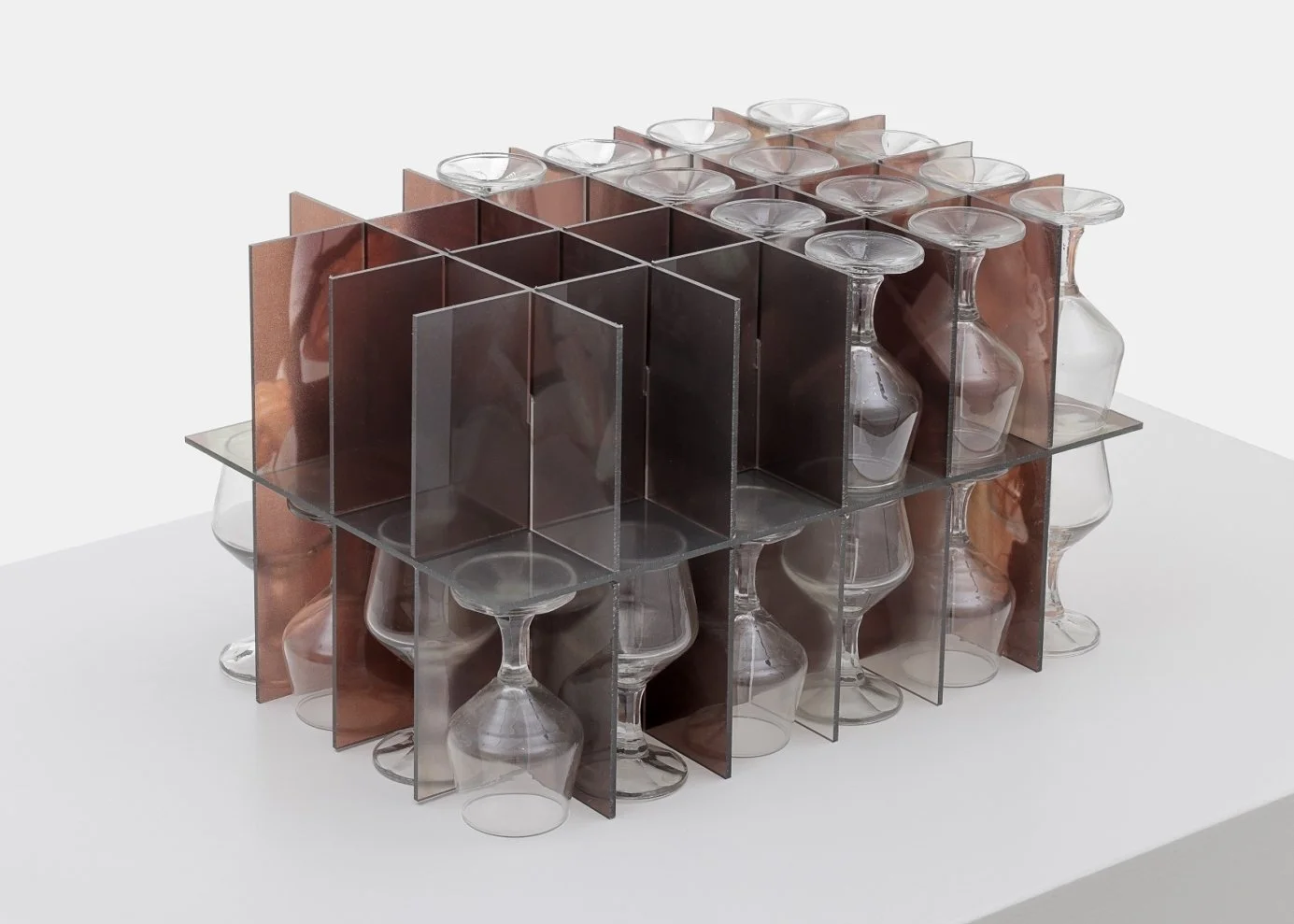
When the almost too famous line is spoken aloud by painters, or in the presence of painters, it is never elaborated upon. There is no need to elaborate: it is understood, absolute, tout court. It is a line that stages a possibility. The line unburdens the painter of all their fears, their “past”, their “friends (let’s from now on call a spade a spade: ‘influences’) & “enemies”, their “art world”, “and above all” else, their “ideas”, releasing them to do the doing of painting, before the verb of painting inevitably, and sometimes regrettably, becomes a noun. 
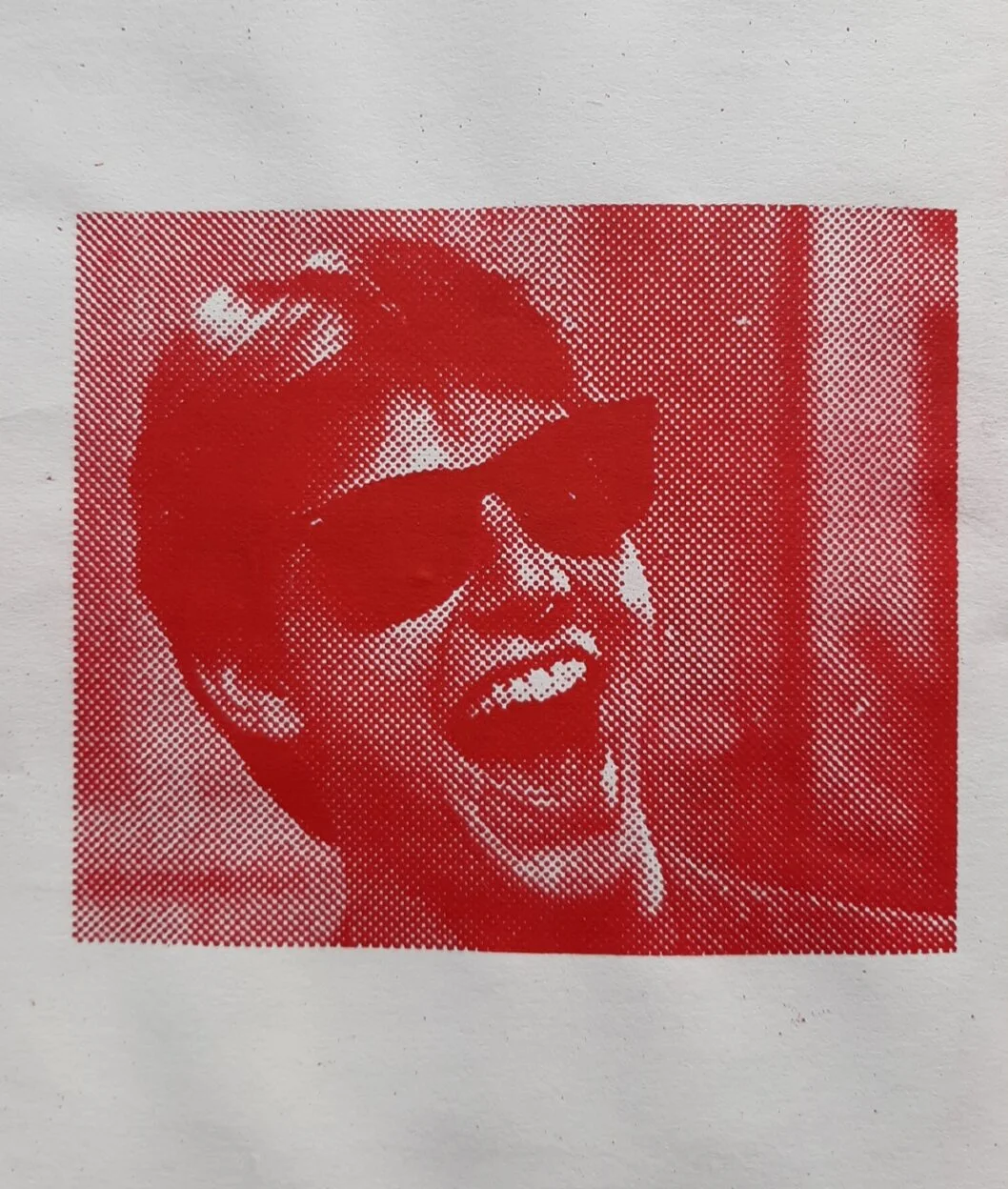
The opening line “I believe it was John Cage who once told me” has the smell of the gospel, void of truth if not faith. At the very least “I believe” could be Guston just parting the waves for his own gospel. There is something of the sacred attributed to Guston, even his paintings of the KKK are received on bended knee if not a Rothko tear. Nevertheless, this sacred observation by Cage or Guston, Guston or Cage, or a synthesis of both that ends up neither, registers as both advice and experience, and fits the avant-garde composer of negation, specifically Cage’s 4”²33”³, a composition “performed in the absence of deliberate sound”, wherein “musicians do nothing aside from being present for the duration specified by the title”. In the line, Cage is talking about Guston while talking about himself as all artists do.

No matter the attribution, Guston is the placeholder and protagonist for Cage’s observation, especially for the painters who believe and hope to follow this impossible mental decluttering in the studio. We can imagine Guston in the studio, unpacking the shit that painters unpack before they forget (or lose) themselves in the act of painting. But, according to Cage’s observation, it is the very anxieties of Guston’s past, Guston’s influences, Guston’s enemies, Guston’s art world and Guston’s ideas that brought him here in the first place. They entered the studio with Guston, looking over his shoulder until there was no shoulder to look over. The artist enters the studio with “the kind of generalised anger that Bruce Nauman said got him into the studio” an artist told me recently with the same empathy. 
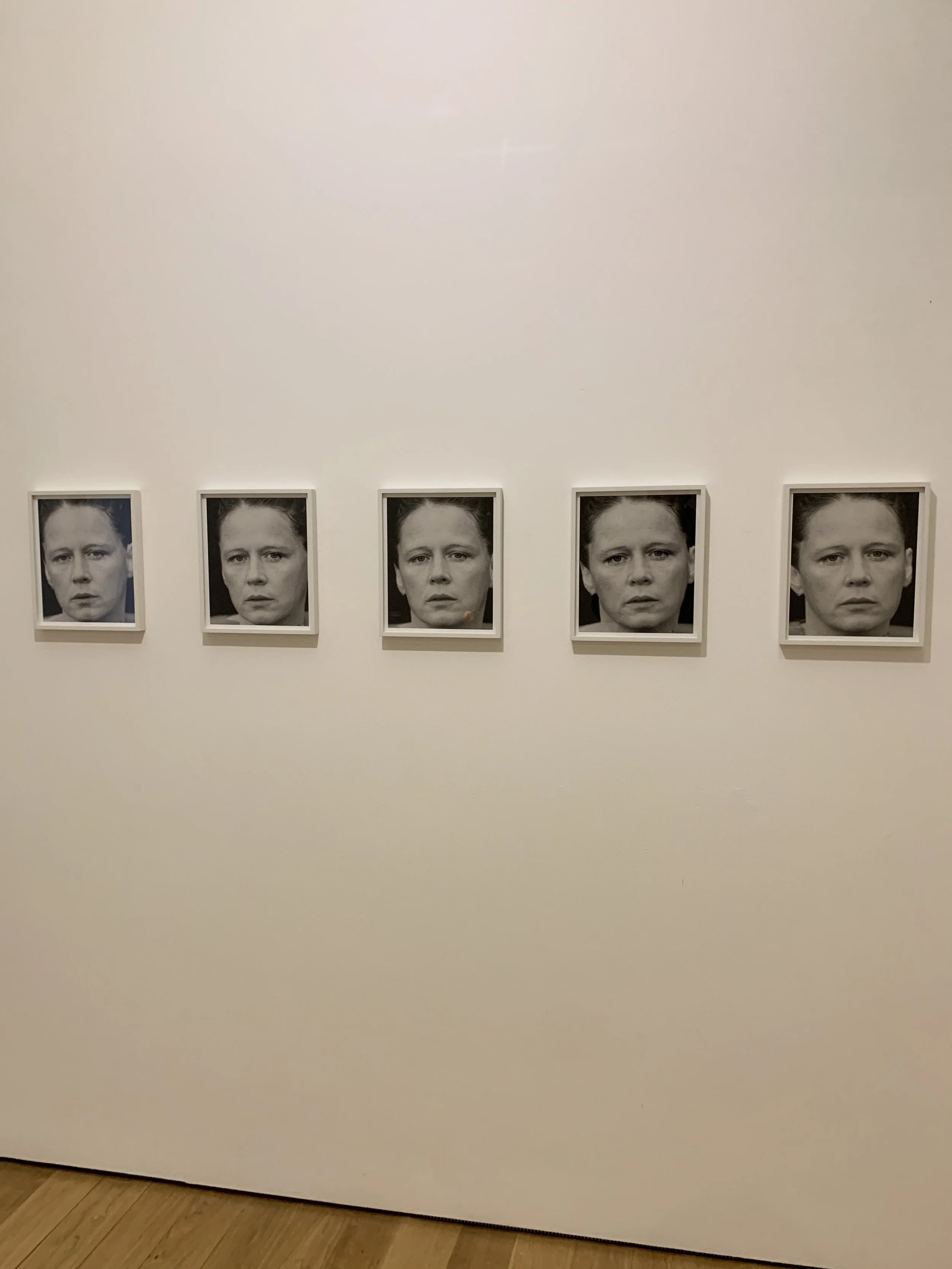
Even though Cage’s observation is anything but practical, it works on a mental level that is somehow comforting if not something the painter can follow or rely upon. Perhaps this process of withdrawal or denial naturally happens in the studio, and the specificity of words just confuses things in their failed correspondence with reality.

It is interesting when you question painters on being a painter — as I have and did in a recent panel discussion in Zagreb with five painters – how they are either struck by amnesia or conceptualise being a painter in the studio, as if they do leave the studio at the moment the painting becomes. If this mental and figuratively physical decluttering does naturally happen in the act of painting, then it is something that places peaceful withdrawal above the confrontation with anxiety, what some philosophers call the spur for art – art being defined here as something that rearranges and reconfigures cultural practices around it, from Heidegger’s Greek Temple to Dave Hickey’s Andy Warhol.

According to Cage’s observation, when the past, influences, enemies, art world and painter’s ideas (along with the painter) exits the studio, something happens that is not the painter’s doing in a conscious sense. The painter is just in the way. Guston is there, not in spirit or mind or intention, but in body, a body freed from the petty mental torments of the past, influences, friends and enemies and art world and his own ideas, to be solicited by the present and paint, a painted present coloured and composed by forms, marks and an edge that gives a necessary limit. Painters need limits as much as anxieties.

That said, there is something awfully romantic about Guston’s picture of the painter withdrawing from the world’s anxieties to produce a picture of the world without them looking over the painter’s shoulder. What we are left with when there is nothing left in the studio is the painter as puppet to the master of a metaphysical universe separate from the world of memory, envy and competition. Nothing ever withdraws fully, it is always there, underneath. Especially emotions we try to suppress: hate beneath love, rage beneath peace. When you deconstruct a word or feeling you end up with its opposite peeking back with bigger eyes. Binaries need each other to be the thing they are, the same way day needs night. 

Martin Heidegger’s Being and Time had lots to say about withdrawal that we can draw upon in virtue of Guston’s disappearing act in the studio. Heidigger writes that when we are using equipment skilfully, the tool in hand withdraws and becomes transparent. What he calls “readiness at hand” transpires and transcends materiality into a moment of attunement. Only when the action is interrupted, like the head of the hammer being flung off in the action of hammering, do we notice the hammer — the thing in itself — as it materially is. Maybe this is what Cage is observing and Guston is hoping for every time he goes to work in the studio. 

The self is a burdensome thing, especially in this age when the sovereignty of the individual is sacrosanct. Indeed, there is something sacred about becoming transparent, painter or hammer, that is very seductive. But there is also something powerful and necessary in the experience of the flung head of the hammer shattering seduction in the process of making art, art, I repeat, that rearranges and reconfigures cultural practices around it.—James Merrigan