Life is but a dream...

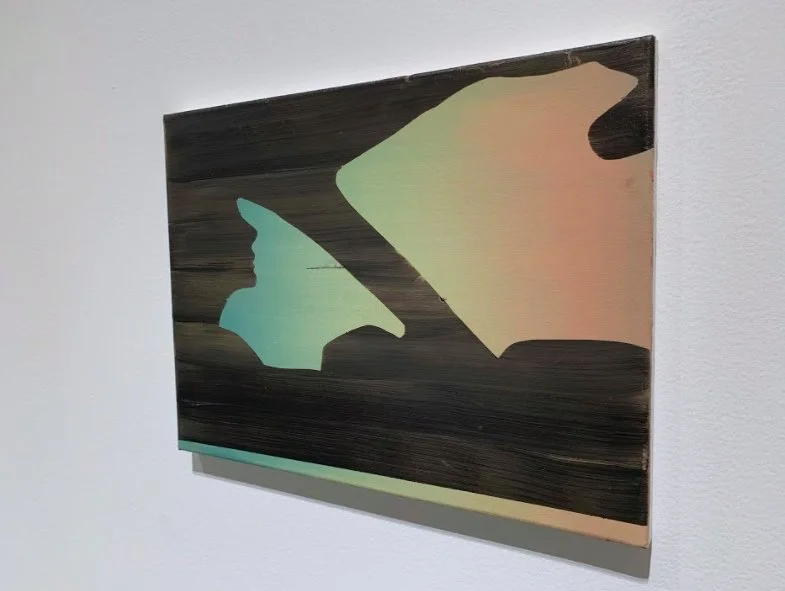
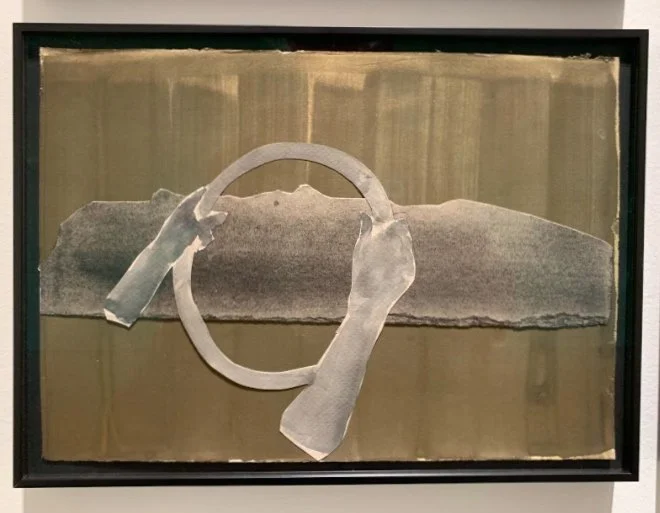
On entering the impressive main gallery at Butler Gallery through an incongruously small doorway, the deep hum of an air conditioner can be heard, creating a somehow sympathetic soundscape for Ciarán Murphy’s enigmatic paintings, which poke atmospheric holes in the precious white walls of the gallery. This hum is soon forgotten, surrounded by the 20-odd bareback paintings and framed collages, the latter being the generative paper tableaux for Murphy’s paintings. 
Dotted among this selection of paintings—curated by Patrick T Murphy—are three images of driving, one collage and two paintings. One of these ‘driving paintings’ is entitled Are we there yet, a minimalist blur of twilight-blue car windows and headlights evoking the sound of synthesisers circa 1986. Are we there yet is the popularised and playfully repetitive childhood mantra of unmaintainable boredom and unreachable desire mediated through The Simpsons and Schopenhauer’s existential pendulum that swings painfully from boredom to desire in his philosophy of the human condition. Are we there yet, designated as a painting title, is also a confession, one that opens up the work and exhibition towards passengers outside the field of painting, the walls of the gallery and beyond Murphy’s sometimes violent crop.
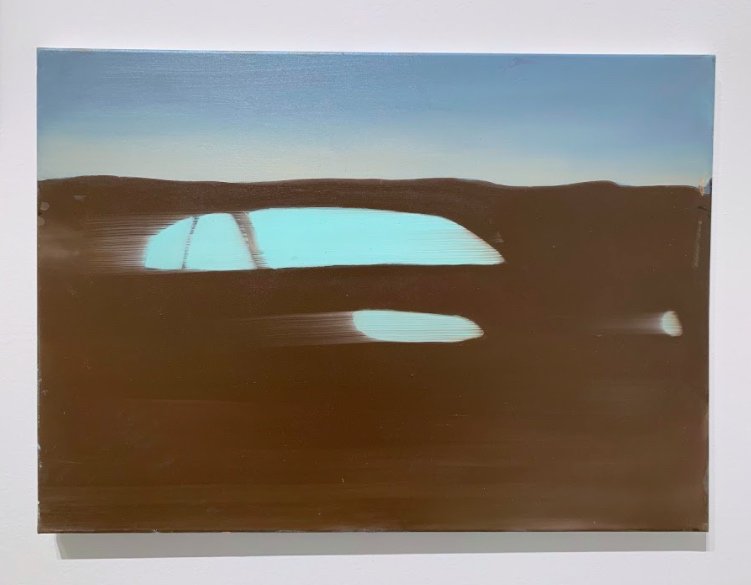
Ciarán Murphy, Are we there yet

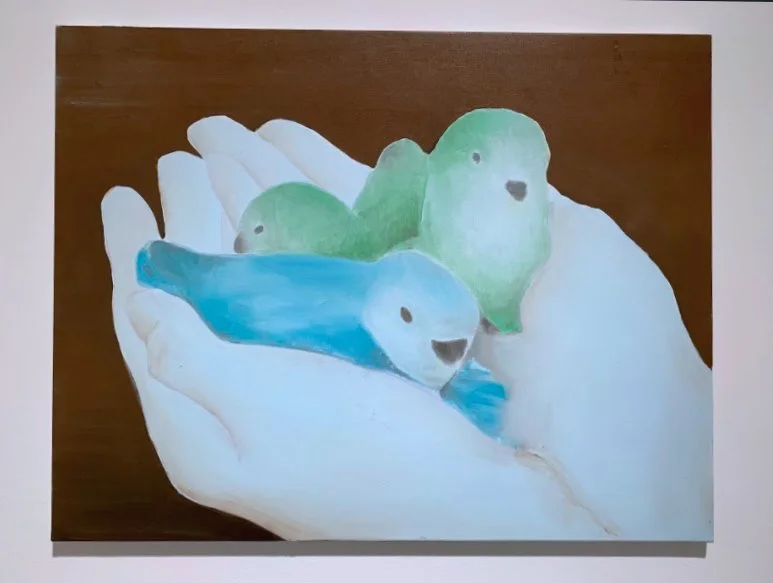
Even though there are no representations of children here, the presence of children is engendered in paintings like the hand-cupped budgies, the prostrate zebra, or the Fauvist dolphin. There is also this feeling of being watched, down low, from a child’s perspective (are those a child’s eyes lazer-glaring through that cropped letterbox-size opening of space?)
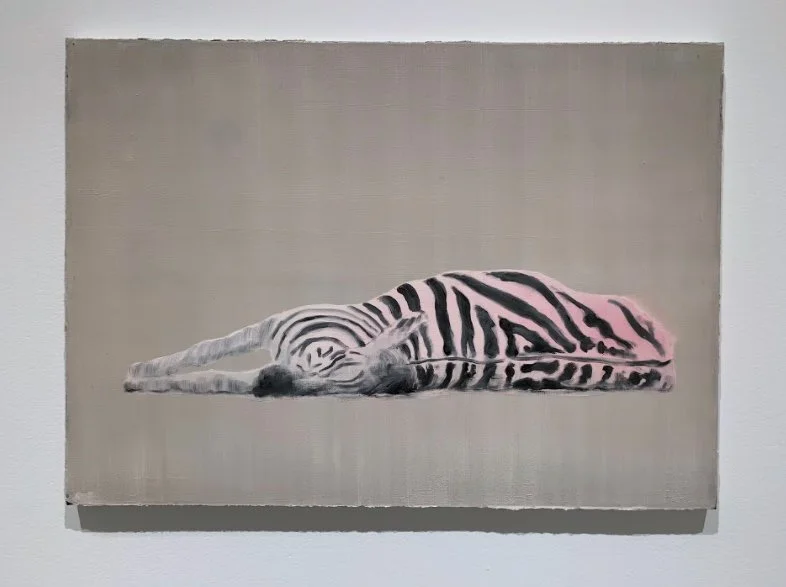
Children are also intimated in the exhibition title Merrily Merrily Merrily Merrily. Like Murphy’s paintings, the title says a lot without saying it all. The artist’s voice in words and paint stops at the moment (or precipice—if you view them as existential paintings as I do) of revelation. The nursery rhyme Row, Row, Row Your Boat from which Murphy had spliced this exhibition title Merrily Merrily Merrily Merrily, ends the four of its verses with the line Life is but a dream. This of course, as a children’s sing-along, is meant positively and protectively, as in Life is but a dream that can be dreamt-up to your heart’s and imagination’s content. It’s unrealistic: to confuse or conflate the dreamworld with the lifeworld ends up being a soft leap with a hard landing. 
Those who are familiar with Murphy’s paintings will know him as a painter who has made paintings consistent in mood with a slow and nuanced evolution in paint application. He is an artist who, even though known on the scene for 15-odd years since his work’s inception in the then new gallery Mother’s Tankstation Dublin, has not oversaturated the scene via that perennial and predictable phenomenon of curtatorial consensus. He is a painter we miss, not tolerate. Murphy became the painter he is today 15 years ago. 
This steadfastness and commitment to his vision (Murphy is a visionary painter) is remarkable in a time when restlessness and anxiety to change is pervasive in an image and self-obsessed world. Perhaps not having an Irish gallery and being represented by Grimm Gallery Amsterdam, with a studio in rural Kilkenny, has helped him avoid this culture of restlessness and anxiety that the contemporary artist is forced to navigate in the competitive city or distil through Instagram illusions. Or he has somehow sublimated and partly disguised his restlessness and anxieties in his paintings. Look and see.
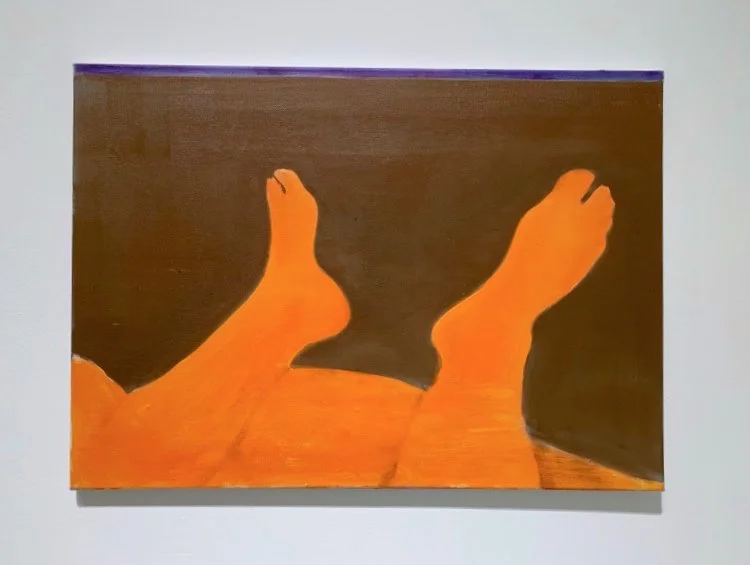
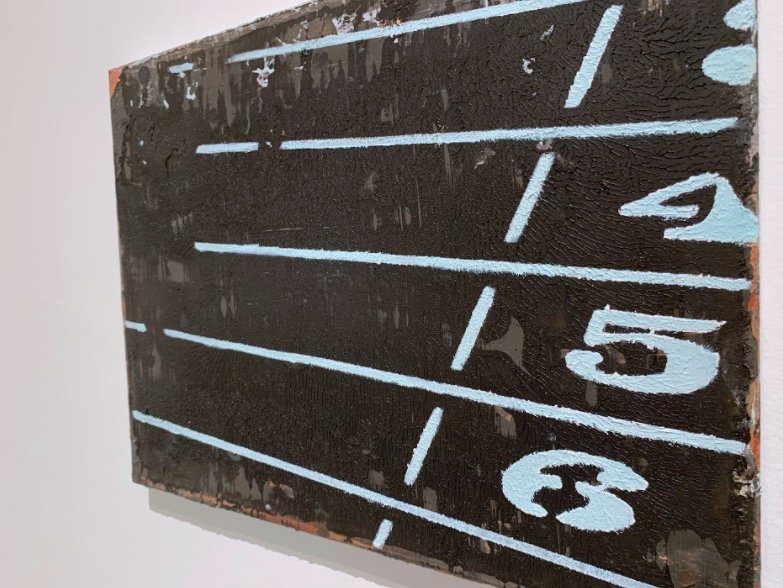
From afar Murphy’s paintings have a visual and atmospheric consistency as if they breathe the same air, but not ours. And yet the artist shifts gears from one painting to the next in how abstract shapes inform or veil the reality he is presenting in all its moodiness. Up close his painterly approach is responsive to his varied subject matter, a subject matter that most of the time lounges, what one might call an ‘aesthetic of lounging’ is at play, from the scalded orange feet lounging on a sun bed, or the serial bodies levitating in miasmic or gradient atmospheres of paint. Bleached white hands, fetishistic in their fragmentation and disarticulation from the whole body, seem all bone and no blood, as they sink into the weave of the canvas and tooth of the primer. The backdrops in contrast are swathed in horizontal or vertical strokes of opaque, dark and heavy paint embossed with a history of other decisions, buried but still haunting the surface. Strangest of all the painted textures is found smeared on Murphy’s painting of a numbered racing track, as if the painting fell onto a palette of dark paint and was then decoupled to leave an orange peel skin texture.
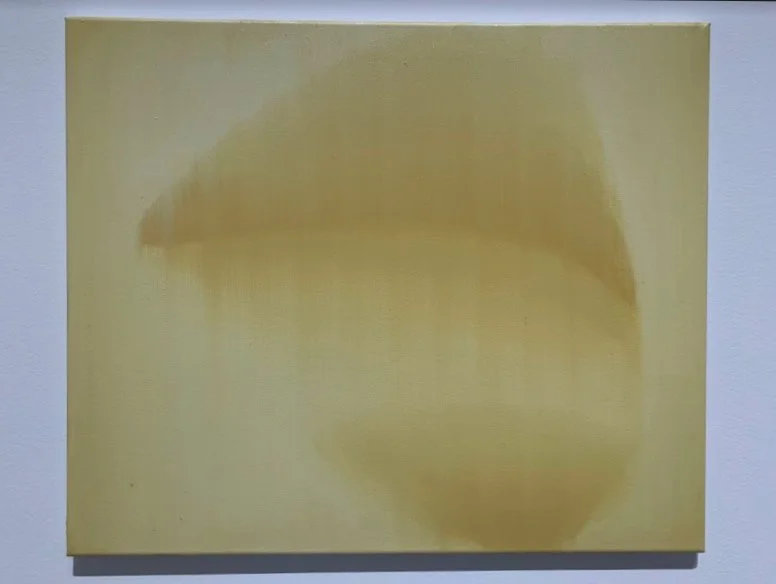
I wrote in a recent review of Ciara Roche’s paintings at Mother’s Tankstation Dublin (link here), that there is “a turn in her paintings” that helps to offset the flatness, and in turn, physically turn you into her paintings. Murphy’s paintings have more of a tilt (like Ed Ruscha’s text paintings) due to their emphasis on flatness, stemming from the source collages, like his painting of the tilted letterbox-framed eyes, or the hands that hold a painting of a head evacuating vapour, smoke or some interior essence from its mouth. Murphy’s paintings tilt against a world of soft and sharp. Some elements are sfumato soft, others are paper-cut sharp. You can’t deny references to Belgian painters Luc Tuymans and Michaël Borremans. That said, Murphy’s paintings are not concerned with the traumatic stain of history or a surrealist theatre of the absurd, but something more timely, present, one insisting on a separation between painted representation and its reality referent. 
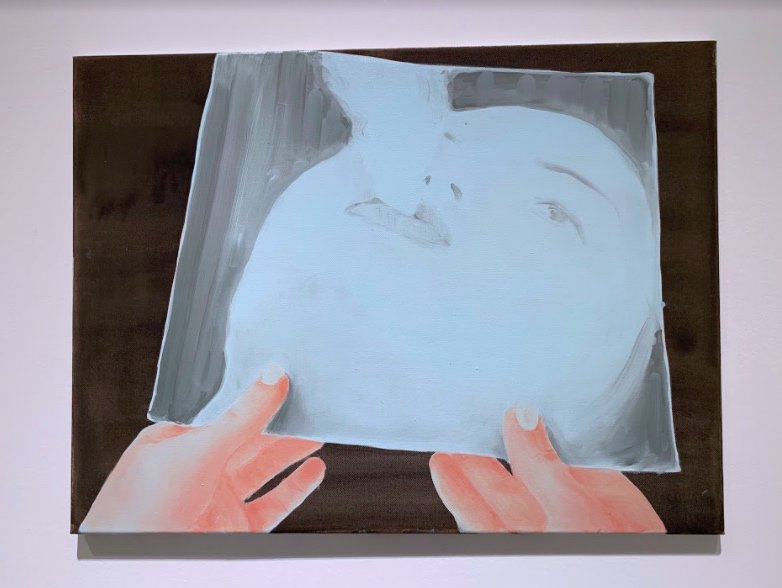
The line Life is but a dream—set adrift on the horizon of this exhibition—is the very thing that Murphy’s paintings struggle with, what he describes in the press release as the possible disentanglement of two interconnected binaries, whether that is reality and painted representation, or the lifeworld and the dream world correlative. What I would say is painting needs reality as a referent, but there is a moment in which mimesis is left behind and painting becomes a property in and of itself in the synthesis of subject with the substance of paint. 
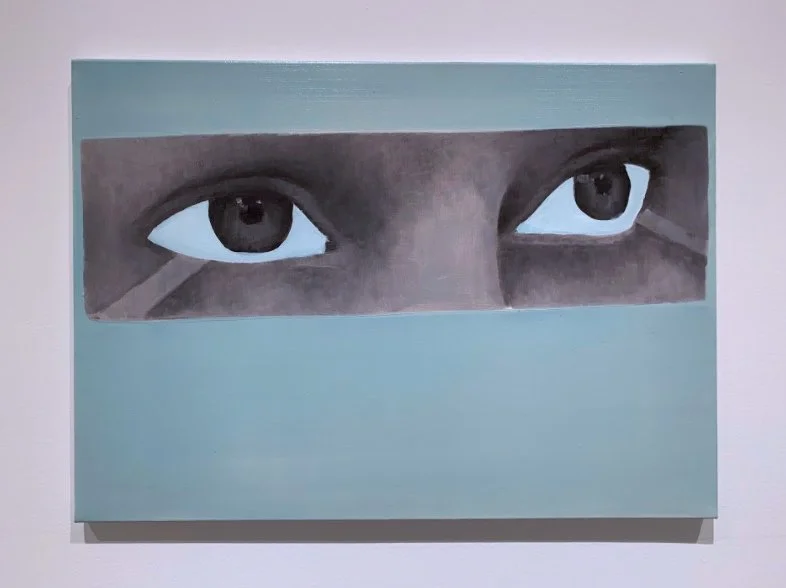
If Life is but a dream, then Murphy’s paintings do that thing that dreams do, what Freud described as “condensation” in his dream-work. The way I describe condensation to my psychoanalysis and art students is to visualise a window in the half light of twilight, with the temperature dropping, condensation, vapours and self-reflection collaborating to mesmerise from within, while rain, shadows, lights and the movement of civilisation and nature amalgamate from without. Condensation is a metaphorical and recognisable space that unifies everything through the transparency and synthesis of a constellation of recognisable dreamt-up images. In the same way Ciaran Murphy’s paintings distil the dizziness of the world of images and the vertigo of freedom to choose in their singularity and entirety. —James Merrigan


Through 9 January 2022.
Sickness as Thought

…everyone who is born holds dual citizenship, in the kingdom of the well & the kingdom of the sick.
— Susan Sontag, Illness as Metaphor

A few months ago I was struck by a sentence from Jacques Rancière’s The Aesthetic Unconscious: “The invention of psychoanalysis occurs at the point where philosophy & medicine put each other into question by making thought a matter of sickness & sickness a matter of thought.” Sickness, or the threat of sickness, is always present as a thought until it is experienced. Most of the time the thought of sickness is repressed or in a latent state. When others get sick we acknowledge it but, somehow, disavow the thought & move on with our forward-moving lives, lives that strive inevitably toward a sickness that can’t be cured but has to be confronted: mortality. If we can disavow death what hope has sickness. Coming up on two years of the Covid pandemic, sickness & its threat has never been more present in terms of data. The majority acknowledge this data as a thought, a thought strong enough to foment fear, while the few repress it as a conspiracy. Both modes are academic. If sickness hasn’t happened to you directly (or via family or friends) then it is just a thought unless it ends in The End. We don’t acknowledge sickness until it’s too late. Sickness is not shocking, death is. Even though sickness signifies mortality we don’t dare connect the two. And even when sickness has happened to you, you soon forget its drag & put one foot in front of the other on the road to inevitability. Sickness doesn’t register, death does. Sickness has to be experienced in the body & calculated in the blood before it becomes real, “The Real” being a breakdown of language into abjection in Jacques Lacan’s thought. Sickness is not collective, death is. What follows the acknowledgment of sickness in the body & blood of the individual experiencing it is abject vulnerability, helplessness & a kind of tackiness sweet with nostalgia & a future full of wondrous possibilities without sickness projected onto the nearest & dearest. Treatment cures such tackiness. Sickness shows you the future, the future where desire is out of reach & death is within your grasp. Sickness is a real experience, death the fantasy of experience. “Cannula” is a pretty word.


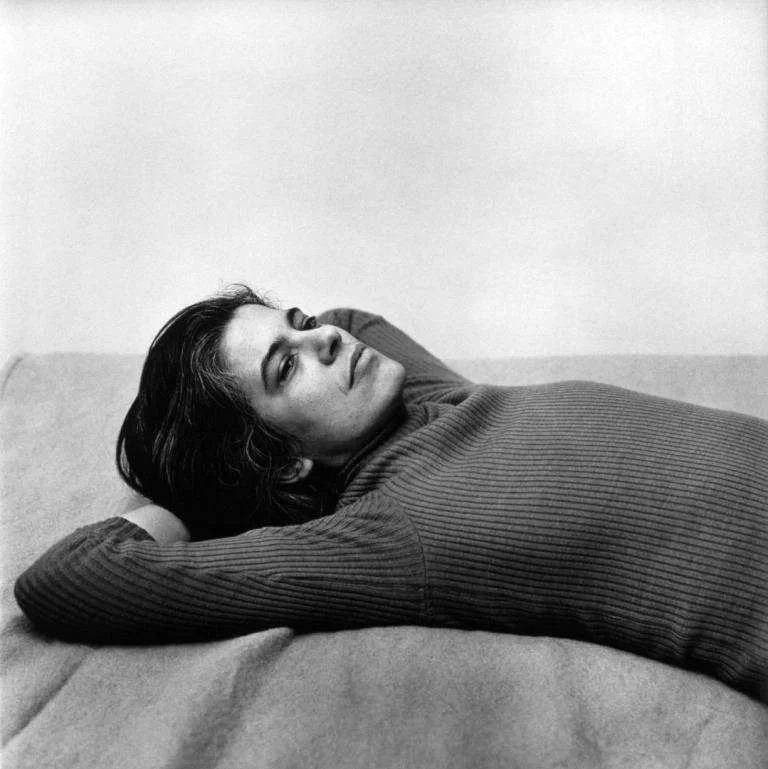
Image: Peter Hujar, Susan Sontag, 1975 (the same year she was diagnosed with cancer)

Holism

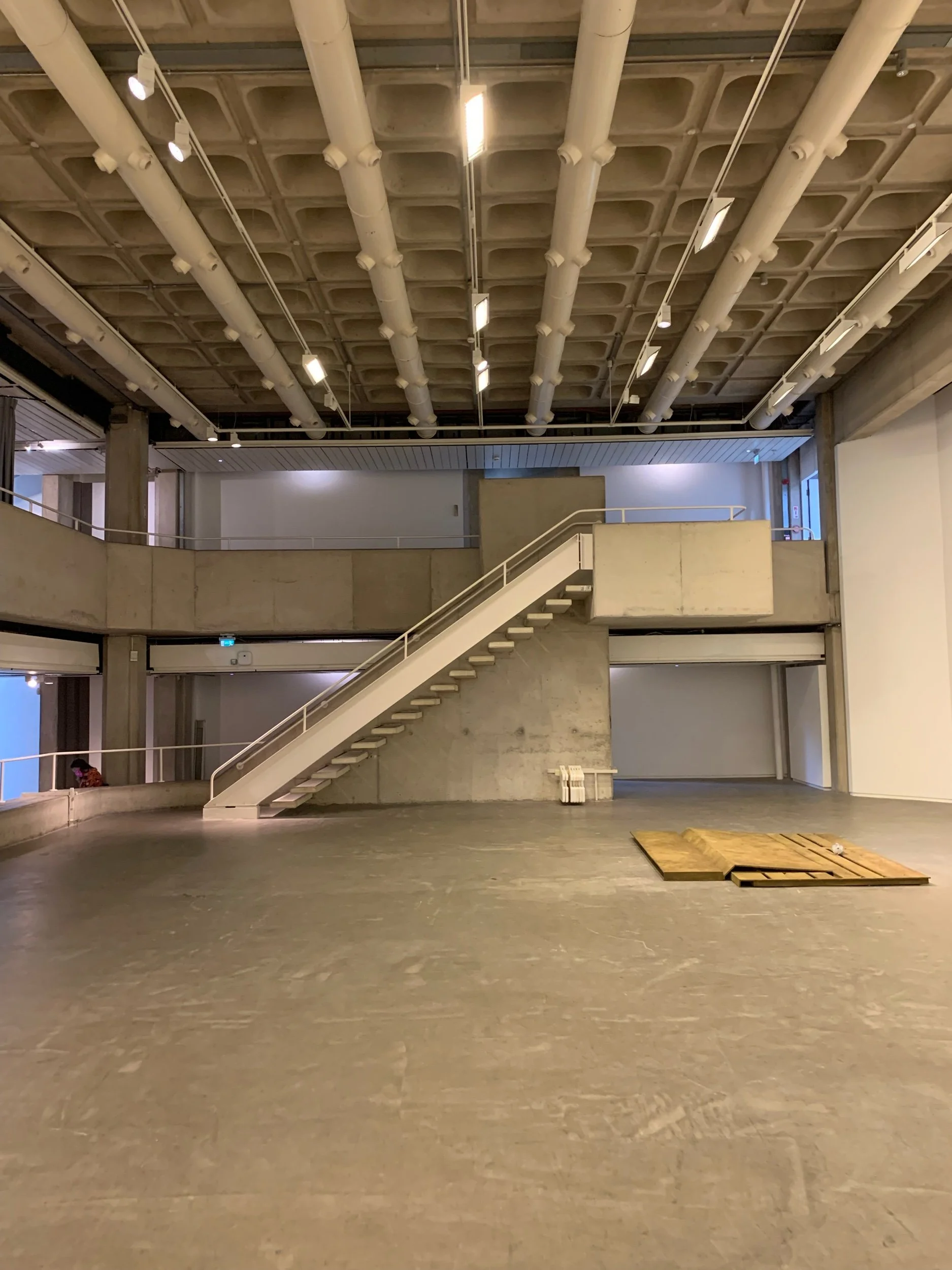
If you’d never been to the Douglas Hyde Gallery Dublin (DHG), you might first become conscious of the encroaching presence of the architecture amidst the receding light of the outside world. Anticipation might cloud your experience in the grey well of concrete; those white sci-fi hatches that lead to a blind, windowless room in a basement aspect with a fridge aesthetic. If you’ve been to DHG numberless times (as I have & by now institutionalised by its familiarity) the architecture & light have long left the building. Today all the building solicits from me is a forever withdrawing presence in a mausoleum of traces from previous art experiences & entities that have temporally inhabited & loitered in the space over many, many years, some forgotten, others imprinted like my parents' faces. Together, but separate, as was John Cage’s, Robert Rauschenberg’s and Merce Cunningham’s ‘Happening’ in the canteen at Black Mountain College in the 1950s, the current exhibiting trio of artworks & artists (the trace of the artist is invoked via the knowledge of the happening of hidden process & change taking place for the duration of the current exhibition) snooozze. They are sleepers; lateralness if not literalness pervades. Perhaps the knowledge of a happening hidden from view & waiting in the wings gives this sense of sleep or sleeping? I don’t know. But somehow the empty space that hangs grey & high above & between these sleepy presences stresses a weight on passivity rather than action. We are awakened by a happening that takes place in our imaginings. Is this deliberate or circumstantial? Or, & this is a big R, has DHG changed, wherein the holism that was presented before, wrapped in a particular identity via esoteric leanings & wilderness tones has transformed into something else, whereby you have to do more work to activate the space rather than being solicited by the holism that came before? Perhaps art in this new DHG condition is one where you are not subsumed by either the architecture or the objects that inhabit it, but a space in which you come to experience the movement, verticality & sound of your own body as you wander without a text. 

—James Merrigan

Through February 2022.

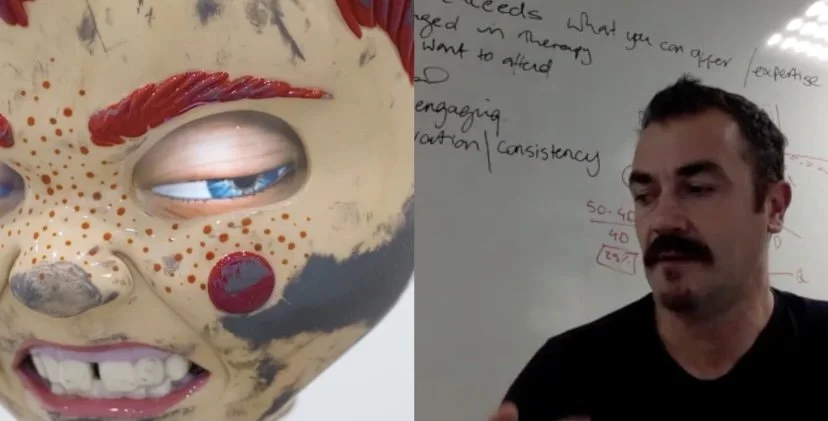
📽Psychoanalysis & Art (mid-module recap and synthesis)

Hello There.

For nearly a decade I have been lecturing in Psychoanalysis & Art at Trinity College Dublin. It is an intense class, one that brings up feelings and thoughts for the students that participate in it fully. With COVID and the onslaught of Zoom, the recording of class has become commonplace for students and staff alike. If technology works then this is fine; if it doesn’t then it’s not — momentum and synthesis is lost. So today it was necessary for me to recap on what had been covered (and lost) so far on the course (the lost object in psychoanalysis is a given as “desire is defined in lack”. This includes: An Introduction; Against Interpretation; Dream-work; The Uncanny; The Missing Part; Aestheticism; The Gaze; The Transitional Object. The artworks I discuss range from Duchamp to Ed Gein to Gregor Schneider to Douglas Gordon’s 24hr Psycho & Zidane (with Philippe Parreno) to Don Delillo’s Ratner's Star & Point Omega to Diane Arbus, among many other psychoanalysts & philosophers who, by embracing or resisting psychoanalytic thought somehow enriched it. What comes to the fore is ideas and feelings about what it is to think through an artwork, where form and content, intellect and the sensible find each other in the same place. Also, the deeper we delve into language the more paradoxes arise, paradoxes that we can either painfully try to unpack, or enjoy for what they are: evidence as to the limitation of language in the face of being an artist, an artwork, or whatever. Oh, and the artist as pervert.

I have included the link to recording of recap in the bio. Although only a recap, hopefully it might get some of you to explore art through a psychoanalytic lens alongside philosophy, literary theory and the infinite ways in which we cope with being human (and being an artist) in the world through language.

Any questions or observations please ask in the comment box.

Thanks

James

DEAD ARM

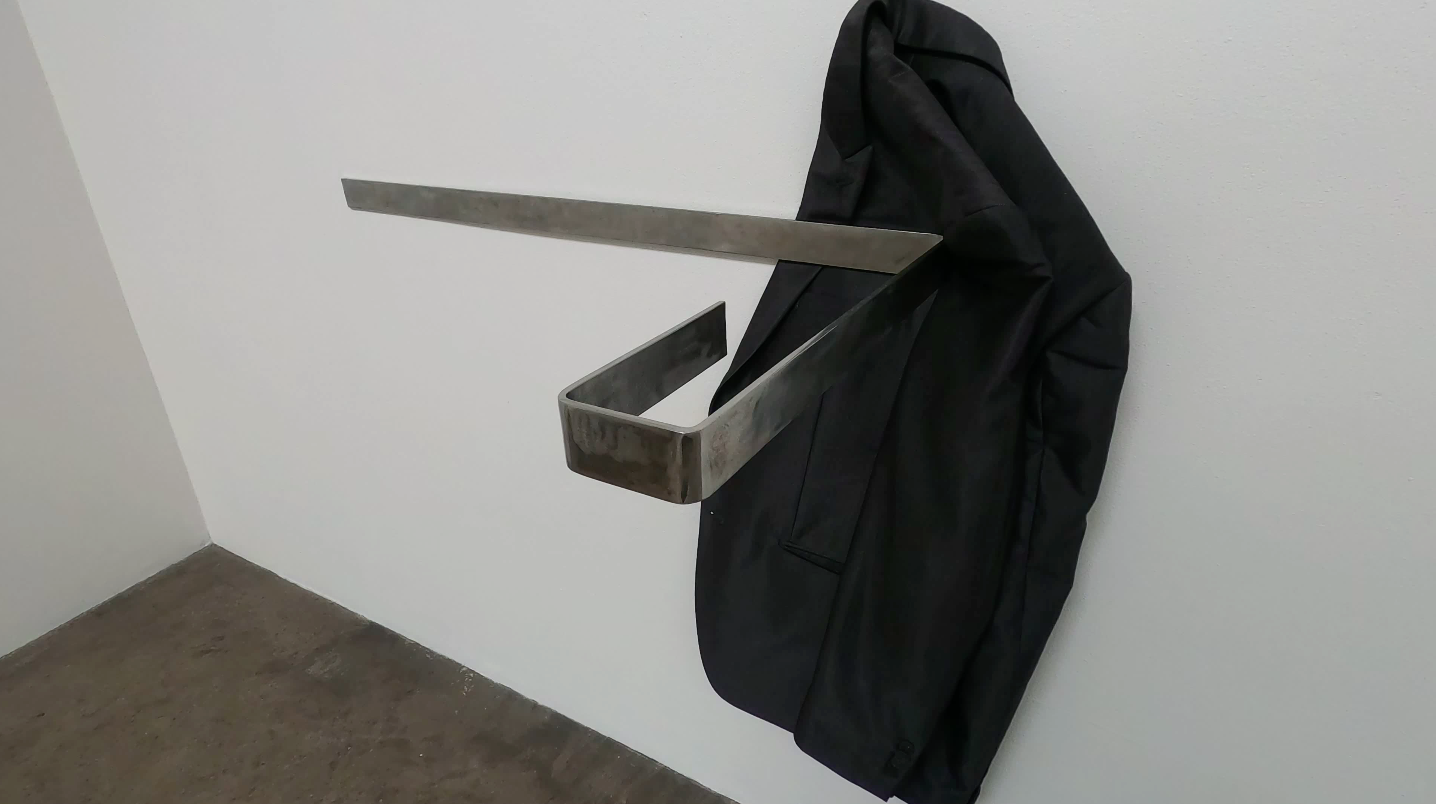
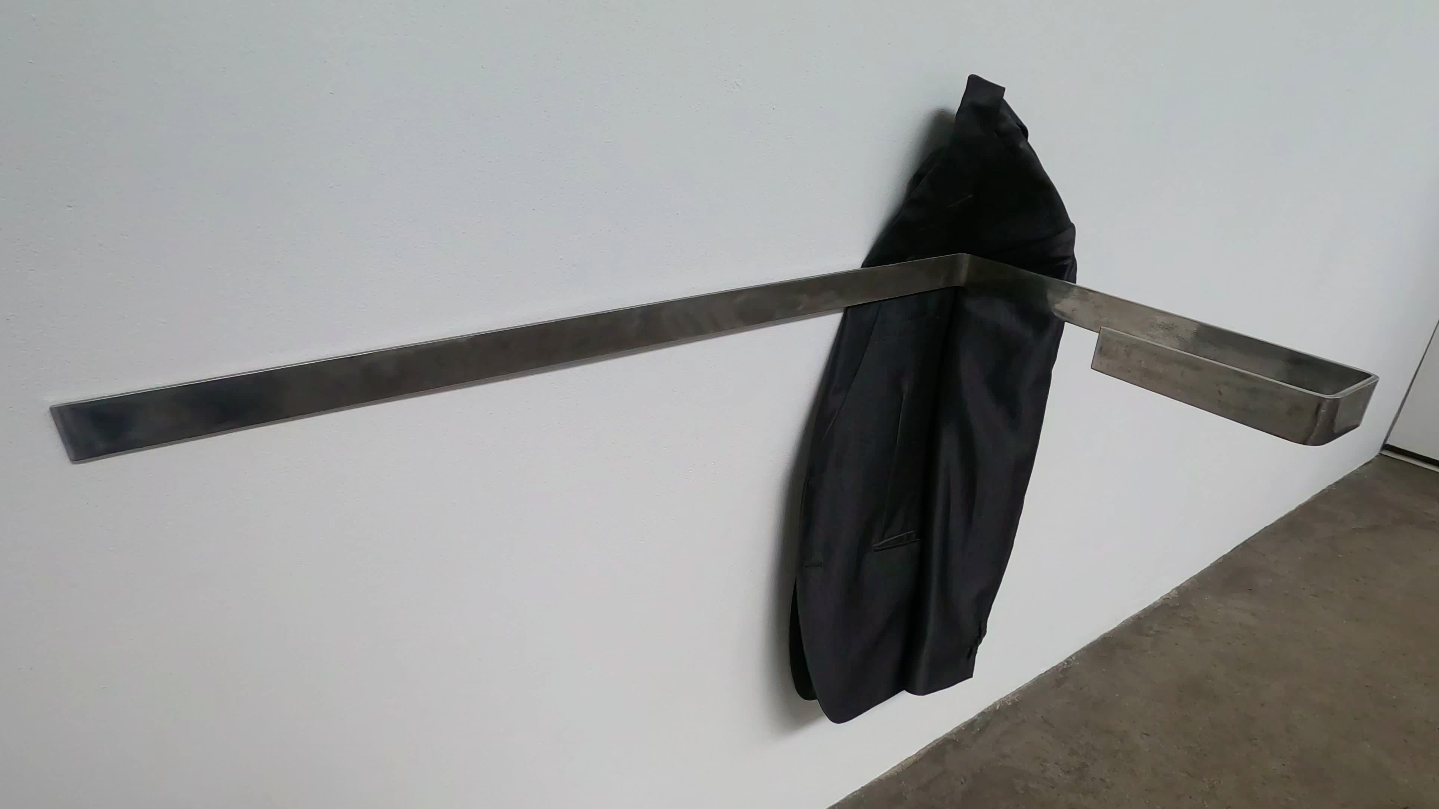
Leave them where they lay. Found in an uncanny corner of the QR generated gallery map for Áine McBride’s solo exhibition point of fold at Mother’s Tankstation, is “notes: titles for works, in no particular order”. Included in the list is “friends, lovers, allies”, but no enemies. A world without enmity? Is that good? Bad? Flat! On closer inspection “friends, lovers, allies” is preceded by “gauge” which, when collapsed with the aforementioned, reads as the measuring of friends, lovers, allies. I like that. There’s hierarchy implied; judgment too. Especially when you consider architecture vis-a-vis society as something that goes up/down, not just flatly across. There can be no rupture or change in society if the fabric of the world is flat. Democracy is the fight for not the realisation of. Then there’s “the in-and-of itself” on the list, which is missing ‘thing’ in Schopenhauer’s terminology – the thing in-and-of-itself. I wonder what world Áine inhabits in her work: the phenomenal world of objects as perceived through the human; or the noumenal world where the essence of things outside of human perception (time, space & causality) exist in and of themselves, & where impossible questions can be paradoxically answered minus the kink of the human to see or hear the answers. Perhaps, as also listed in her notes on the “power stance” —‘tilted head, relaxed posture’— there is an implication of being “both ‘n all” in her work? If Áine’s work exists in the noumenal world, or the in-and-of-itself, then there is nothing left to say, as any word mentioned in the vicinity of her objects would miss the point. I firmly believe art is concerned with sociability, & that Áine McBride’s sculptural articulations in space elegantly invite the awkward human to physically stoop, intellectually stumble, imagine & feel the knuckle of steel that dead-arms that bruised pinstripe blazer pinioned to the gallery wall. Power punching without the rhetoric! These objects are something to embody & empower a way of thinking & moving in/out & between the world of things & subjects. Especially when confined to the footprint of a gallery signposted with Private spaces that sidewind consciously out of view.

—James Merrigan

Through 4 December 2021. 

Whoops!

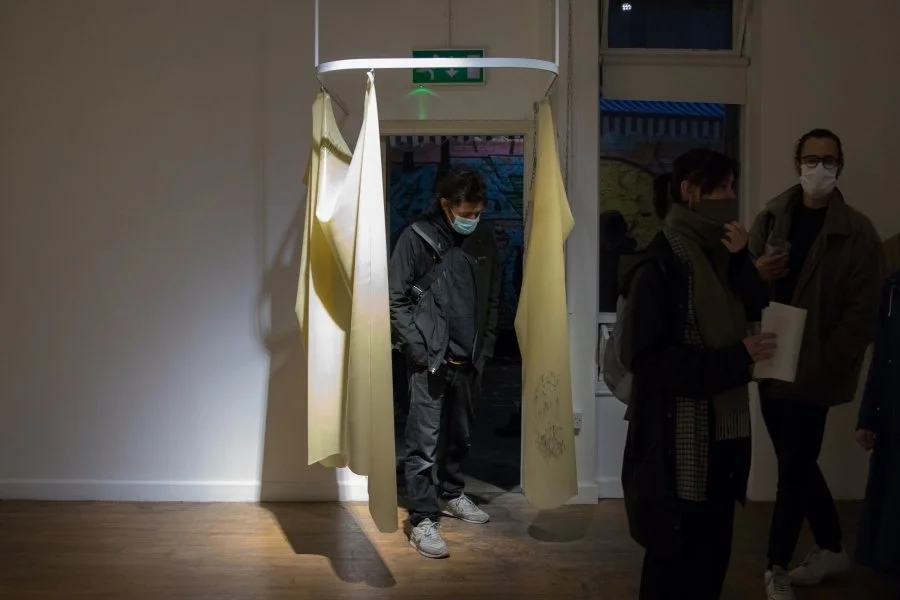
WHAT is present & unadulterated in Laura Ní Fhlaibhín’s solo exhibition trailblazer at Pallas Projects Dublin is the low light, first caught in the yellowed latex sheet that flares like nostrils from a hospital rail over-hanging the door you step into on entering the gallery. No escape; no choice; you're in. Residual marks spot the latex; abject spray, drip & smell hits your eyes & nose. Down low one floorboard has been pulled & discarded to reveal the dusty bedding underneath. A surgical tray sits in one of two, three, four, five valleys of the underfloor. Wine or blood red, the liquid is twin-engine oil that drips from its container hung high by steel chains that network through the space creating rhizomatic connections between disparate objects, like the shower you just just stepped out of, the pink sheet cradling carbon gristle & peeing oil on the floor, & the floor-bound collection of Lilies held in Two-Stroke vases. What initially feels like a den of delicately induced despair is injected with the gush of flowers, opening your nose & eyes to other things: like the sculpted, malformed, Hans Belmer nodules of bronze that plug or grow from the ends of the chains as if to stop them from unraveling from some deep, unknown source; or the embossed text that inscribes the pink sheet like skin blisters. Lively. This is lively. There is no other word for it — Lively! Things connect & contain one another: holding, bracketing, soaking. Beyond what we can attach to this from the external social or ecological world, this is an exhibition that has no inside or outside. As Jean Luc-Nancy wrote in response to the sacrificial & lacerated body of George Bataille, the body’s orifices are not cuts, but a connective tissue of touching. Laura Ní Fhlaibhín’s art practice is a caring one. The artist touches space, interweaving a balance between rupture & repair & back again. Like Àngels Miralda writes in the accompanying text, two things have become a “singularity of vibrating matter” (or anxiety) as the missing floorboard & the plank that pokes through the gallery’s partition wall intimates a demolition or democracy to come. Whoops! That’s for another day.

—James Merrigan

Through 3o October.

Painting that Protects

Daniel Rios Rodriguez, El Rey, 2020, Flashe, oil on canvas with wood frame, 223.5 x 170.2 cm, Kerlin Gallery Dublin.

Directly following Merlin James at the Kerlin Gallery Dublin, Daniel Rios Rodriguez comes across as a bit of a Jamesite. And it’s not just the insider-outsider-insider blood and guts intestinal surgery towards a transparency to make painting less of a noun and more of a ramshackle verb. No. It’s something to do with the bits and pieces — paint or otherwise — that could make up a painting.

Merlin James is more of a how-to-make-or-break-a-painting painter. His paintings are physically awkward. They twist as objects — what the Greeks called contrapposto — and subjects — what we might call ‘intellectually coy’. Merlin James is a critical painter, one who is acutely aware of the narratives (insider to outsider; Alex Katz to Forrest Bess) of hammering a painting together with a brain. His paintings literally buckle and twist under the weight of history. They are history paintings, both as subject and object, uncannily knock-knock knocking on the door of the present, or at least poke-poke poking through a badly made Duchampian peephole. In a Merlin James the ur-history of painting and the history of a painting is turned inside-out and upside-down to show the seams and threads of the inner workings of a painting. His paintings sing both the A-side and b-side of art history, the inner and outer circles of a vinyl constellation that skips and scratches with a broken needle. Painters, after all, are bad musicians; they play air guitar with the hope that one day it will make a sound to emote the thing that was missing in the first place: feeling. 

Contra-Merlin James, Daniel Rios Rodriguez is a feeler, and he wants you to feel him and feel with him (he says so in the press release). It’s a strange but good thing to read, a painter admitting to such a thing as feelings in the context of this cold penthouse of commercialism in Dublin City. We might not believe it standing here among these hot paintings and red dots in the cold light of the gallery, but I do. I don’t think Merlin James would ever refer to himself as a lizard hiding under his studio rock from the baking sun mechanics of display and desire to buy and sell paintings in the gallery. Daniel Rios Rodriguez does, metaphorically.

There is something to that, isn’t there? Mystical metaphor as a way to relay feelings both inside the text and on the paintings, as if to come out from under the rock fully naked, tail and all, the cold-blooded painter would end up getting burnt by the world. In this context not many artists would admit to why they come out from under their studio rock. Daniel Rios Rodriguez does: “But I must come out. I must eat. I must live.” The verb of painting in the studio always becomes a noun in the world. Perhaps that is why all artists come out from under their rocks, if living and eating is a real possibility.

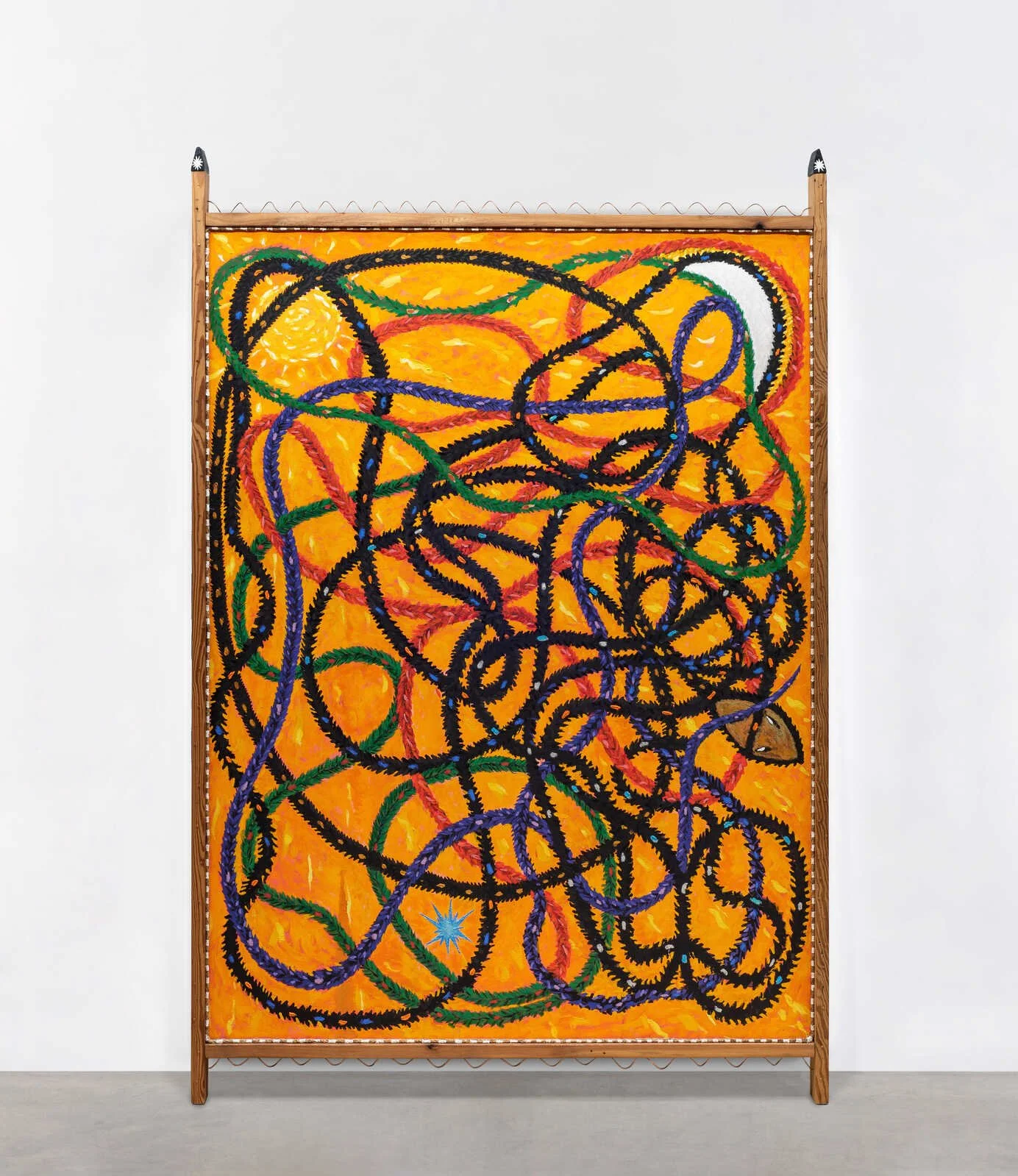
Daniel Rios Rodriguez, Sonidera de Sueños, 2020-21, Flashe, oil, nails, rope, copper, wood on canvas, 232.4 × 154.9 cm

Daniel Rios Rodriguez, Sonidera de Sueños, 2020-21, Flashe, oil, nails, rope, copper, wood on canvas, 232.4 × 154.9 cm

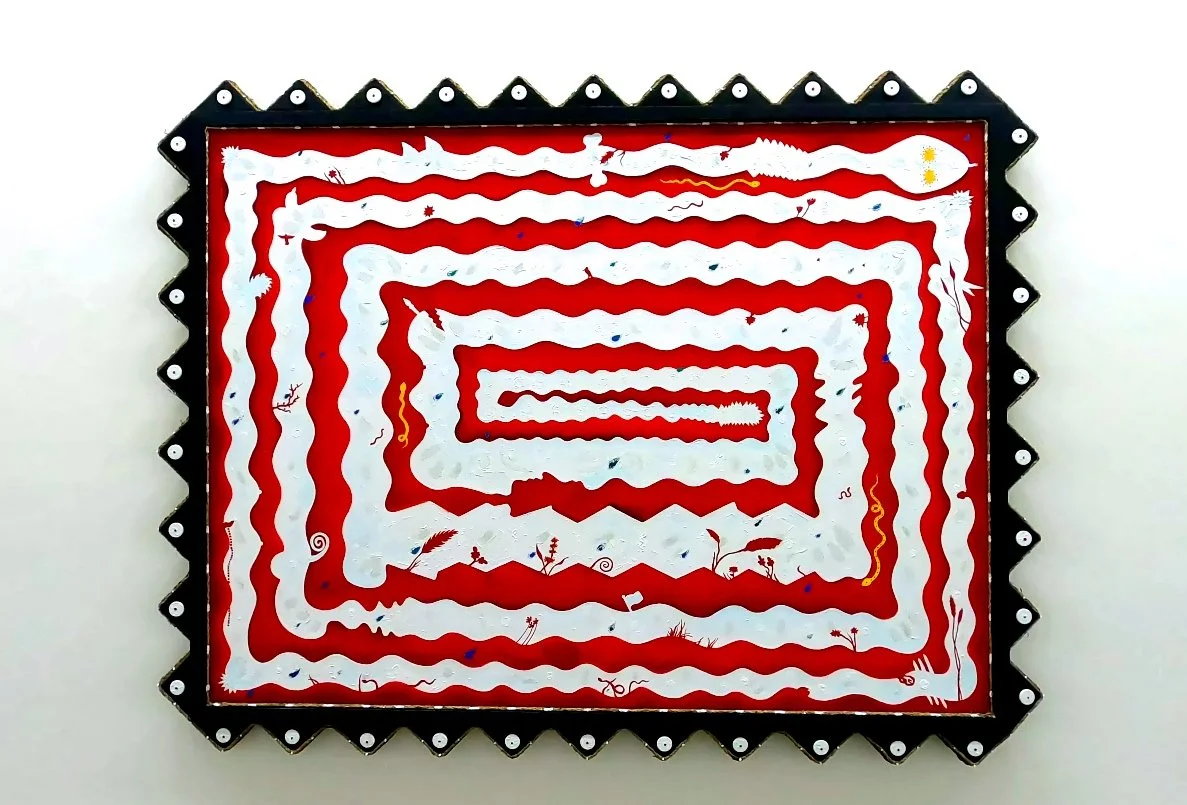
Before being informed that these paintings are loosely exorcised from dreams, we are met by the physicality of these things in the gallery. One painting sets the stage as you clear the stairs into the gallery. Standing on the floor, a bulky frame, resembling a bed headboard found in some woodland lodge retreat in the Americas (maybe Twin Peaks’ Great Northern Hotel where strange dreams are made stranger) makes its presence felt as both a linchpin and centrifugal point from which Daniel Rios Rodriguez’s paintings dream outward. This painting holds the exhibition together and itself together, composed as it is of a plexus of snakes. It helps to pinion the metaphysical subject and object of dreams that traverse the walls. It makes a horizon of paintings into a home of paintings. Manifest and distinct from the paper text in the gallery, the paintings are nouns in terms of how Daniel Rios Rodriguez’s closes the circle of his paintings with a succession of framing devices: frame, rope, copper wire, buttons or paint itself. These paintings are folk quilts held by buttons and nails that, in Freud’s dream-work is called condensation, when images come together in an unconscious layering and doubling like the radio station tuned into two stations at once. They vibrate with reference, like the spiralling red rectangular snake that hovers on a hidden sheet of green and duvet of white as if Jasper Johns’ American flag painting had come alive. The American Dream becomes a serpent.

Relayed in the artist’s words, you get a sense from the press release that Daniel Rios Rodriguez doesn’t want to be misunderstood but also doesn’t want to come out fully from the shade of his studio rock to the feeling viewer. Even though his words and paintings are hidden beneath mystical metaphor, it is realism on both the paper and the paintings that comes through (combs true) in the gallery. When he writes about being aware of his kids’ dreams, combined with the necessary needs of eating and living, we, as viewers, have to contend with not only the dreams of the artist bent on desire, but also on the context that shapes them. What did Freud say about the father? Their job above all else is to protect. Love could even be secondary to protection in the father-child relationship, or love is just protection in disguise.

Whereas Merlin James pokes holes in wholeness, Daniel Rios Rodriguez finishes the circle. Neither one is better than the other, they are just different experiences, metaphor vs metonymy. Daniel Rios Rodriguez paintings are gestalt galaxies unto themselves, containing everything if you are willing and able to dream beyond the silhouettes and framing that wrap them tight in a protective blanket. To eat. To live.

—James Merrigan

Through 20 November.

Words & Things

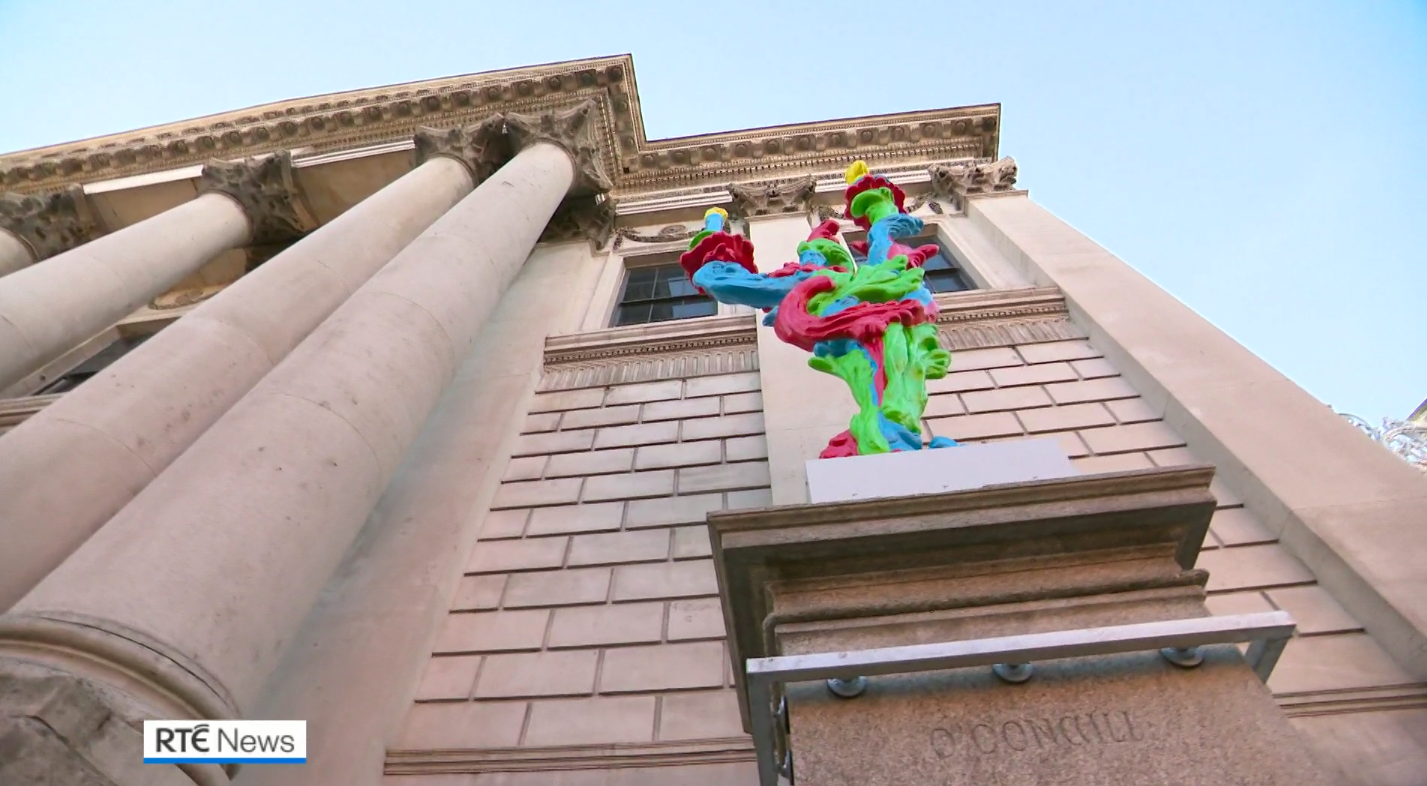
ALAN PHELAN RGB SCONCE, HOLD YOUR NOSE [3D printed eco-plastic, bonding adhesive; paper, glue, paint, and varnish; padded steel supports; LED lights, electrics]

ALAN PHELAN RGB SCONCE, HOLD YOUR NOSE [3D printed eco-plastic, bonding adhesive; paper, glue, paint, and varnish; padded steel supports; LED lights, electrics]

Alan Phelan likes words. The artist uses words both precisely and perversely to complicate his things. He is one of our best writers on art in the playfully critical Wayne Koestenbaum vein. The words that inhabit his work – energetically abbreviated and pointed, but promiscuously flirtatious with meanings – hone in on the handsy materiality of his objects, which collapse and conjoin in an amorphous play between thoughts and things while never settling on either (i.e., Once Phelan titled a series of works “Cabbages and Things” influenced by – among many, many other things – The Thing from The Fantastic Four). 


There's a particular handsiness and craftiness (in words and material) to Phelan's sculpture – something I have personally missed in his detour and détournement into the photographic and filmic of recent years. When thinking of his work, past and present, I cannot shake his earlier papier-mâché sculptures and a specific reference to Odo from Star Trek Deep Space Nine, the changeling who couldn't shape-shift properly. (*Side note: Odo's purest form was simple liquid but his failed endeavour to mimic the human form was his desire. As Plato claimed, the poets (artists and I suppose Odo) are bad imitators of reality.) 


Like Plato's poets or Star Trek's Odo, Alan Phelan is a bad imitator of reality. His things stick out from reality to align with Aristotle's notion of art as being not how reality is but how it ought to be. His latest work, a giant, colourful and again handsy candle holder with Play-Doh precision displayed on a plinth flanked by slender and black lolly-pop head street-lights outside Dublin City Hall in the surrounding splendour of Georgian architecture continues this meeting and marriage between things and thoughts in the odd title of the work “RGB Sconce, Hold Your Nose,” a title that brings some RGB light to some marvellous hidden histories from colonial Dublin.

In this new sculpture, strayed from the gallery and spawned in the most public of spheres – City Hall and that yellow latticed junction of bus and passerby, Phelan's “RGB” reference is transposed from a body of work the artist has been working on (and exhibited) for several years (and in several spaces) via his committed revival of an obsolete method of photography, The Joly Screen Process, invented in Ireland in the 1890s by John Joly. Phelan writes somewhere that every colour can be mixed from red, green and blue (RGB). Obviously Phelan is referring to light not pigment, hence the candle holder, or “sconce” (a typical Phelan word), to denote a decorative and bracketed tool for light in times and places when there was none. Today there is no escape from light so Phelan's candle holder becomes a metaphor for other things, such as emancipation, transparency, liberty and hope. That said, the artist's candle holder performs thingfully as pigment but thoughtfully as light, and so double binds become double entendres in a doubling up between what we see and what we imagine, what we can touch and what we desire, what is symbolic and what is allegory. 


The word “sconce” has more to it than meets the eye or the mind too. From old French, esconse can be translated as “lantern, hiding place.” Whereas abscondre – “to hide” originates from the Latin abscondere “to hide, conceal, put out of sight.” It's very complicated (but fun if you are into this type of thing) in terms of the words that denote the things in Phelan’s art. This hyperlinked etymology is counter-intuitive to what a candle holder does in the world, show the way, especially “sconce”: a bracketed candle holder attached to a wall for a torch or candle. Obviously, “hiding place” or to “put out of sight” also plays into the subtitle of the work which, if you do your homework (in the artist's words) “refers to a collection of ‘sanitary songs’ that was published during the 1884 Dublin Castle Scandal, located in the adjacent building complex which was the site of the British colonial administration. Irish Nationalists revealed homosexual activities of high-ranking British civil servants, using this as proof of corrupt and immoral British rule. The poetry pamphlet instructs ‘decent men’ to ‘hold their noses’ so not to breath in the perceived debauchery of the castle.” 


Now... if you are one of those New Critics or Object Orientated Ontologists who believe art or objects exist in and of themselves, autonomous from the world in which they inhabit in the appreciation, interpretation and experience of them in the world, then Phelan's candle holder, sconce or whatever you want to call it, will rise up out of the grey city as a colourful, somewhat gaudy and kitsch sculpture to inflame or douse you as you pass by. Without words or context you may pick up on the RGB and foliage that snakes up the arms of this thing. Stall your bike or stride you might notice the form of the sculpture has a tactile appearance like that of hand-raised pastry. From across the road you might even pick up on the contrasting classical and straight architecture that helps to project this kindergarten splat forward from its grey institutional perch directly beneath and opposite the Georgian buildings' plasterwork and marvelous hidden histories that inspired it. You might even speculate towards some reference to light or liberty in the upward thrust of its historical purpose and form. But contemporary art comes with passengers and baggage, and they are called context, history, and us. 

Screen Shot 2021-10-02 at 10.47.29.png

Can we desire Phelan's new play thing outside City Hall? Surely not! Is it a matter of taste? No! The sculpture does that thing that Andy Warhol did so well by vying taste against desire, so we are left unstuck. The threesome of red, green and blue work as light, or with light, but not pigment. The RGB of Phelan's John Joly screens is lovely because it disguises the monster with three backs, a ménage à hulk, devil, smurf. Here RGB wrestles rather than blends in Baroque drama and Rococo frivolity. It's like modern art has once again become a victim of a nutcase's bucket of paint (three in this instance); the artist anticipates offence before it can be performed. 

Alan Phelan’s sculpture at City Hall is not a symbol, like Lady Liberty, but a free-floating allegory drenched in signification. It’s cloaked in ideas of emancipation from the back alleyways of history and the sensible redescription of those histories in unlikely and unwieldy forms that can melt the heart but will invariably melt the mind. What RGB Sconce uncovers is the silhouette of history, a candle that shines a light upon itself to demystify and liberate itself from symbolism, from one meaning or message, from us tasting and desiring machines. This is not a healthy classical sculpture – like the grey civic building that looms behind it with a bad taste in its mouth – but an unhealthy baroque one. It disrobes its pluralism in plain sight, a sad clown wearing a flasher's rain-mack underneath red, green and blue makeup with a knowing smile. Layers.

—James Merrigan